


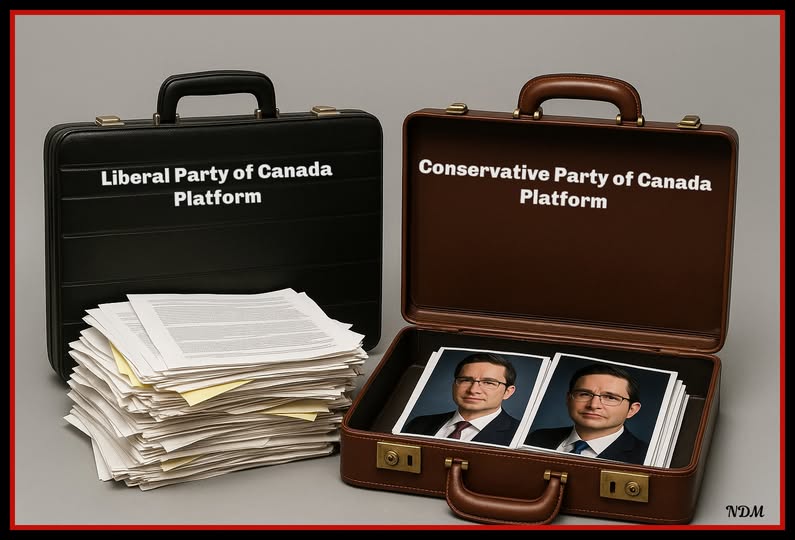
Budget Reality Check: One Plan Adds Up. The Other Just Adds Photos. This isn’t a popularity contest. It’s a budget.
And five days from now, we’re not just voting for personalities, we’re voting for the people who will be in charge of your tax dollars, your cost of living, your national defence, and your kid’s future. So let’s stop pretending every platform is equal just because it has a logo on the front. One party has released a fully costed, detailed plan. The other gave us 30 pages, half of which are glamour shots of a guy who thinks “common sense” is a substitute for economics. This isn’t about who you like. It’s about who’s telling the truth, with numbers. Let’s skip the slogans and get straight to the receipts. Not what the bots are repeating. Just the real math.
So I’ve been running both platforms through a fiscal filter by consulting with finance folks and a political scientist, because I care deeply about policy, and I also believe in peer review.
And here’s the headline: Only one of these platforms is remotely ready to govern. Only one has a roadmap. The other? It’s a collage of slogans with a few bar graphs and a lot of Poilievre’s face.
This isn’t about partisanship. This is about math.
The fiscal breakdown-clean and clear.
Let’s start with transparency and structure Liberals (Carney): 72 pages, fully costed, with a complete fiscal annex reviewed by the Parliamentary Budget Officer. It outlines multi-year projections, fiscal anchors, and targeted investments with identified revenue sources. Conservatives (Poilievre): 30 pages. Roughly half is photography. There is no line-by-line costing, no third-party review (PBO) and no formal budget plan. The phrase “trust me” is doing a lot of heavy lifting.
Revenue Measures (Money In) Liberals: Introduce a 0.5% annual tax on wealth over $20 million, crack down on offshore tax havens, apply a tax on foreign homebuyers, close corporate loopholes, and maintain carbon pricing (which funds rebates and transition projects). Conservatives: Repeal carbon tax. Cut CBC. Talk vaguely about “economic growth” and “efficiencies.” No new revenue streams identified. Just vibes.
Spending Committments (Money Out) Liberals: Heavy investment in housing (land access, trades training, incentives), climate infrastructure, clean tech, military upgrades, health care, and a national child care system, all with associated costs and timelines. Conservatives: Promise tax cuts. Cancel clean fuel regulations. Mention housing, but offer no build targets. Say they’ll bring jobs home — but have no plan to do it. No costing = no clarity.
Fiscal anchor and Path to Balance. Liberals: Maintain a debt-to-GDP anchor. Deficits shrink gradually over four years, with targeted economic growth strategies to protect long-term stability. Economists note the risks but say the structure is sound, especially with global instability in mind. Conservatives: Claim they will “balance the budget,” but offer no schedule, no breakdown, and no anchor. Political scientists call this a “narrative device,” not a plan. If there’s a balance strategy, it’s hiding behind the camera that took all those portraits.
I kept those details non partisan but I need to change things up. Those were just facts and now I am going to sound a little snarky. But someone has to say it. Let’s talk about that Conservative “budget.” And I use that word generously. It’s less a fiscal plan and more an Instagram reel in PDF form. There are more pictures of Pierre (not kidding-go look at it) than there are defined costed commitments. Honestly, the only balance in the document is between smirking poses and empty platitudes.
And look, I’m trying to take this seriously. I wanted to be non-partisan totally on this topic. Well at least I was for the detail part of this post but when a platform shows up with less math than a game of Monopoly and expects to be handed the country’s books, I have questions.
Like: Where exactly is the money coming from in the Conservative platform? How do you cancel billions in revenue (carbon tax) and promise new spending without explaining a single offset? Are they running a government or entering a photo contest? That “you can’t spend a dollar without bringing in a dollar” line? It sounds like the kind of thing someone says just before cutting child care and selling off public broadcasting, while somehow still finding $20 billion for boutique tax breaks.
And here’s the brutal truth: even if you support some of the ideas in the Conservative platform, say on housing, they will not happen. Not because they’re bad ideas (though some certainly are), but because they aren’t funded. Without investment, without a fiscal path, and without real revenue, they simply cannot be implemented. And when that reality hits? The excuse will be, let me guess… “the lost Liberal decade.”
Dear God. You can’t run a G7 economy like it’s a checkout line at Dollarama. Fiscal policy is not just a matter of saying “no.” It’s about understanding where the country needs to invest to grow, in people, in productivity, in sovereignty, and yes, in survival. Because we’re not just paying for today, we’re preparing for what’s coming. Climate. Conflict. Competitiveness. You don’t slash your way through that. You build for it. And building costs money, but at least the Liberals tell us how they’ll pay for it. Even if we don’t like the cost.
This isn’t about Left vs Right, It’s about Real vs Reckless
Whether you support the Liberals or not, they’ve given us a detailed plan with costing, timelines, and trade-offs. It’s transparent. It’s measurable. It’s open to scrutiny. The Conservatives? They’re asking for power, but haven’t shown how they’d use it, fund it, or safeguard it. You don’t get to show up for a job interview without a resumé. And right now, the Poilievre platform looks like it was written in the Uber on the way to the press conference.
So here’s the deal: Five days. One country. Two visions. And only one of them bothered to bring the calculator. “This isn’t about who you like. It’s about who’s prepared to govern — and who’s hoping you won’t read the fine print.”
 Nancy's Notes