


Let’s Talk About Political Polls (Yes, Those Polls)
Okay, okay—nobody wakes up excited to read about polling methodology unless you’re the kind of person who finds joy in spreadsheets and C-SPAN reruns. But bear with me, because in the absolute fever dream that is the 2025 Canadian federal election, understanding political polls is like learning how to read the tea leaves in a haunted house—you might not like what you see, but at least you’ll know when the floor’s about to collapse.
Now, first things first: the heavy hitters in Canadian political polling. In rough order of reputation and reliability, we’ve got:
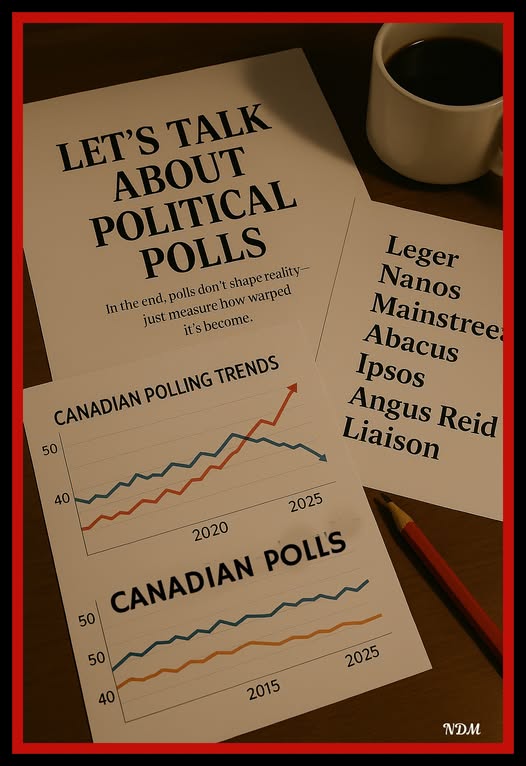
Leger, Nanos, Mainstreet, Abacus, Ipsos, Angus Reid, and Liaison.
These firms are all members of the Canadian Research Insights Council (CRIC), meaning they’re bound by strict ethics, privacy guidelines, and the eternal curse of being corrected on Twitter by armchair psephologists.
Let’s get one thing straight: polls can be biased. But responsible pollsters account for that by including margins of error. That’s the ±3% you see in the fine print, usually ignored by people who post “OMG LIBS DOWN 2 POINTS” like they’ve just cracked the Enigma code.
Now, a lot of people love to scream: “The polls are bought!”
Well—yes. Obviously. Pollsters are companies. They’re not some monk-like order quietly collecting voter intention in the wilderness. They sell a product: data. Whether it’s Jean-Marc Léger or Nik Nanos, these people run services intended to turn a profit. And who buys that product? Political parties, governments, media outlets—all of whom need this information. Campaigns use it to decide where to send the leader and how to spin the next attack ad. Governments use it to test the public temperature before announcing things like tax credits or poorly branded climate plans. And media? They need it for clicks. “New Poll Drops” is almost as big a deal as “New Stock Numbers.” The important thing is not who commissions the poll, but whether the methodology is sound, the data is public, and the transparency is there—which, in the case of CRIC-certified firms, it is. You’re allowed to be skeptical, but maybe aim that skepticism at how we interpret polls, not at the fact they exist.
Now, to address the elephant in the war room: 338Canada. You’ve probably heard someone say, “Well, 338 says the Liberals are going to lose…” Cool. 338 is not a poll. It’s a poll aggregator. Think of it as a very sober oracle who takes all the polls, mixes in past election results, demographic trends, regional factors, and the whispers of the political wind, and then spits out seat projections. So no, 338 doesn’t have secret knowledge. It’s just very, very good at reading the collective mood swings of Canada’s pollsters.
Why does all this matter? Because in a chaotic election year—where we’ve got a freshly-minted Mark Carney trying to reboot a shell-shocked Liberal brand, Pierre Poilievre auditioning for the role of Canadian Batman villain, and Jagmeet Singh looking increasingly like the best man at a wedding he wasn’t invited to—the numbers actually help cut through the noise. But here’s the thing: polls are not predictions. They are snapshots. Blurry, maybe a little drunk, and taken under questionable lighting—but snapshots nonetheless.
So before you scream into the void about a single poll showing the Greens at 12% in Nunavut, remember this: The map is not the territory. The poll is not the election. And the truth? Well, it’s somewhere between the margins of error and a Tim Hortons drive-thru in Moncton. Because if you’re relying on polls to save your party, your party’s already halfway to hell—you’re just arguing over the playlist. In the end, polls don’t shape reality—they just measure how warped it’s become.
 Nancy's Notes