


Quebec: The 1867 version of Let’s Make a Deal! Information that Canadians (particularly Albertans need to know)
Okay, today’s conversation may not be as thrilling as a convoy conspiracy or a TikTok rant about Trudeau’s socks, but it matters. Because no matter where you live in Canada, you will inevitably spend a lot of time talking about Quebec. Sometimes with admiration. Sometimes with resentment. Often with confusion.
Here’s the deal. Literally. Don’t shout at me and say I’m on Quebec’s side. I’m just providing a little more information so we can be informed when we act as advocates for our beautiful country.
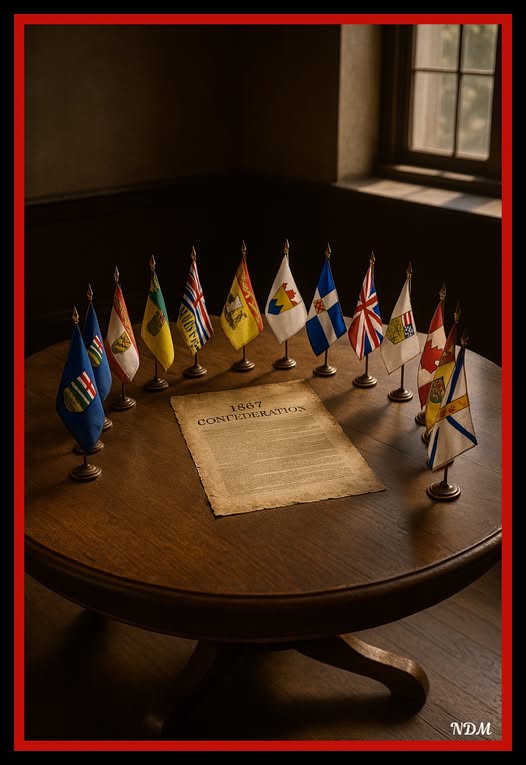
Back in 1867, when Canada decided to become a thing, it was supposed to be a tidy little club of New Brunswick, Nova Scotia, and Ontario. Quebec wasn’t really interested in being part of this little clique they were going to name Canada. But they needed Quebec. Strategically, geographically, and economically, Quebec was the keystone in the arch. At that time, the population of Ontario was only 1,600,000 and Quebec’s was 1,100,000. So those Fathers of Confederation made a deal. A constitutional one. Quebec could protect its language, its religion, its civil law system, and, crucially, it would get everything the rest of Canada got. Equal status. Equal opportunity. Equal headaches.
So when people say “Quebec gets special treatment,” the correct historical response is: no, Quebec gets what it negotiated. The rest of you just showed up later and signed the waiver. Now fast forward 158 years. Is Quebec different? Absolutely. But let’s not pretend the rest of Canada is just one beige wallpaper of sameness. If you think Saskatchewan and Newfoundland have the same vibe, you’ve never been to either. Quebec’s not the weird cousin at the family reunion, it’s the cousin who read the fine print and brought a lawyer.
Now, Alberta and Quebec will be clarifying their expectations in the coming days. ‘Danny’ has already laid down the rules of the game as written by her. Premier François Legault, the same guy who once flinched at the word “pipeline” like it was printed on a federal income tax return, is now saying his population is more open to energy corridors. Yes, that’s right. Quebec is not the immovable monolith that Bloc Québécois leader Yves-François Blanchet pretends it is. Blanchet says a lot of things, but mostly the things that would keep him from losing even more seats.
Here’s where it may sound a little personal. Because, as you read my posts, remember that it is my personal perspective I write them from.
My husband is a French-Canadian, born and raised in small-town Quebec. His family didn’t really see themselves as part of Canada they saw themselves as Quebecois. That kind of terminal uniqueness ran deep. But my husband joined the Canadian Armed Forces, and he’s been gone from Quebec for decades. Today, as a technically bilingual pipeline consultant, he is often called on to work in Quebec so he can blend the white collar needs of the Calgary engineers and manage the Francophone Quebec workforce. And while he remains proudly French-Canadian, he now often feels as much like an outsider when he is there and as when he is home in Alberta; caught between two solitudes that both claim and reject him.
That contradiction lives in a lot of us. And if you spend time in Quebec, not just in the cafés of Montreal but in the towns, the villages, even up north where few Canadians know they’re crossing into Inuit territory, you start to see something beautiful. Yes, there are tensions. But there’s also a shared heartbeat. People who want to raise their families, laugh on long weekends, pay their bills, and feel like they matter. Strip away the language laws and the lawn signs, and you’ll find we’re not speaking so differently after all.
I grew up in Moncton, the only officially bilingual city in Canada. Think about that. It’s not Montreal, not Quebec City and not Sherbrooke. Not even in Quebec. It’s Moncton which is in New Brunswick. And I’m an Anglophone who grew up in that bilingual reality. Where we didn’t just tolerate French, we lived alongside it. It was messy. It was loud. But it worked. French and English, side by side, not just in signage but in life. That taught me something early on: that difference isn’t the problem. Dishonouring the deal is.
So now, as we move forward and debate pipelines, energy corridors, climate, transfers, and provincial autonomy, we need to come back to this basic truth: Quebec made a deal. And we agreed.
The challenge now isn’t “How do we build energy corridors in Quebec?” or “How do we save Alberta?” It’s how do we build Canada, on terms that reflect who we are today, without forgetting the deals that got us here.
And as we work our way through every province and territory in this sprawling, imperfect federation, we’ll find what we’ve always found: our differences are real, but so are our connections. And remember we made the deal with Quebec in 1867.
Alberta? Alberta didn’t even get a seat at the table until 1905, nearly four decades later. So if it feels like the rules were already written… well, they kind of were.
 Nancy's Notes