


Twenty-four years. I remember every moment.
I had just sent my older son off to school. My younger one was a toddler, wandering around the kitchen while I stood at the island with paperwork spread everywhere, the TV set propped on the counter. And then the news alert saying the first tower was hit. Like everyone else, I was watching when the second was hit. I didn’t sit down. I just stood there, trying to keep my little one occupied, trying to absorb something that would change all of us forever.
My dad was still alive then. I called him from Calgary, his voice steady from New Brunswick, but we both knew this was different. He was a man who lived by service, signing on with the Royal Canadian Air Force in 1941, then dedicating his life to his community and volunteerism. We spent much of that day talking and processing what we had seen and heard. That day reminded me just how fragile the world could be, and how deeply our choices matter. The loss of innocence for the generation before me was the Second World War. For me, it was September 11, 2001.
My sister and her husband live in Gander, Newfoundland and like most of the community opened their hearts when the planes arrived. My brother in law was an air traffic controller, but more importantly a very active member of his community. And that small community of fewer than 10,000 took in almost 7,000 stranded passengers. If you don’t know that story, you don’t know one of the proudest chapters in Canadian history. They fed, housed, clothed, and comforted complete strangers. They showed the world what it means to be human.
That day was also a reminder of the Canada–U.S. relationship. In modern history, outside of the Second World War, there has been no moment when we stood more firmly with our American friends. We didn’t hesitate. Because geography placed us side by side, but history, sacrifice,and human decency kept us there.
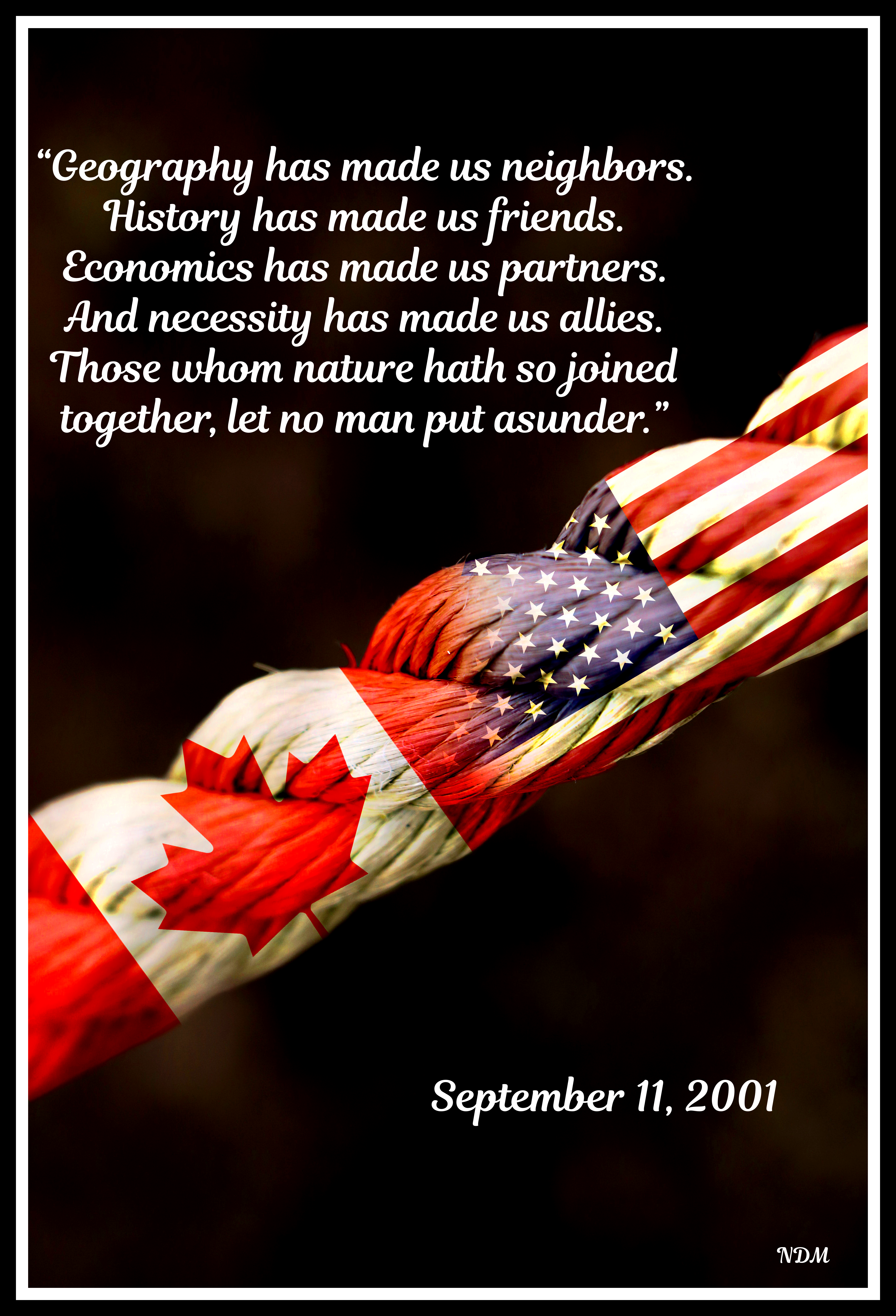
It was John F. Kennedy, speaking in Canada’s House of Commons in 1961, who said it best:
“Geography has made us neighbors.
History has made us friends.
Economics has made us partners.
And necessity has made us allies.
Those whom nature hath so joined together, let no man put asunder.”
That is what I hold onto today. Because I look at where we are now, at the toxic politics, at the self-serving narcissism of one man determined to tear countries apart rather than bring them together, and I think: my God, what a loss. The Department of War is not strength. Defense is strength. Community is strength. Humanity is strength.
For those too young to remember 9/11: this isn’t about the loss of shampoo bottles in your checked luggage or the inconvenience of airport security lines. It’s about the moment when thousands of lives were ended in real time, on live television. It’s about the day when every school teacher in North America looked at their classroom differently, wondering how to explain the unexplainable to terrified children. It’s about the trauma imprint, on parents, on kids, on communities, that still lingers close to a quarter century later.
I think of my own children and how that fear landed in our home. The phone calls to family. The way the air itself felt heavier. The stunned silence on streets and in the grocery store. I believe as I speak these words, I can still feel what it felt like. And as I write, I try to honour both the factual pieces of that day and the raw human pieces of how we felt.
That is why Gander matters. That is why our shared history matters. We rose to support our American neighbours not because of politics, but because of humanity. Because Canadians understood instinctively that the border was invisible when people were in need. And we acted on it.
And yet, walking through every single day now, watching the constant erosion of our shared ideals, the loss of that relationship between the United States and Canada feels even more hurtful. The U.S. once needed and wanted the world’s help. Now, under leaders who confuse bravado with strength, it acts as though it doesn’t. That breaks something in me. Because for all our differences, for all our arguments, the bond forged in tragedy should have been unbreakable.
But bonds only hold if we choose to honour them. The lesson of September 11th isn’t just about vigilance; it’s about unity. It’s about ordinary people doing extraordinary things in the face of fear. It’s about our country who opened its arms to stranded strangers and made them neighbours.
I miss being able to call my dad to talk about the things going on in our world, to hear what he would say. And yet, I’m also glad he isn’t here to see the anger and division that have followed. What I know is this: there are still people fighting for our country, not with weapons, but with words, service, and courage. They are the counterweight to war. The living proof of Kennedy’s words.
We say we will never forget. And we shouldn’t. Because forgetting isn’t just about losing memory; it’s about losing ourselves. And if September 11th taught me anything, it’s that the opposite of fear is not comfort, but action.
On that day, our innocence shattered, but our humanity showed. Today, our politics are bitter, but our capacity for decency still exists. It’s up to us to defend it, fiercely, to make sure geography and history continue to bind us, and to refuse to let any man, no matter how powerful, put it asunder.
 Nancy's Notes