


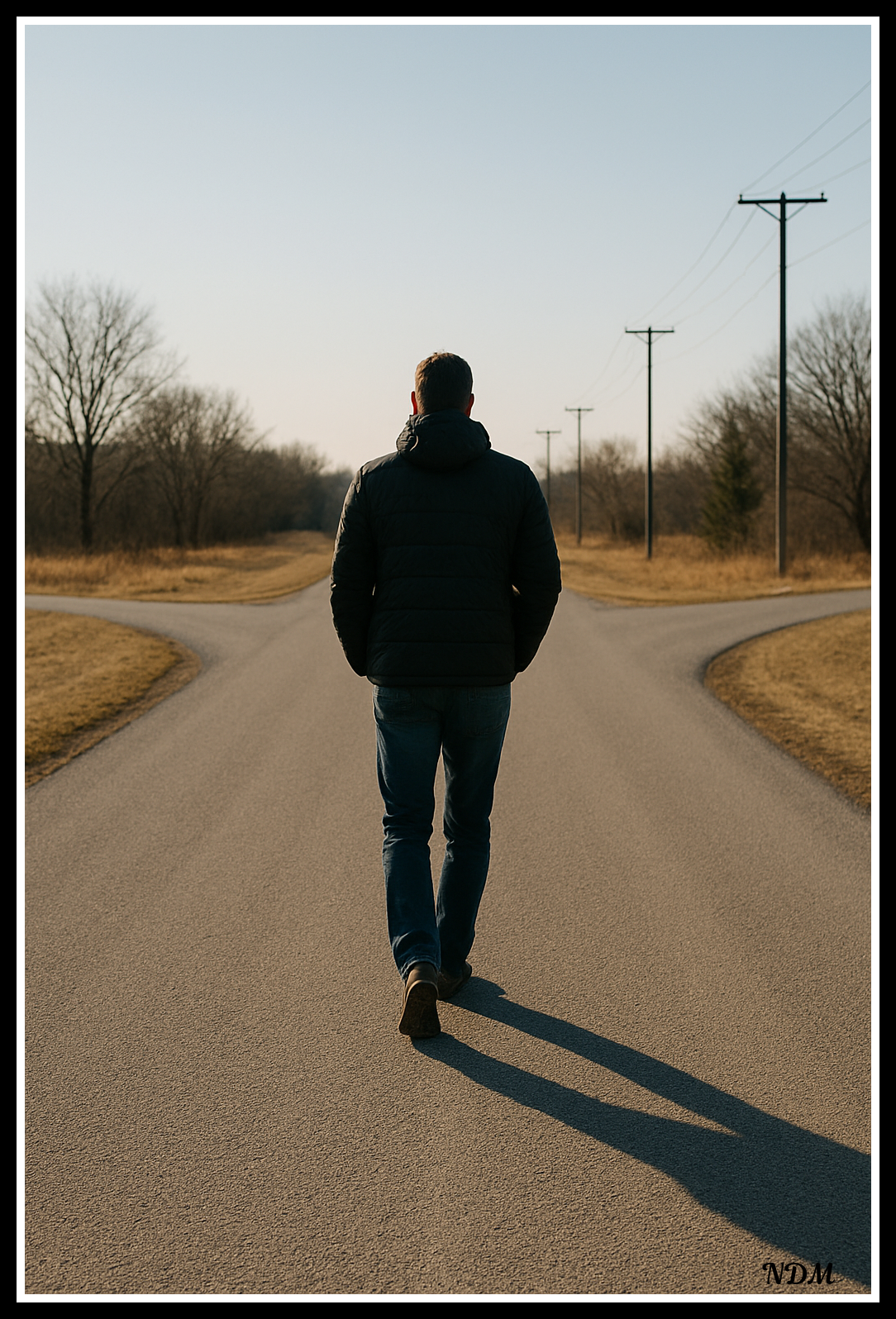
There’s an expression I’ve used for decades. I don’t know who first said it, but it has stayed with me longer than most political slogans or news cycles ever will. ‘If you blame others, you give up the power to change.’
When I first started using it, it had nothing to do with politics. It was about people I knew, family, friends, community members, who faced difficult circumstances. We’ve all known those situations where two children grow up in the same home with the same opportunities and the same challenges, and one rises despite adversity while the other drowns despite prosperity. Circumstance isn’t destiny. Choice is always part of the picture, small, incremental choices about how we react, how we cope, and how we move forward.
But somewhere along the way, this human truth got swallowed by something much larger. Blame has stopped being an individual habit and has instead become a societal norm. It’s now a default setting, a reflex, a cultural posture. It doesn’t just show up in personal relationships or family dynamics. It shows up everywhere now. In politics, in public discourse, in online communities, in the way we talk to strangers and the way we talk to ourselves. It has become the new standard, and an unhealthy one.
And nowhere is that more obvious than in the way politics is now practiced. Over the past decade, politics has increasingly become a performance of victimhood. Not genuine suffering, but strategic grievance. In the United States, Donald Trump has practically built an empire out of it. You hear his refrain daily. Joe Biden this, Crooked Joe that, on and on and on. It’s a relentless drumbeat of pointing fingers outward to avoid ever turning the mirror inward.
And here in Canada? We’re not immune. Pierre Poilievre has turned Justin Trudeau into his entire personality. Ten plus years of the same line: Trudeau broke it, Trudeau ruined it, Trudeau is the cause of every pothole, every grocery bill, every global shockwave, every structural issue that existed long before he was even an MP. There is never a solution, only a scapegoat. And if he ever stopped blaming, he’d have to start explaining, which is far more difficult.
But this isn’t just about them. The real danger is what this style of politics does to us. When leaders model blame, they normalize it. They give society permission to adopt the same posture. And suddenly we are a nation, and a generation, encouraged to externalize everything. Everything becomes someone else’s fault. Someone else’s failure. Someone else’s responsibility to fix.
It creates a kind of moral paralysis.
If everything is always someone else’s doing, then nothing is ever within our power to change. The story becomes fixed. Our agency disappears. And once agency disappears, cynicism fills the space it leaves behind.
This is not the country I grew up in. It’s not the country many of us tried to build. And it’s certainly not a healthy model for young people, because when the only thing they hear from politicians is blame, how on earth are they supposed to learn accountability? How are they supposed to believe they have influence over their own lives, let alone their communities?
If society keeps modelling the opposite, if our political culture keeps rewarding the loudest finger pointer instead of the most honest problem-solver, then we shouldn’t be surprised when the entire public starts behaving the same way.
Leadership is not about who can yell “not my fault” the loudest or who can dig up the oldest grievance. Real leadership is quieter than that. It’s steadier than that. It’s the person who wakes up and without pageantry puts one foot in front of the other and deals with the issues actually in front of them. No excuses. No endless rehashing of who messed up what ten years ago. Just the work.
That’s the kind of leadership I prefer: the kind that solves instead of performs. The kind that owns responsibility instead of outsourcing it. The kind that doesn’t need an enemy to justify its existence.
Because the alternative is exactly what we’re living through, a political landscape where deflection has replaced direction, grievance has replaced governance, and blame has become the cheapest currency in public life.
And honestly who is driving that trend? Donald Trump has built an entire political identity around never taking responsibility for anything, ever, even when the consequences are catastrophic. Pierre Poilievre has spent more than a decade scripting every sentence around Justin Trudeau as if reciting a grievance is the same thing as offering a plan. And Danielle Smith has turned deflection into an art form, blaming everyone from judges to civil servants to the federal government rather than simply governing the province she was elected to lead.
This is not strength. This is not vision. This is not leadership.
We deserve leaders who face the hard truths, not run from them. Leaders who build instead of burn. Leaders who don’t need a scapegoat to feel powerful — and who understand that their job is not performance art but public service.
And we deserve leaders who model that for our children. Because whatever behaviour we normalize at the top quickly becomes the behaviour young people believe is acceptable. They watch how we speak, how we react, how we handle conflict, how we take, or avoid, responsibility. If all they ever hear is blame, then blame becomes the cultural default.
We deserve a society that refuses that path. A society that understands that blame might feel satisfying in the moment, but it is a dead end. It does not move us forward. It does not solve a single problem. It keeps us exactly where we are, frozen in place, circling the same resentments, repeating the same grievances.
And it brings us back to the line I’ve carried through decades of my life, a line more relevant now than ever. “When we blame others, we give up the power to change!”
 Nancy's Notes