


I cannot get one line out of my head from today’s briefing. “We are not defenders anymore. We are warriors.” I have replayed it several times, trying to decide whether I am overreacting or whether my instincts are correct. Because words matter. Especially when bombs are falling.
For decades, the American military has described itself as a defensive force. Even when conducting offensive operations, the framing has been clear. It exists to defend the Constitution, to defend the homeland, to deter threats, to protect allies. That distinction has always mattered. It has mattered to Americans and it has mattered to those of us watching from allied countries like Canada. Defence implies restraint. Defence implies necessity. Defence implies force as a last resort.
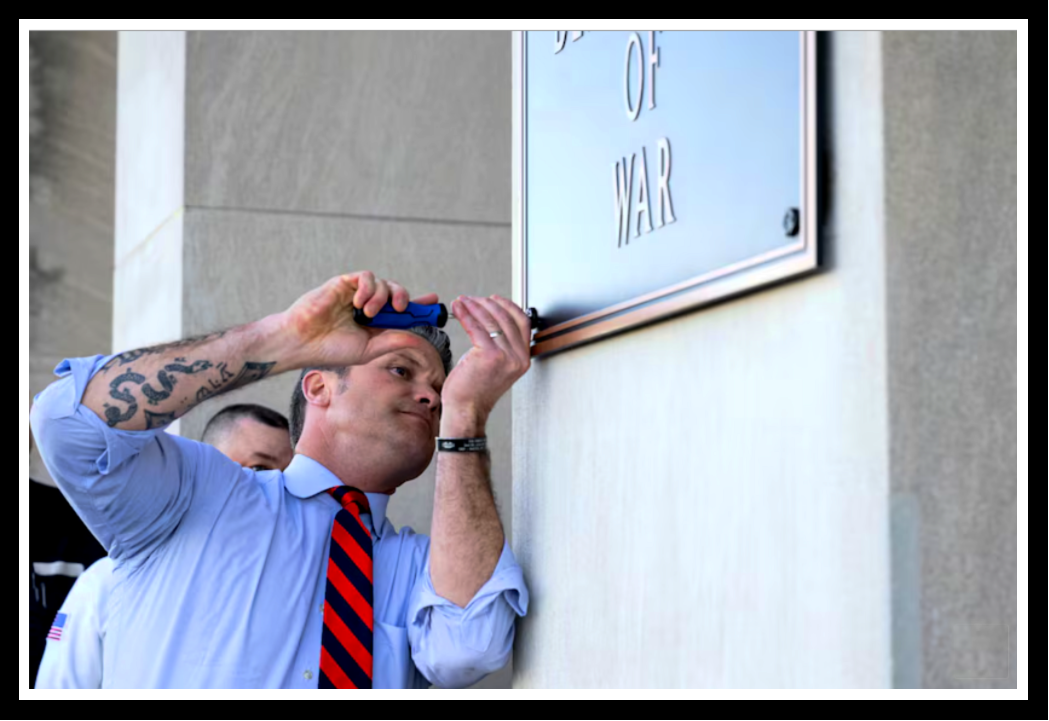
Warrior implies something different. A warrior fights. A warrior embraces lethality as identity. A warrior is trained to kill and break the will of the enemy. None of that is morally shocking in a military context. Militaries exist to fight. But when civilian leadership stands at the Pentagon and declares that the force is no longer a defender but a warrior, that is not casual rhetoric. That is an identity shift. Three months ago, through executive messaging, the administration began referring to the Department of Defense once again as the Department of War. We all know Congress did not legally rename it. That would require legislation. But signage changed, messaging changed and more specifically the symbolism changed. And symbolism is not accidental. When leadership chooses to elevate “War” over “Defence,” it signals posture, direction and mindset.
Now we hear “We are not defenders anymore.” It is hard not to see the alignment.
The Secretary’s remarks today were not delivered in the clipped, cautious language of a standard Pentagon briefing. They were sermon-like in cadence. There was prayerful language, invocation of biblical wisdom, generational framing, moral certainty. It sounded less like a policy update and more like a proclamation. That may resonate deeply with some Americans. For others, it raises questions about how war is being framed.
In contrast, General Kane’s operational update was measured and factual. He acknowledged losses. He spoke of duration. He described complex integration across domains. He made no identity declarations. He spoke as a professional soldier describing major combat operations that will take time and will likely cost more lives. The contrast in tone was striking.
Which brings me back to the question I cannot shake. Why now?
If this is not regime change, and they have explicitly said it is not, then what is the defined end state? If this is not occupation, and no one is suggesting boots on the ground in the traditional sense, then what does “finishing it” actually mean? Air superiority can be measured. Missile degradation can be measured. Nuclear facilities can be struck. But political transformation is something else entirely.
Over the past day I have been speaking with people I know in the Middle East. One friend from southern Lebanon, who has family being evacuated told me that his parents, grandparents, great grandparents and generations before them have lived with cycles of unrest. For Americans, 1979 may feel like the beginning of this story. For many in the region, it is one chapter in a much longer one. When American leadership speaks of a generational turning point, people in the region hear something different. They hear another turn of the wheel.
That does not mean Iran’s actions are benign. It does not mean missile programs and nuclear ambitions are not serious threats. It does mean that rhetoric about warriors and finishing a decades long conflict raises expectations that air power alone rarely fulfills.
I am Canadian. These are not my armed forces. But as an ally, and as someone who believes deeply in democratic institutions and civilian oversight, I care about how force is framed. Democracies have historically been careful to describe their militaries as defenders, even when fighting offensively, because the legitimacy of force rests in protection, not in identity built around war itself.
So I will ask it plainly, and I direct this directly to the President of the United States. What is your end goal? What is the defined, measurable, durable outcome that justifies this moment?
And to my major question. Why now?
Perhaps there is intelligence we are not privy to. Perhaps a threshold was crossed. Perhaps deterrence had failed and waiting carried greater risk. If that is the case, say so clearly. Define the objective. Define success. Define the off ramp.
Because warrior is a powerful word. And once embraced as identity, it shapes how a nation sees itself and how it acts.
When we move from defender to warrior in how we describe ourselves, it is not unreasonable to ask why, and what comes next.
 Nancy's Notes