


There are moments when a politician says something and you immediately know they have never actually lived through what they’re talking about.
On Saturday Alberta Premier Danielle Smith described how healthcare should work in Alberta. She said that when someone arrives at a hospital they should be seen within four hours. If they need to be admitted, tests should be completed within twenty-four hours. If they require a hospital bed they should stay perhaps five to eight days. And she said no one should ever remain in hospital longer than thirty days.
Thirty days.
I have spent the last five years watching my husband fight for his life inside Alberta’s healthcare system, and I can assure the Premier of one thing: illness does not run on a political timeline.
My husband was a healthy fifty-five-year-old man when COVID entered our lives in April of 2020. This was before covid vaccines and during a time when hospitals were locked down and families were not allowed inside. When he was admitted, I did what thousands of Canadians did in those early months of the pandemic. I sat in the hospital parking lot waiting for updates that came by phone. I watched the entire series of Schitt’s Creek sitting in that parking lot. I read books. Mostly I stared at my phone and waited. No one told me there was a timeline for illness.
He survived. But our journey through the healthcare system was far from over.
In 2022 Mario became sick again. By the time he was taken by ambulance to the hospital he was already critically ill. Scans revealed thirteen large masses on almost every major organ in his abdomen, the liver, pancreas, gallbladder, colon and spleen. A palliative care doctor came into his hospital room and told us they believed it was metastatic cancer, likely originating in the pancreas or liver, and that we should prepare for end of life.
The next morning the pathology report came back. The diagnosis was stage four high-grade diffuse large B-cell lymphoma. Compared to what we had been told the day before, it felt like a miracle. But what follows a diagnosis like that is something most people cannot imagine until they are living it. Suddenly, your vocabulary fills with words you never expected to know. Biopsies, bone marrow tests, ports and chemotherapy protocols with names like R-CHOP. Endless blood work, endless scans, and teams of specialists trying to determine how aggressively the disease must be treated. Some people receive a cancer diagnosis before they are seriously ill. Mario was not one of those people. By the time he was diagnosed, he was already critically ill and hospitalized. It’s a good thing no one put a limit on how many days they could provide care.
Treatment began immediately, and it was aggressive. The chemotherapy alone involved five powerful drugs and brought complications of its own. He developed a pulmonary embolism. He acquired MRSA, a resistant staph infection that required treatment that shut down his kidneys.
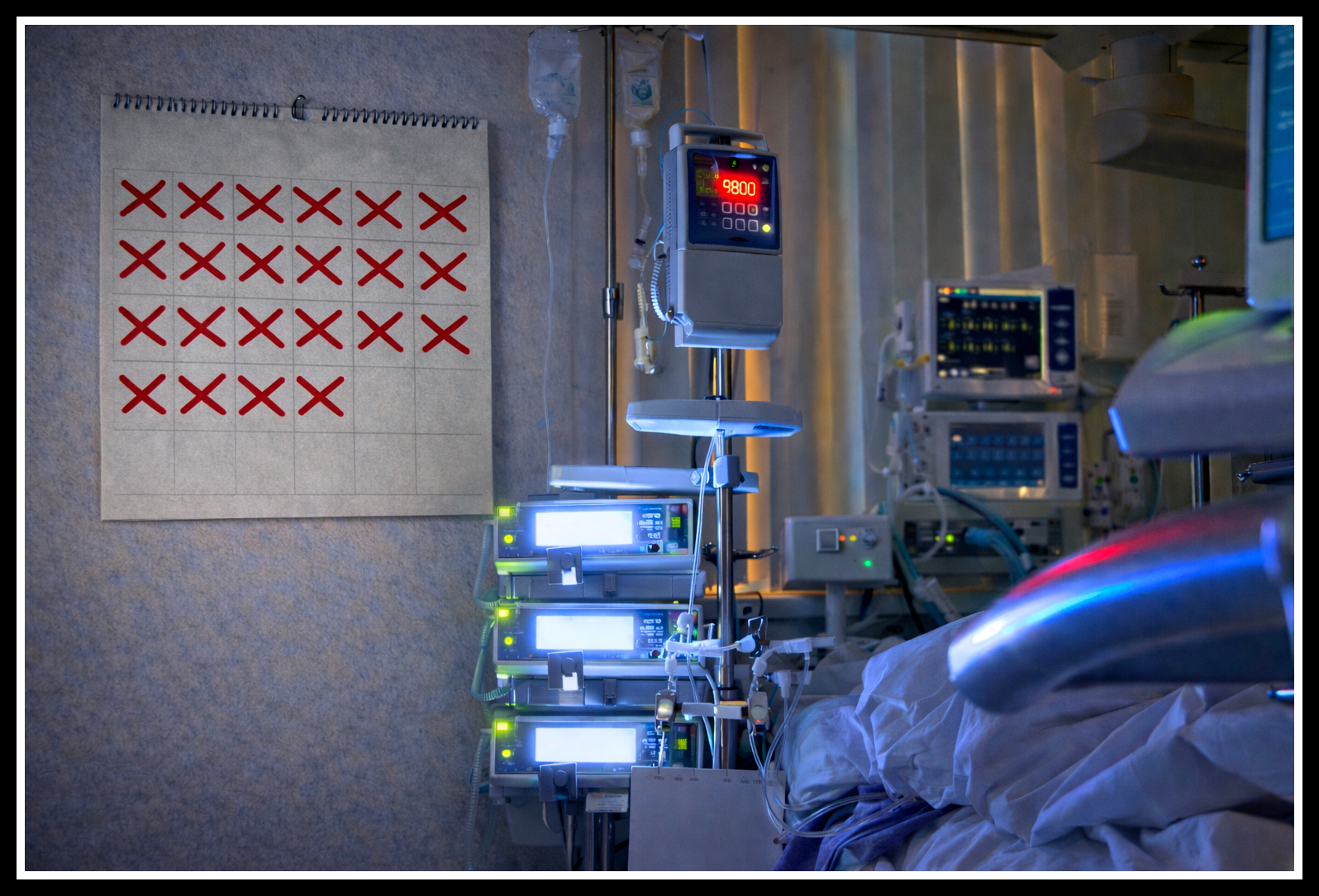
Through all of this there were extraordinary people inside Alberta’s healthcare system, doctors, nurses and specialists navigating a system that is clearly under pressure but still held together by the people working within it. And through all of those weeks, surrounded by tests, infections, complications and uncertainty, not one person walked into that hospital room and said, “Well sir, it’s day twenty-eight. We’re going to need to wrap this up.” Because that is not how cancer works.
Eventually Mario was discharged and continued chemotherapy outside the hospital. By the time he finished treatment the two-hundred-and-five-pound man I had married weighed one hundred and thirty-three pounds. He survived that too.
Then on June 8th, 2024, another chapter began. Mario had been outside working in the yard for several hours. Then the fellow helping him came into the house and said he thought Mario needed a glass of water. I grabbed one and went outside. At that exact moment Mario began to lose consciousness.
Our youngest son was home who serves in the Canadian Armed Forces and immediately began CPR while I called 911. He performed compressions but could get no pulse or respiration. EMS arrived within fifteen minutes and took over CPR. Still no pulse. Firefighters arrived and took over the compressions and they did not stop.
From the moment Mario collapsed to the moment they were preparing to call his death, forty minutes had passed. Then I saw his chest rise. At minute forty-two. He was rushed to hospital, intubated and placed in a deep medical coma. Survival after an out-of-hospital cardiac arrest is already low. After forty minutes it is almost unheard of.
But our son had started immediate CPR which meant oxygen was still reaching Mario’s brain.
And then the waiting began again. Teams of doctors, literally teams worked to determine what had happened and whether he would recover.
Days passed. Weeks passed. And then he woke up. Slowly his cognitive ability returned and then his physical strength. Forty minutes of CPR leaves broken ribs and a battered sternum but he was alive. I remember looking at the Intensivist and asking how this was possible. Immediate quality CPR.
During these five years I have said many times that I am not sure how families manage this system without someone advocating for them every step of the way. I am a very resource-driven person. English is my first language. I am not afraid to ask questions or push when something doesn’t make sense. Even with those advantages, navigating the system was incredibly difficult.
Our sons were part of that journey in different ways. Chris’s military training allowed him to begin CPR that day in our yard. Our other son married a healthcare professional, and I cannot tell you how many times her knowledge helped guide me through terminology, decisions and questions I never expected to face. Even with that support, this was not easy to navigate. There were many more hospital visits as health care providers found the best treatments etc. for my husband but most were within the magic 30 day number although several surpassed the five to eight threshold. Imagine!
Which brings me back to the Premier’s remarks. After everything our family has lived through since 2020, COVID, stage four lymphoma, aggressive chemotherapy, MRSA, pulmonary embolisms and a forty-two-minute cardiac arrest, I can say with certainty that not one doctor, nurse, paramedic, firefighter or specialist ever looked at a calendar and said, “Well folks, thirty days is the limit.”
What saved my husband’s life was not a timeline announced at a podium. It was people. And thank God the people doing the real work in Alberta’s healthcare system don’t operate on a thirty-day deadline. And tests within 24 hours will require additional machines and more manpower and anyway you may not even be seen in the ER within 24 hours.
And if Danny ever wants a slightly more detailed education on how healthcare actually works in Alberta, I’d be happy to have that conversation. After the last five years, I’ve had a pretty intensive course in it.
And I’ll even try to keep it simple. Four hours. Twenty-four hours. Five to eight days. Thirty days. Those numbers might work on a government briefing note but not on a human body in a health crisis.
 Nancy's Notes