


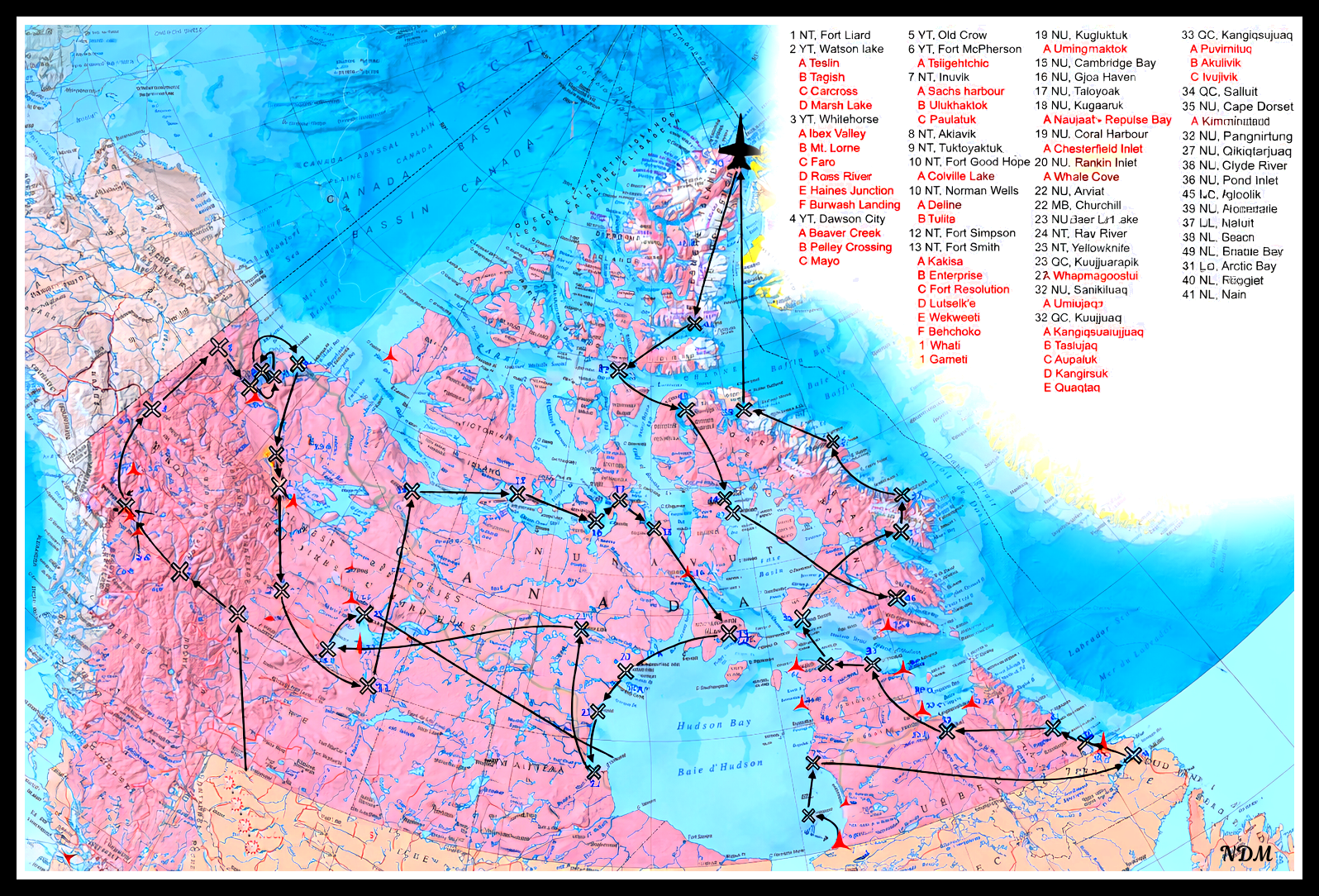
There’s a place I talk about fairly often because it’s a place that truly has my heart, as the expression goes. Northern Canada. What I’m referring to specifically are the territories: Yukon, Northwest Territories, and Nunavut. What is becoming more and more apparent in the coming years is the issue of Arctic sovereignty, and Canada is entering a moment where we must take that responsibility seriously.
The last time Canada felt the need to demonstrate sovereignty in the High Arctic was during the early years of the Cold War, and the story of how that was done is not one of our proudest chapters. In 1953, the Canadian government relocated eight Inuit families to the High Arctic, specifically to Grise Fjord on Ellesmere Island. The families came from what is now Nunavik in northern Quebec, an Inuit region that many Canadians still do not realize exists. The relocation was intended to strengthen Canada’s territorial claim by establishing a permanent population in the far north.
The families were promised homes and abundant wildlife for hunting, and they were told they could return home after a year if the relocation did not work. Those promises did not materialize. Instead, these families found themselves thousands of kilometres away from the land they knew. The animals followed different migration routes then what they knew. The seasons behaved differently. Even the landscape itself required a completely different understanding in order to survive.
Yet survive they did. They learned the migration routes of whales and animals and hunted across vast territories they had never known before. They relied on one another and on their resilience because there was no other choice. Many Canadians are unaware of this history, but it matters in the conversation we are having today because the North is once again becoming central to Canada’s national priorities.
Before talking about the new announcements, it’s important to understand what life in the North actually looks like. People often use the word remote rather casually. Someone might talk about having a cottage somewhere in northern Ontario or Saskatchewan and describe it as remote. But the Arctic exists on a completely different scale.
In Nunavut, for example, there are no roads connecting communities. None. The only roads that exist are the small ones within the hamlets themselves. Travel between communities happens by air, by boat during the short summer season, or by snowmobile across the land when conditions allow. Even that doesn’t fully convey the distances involved. Many communities are separated by hundreds, sometimes many hundreds, of kilometres of land and water.
It is a scale of geography and isolation that most Canadians have never experienced.
Only about two percent of Canadians have ever travelled to the territories. And even among those who have, most have visited Whitehorse or Yellowknife. Those are important northern cities, but they remain relatively southern in Arctic geography and can resemble towns in northern Alberta or northern British Columbia. The High Arctic is something altogether different.
Yesterday, the Prime Minister announced investments that directly relate to this region and to Canada’s future there. The plan involves approximately $35 billion in defence and infrastructure spending focused on the North. Much of that funding comes from a modernization effort tied to NORAD, the binational North American aerospace defence command Canada operates jointly with the United States.
The plan includes upgrades to northern bases, including runway expansions so they can support Canada’s new jets. Hangars, roads, and other operational infrastructure will be built or upgraded across Arctic locations. Forward operating sites will be strengthened in Inuvik, Yellowknife, Iqaluit, and Goose Bay. Additional operational hubs will be created in Whitehorse and Resolute, where equipment can be stored and troops staged when needed. Smaller operational nodes will also be established in Nunavut communities such as Cambridge Bay and Rankin Inlet.
The goal is to allow Canada’s military to deploy and operate across the North year-round, even in the most remote regions.
These investments extend beyond strictly military infrastructure. The announcement includes improvements to civilian airports in communities such as Rankin Inlet and Inuvik, along with major transportation projects including the extension of the Mackenzie Valley Highway and the development of the Grays Bay road and port project. If completed, that project would create Canada’s first overland connection to a deep-water port on the Arctic Ocean and help move strategic minerals from northern regions to global markets.
These are enormous undertakings. While the announcement is often described as a $35-billion investment, the broader NORAD modernization effort could represent closer to $87 billion over time when measured on a cash basis rather than standard government accounting.
That naturally raises the question some people will ask. Is this too little, too late? Personally, I don’t believe it is too late. But it has been a long time coming. The Arctic is no longer a distant policy discussion. It is becoming one of the most strategically important regions on the planet. Shipping routes that were once blocked by ice are becoming more accessible. Strategic minerals, energy resources, and the Northwest Passage are increasingly part of global conversations about trade, security, and economic development.
We often think geopolitical tensions happen somewhere far away, but the world has become very small. If you want an example of how a relatively narrow geographic location can influence global stability, you only need to look at the Strait of Hormuz, a small stretch of water with enormous implications for the entire world.
The Arctic has the potential to become just as strategically significant. That means Canada cannot afford to ignore it.
At the same time, there is something we must never forget as we move forward. The story of those Inuit families relocated in 1953 should remain part of this conversation. Canada cannot build its future in the North by making decisions about the region without the people who live there. This must be done with northern communities and Indigenous leadership at the table from the beginning. Done properly, these investments could strengthen infrastructure, improve connectivity, and create opportunities for people who already call the Arctic home. Done poorly, they risk repeating mistakes we already know too well.
Most Canadians will never see the High Arctic with their own eyes. But it remains an essential part of who we are as a country. And in the decades ahead, it may also become one of the most important places in determining Canada’s future.
For those of us who have spent time in northern communities, the North is not an empty expanse on a map. It is a living place filled with remarkable people whose resilience and ingenuity have allowed them to thrive in one of the harshest environments on Earth.
The work ahead will not be easy. It will take time, investment, and patience. But the Arctic is not simply Canada’s northern frontier.
It is Canada’s responsibility.
Someone is going to shape the future of the Arctic. That is inevitable. The question is whether Canada will do it, or whether we allow others to do it for us. And if that ever happens, we will learn something the hard way: sovereignty is not something you keep simply because it appears on a map. You keep it because you show up. Because if we don’t, someone else will.
And that is a future that would change Canada in ways most of us are not prepared to imagine.
 Nancy's Notes