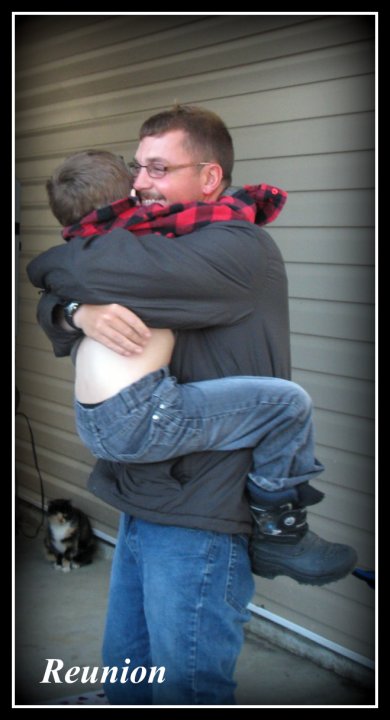
This memory from 15 years ago just came up on my feed. This is my nephew Donnie (who has recently retired from the RCAF) and his son, who reunited after Donnie’s tour in Afghanistan. Just a reminder of the many times Canada has stepped up to be there for the United States. I don’t think we sent them a bill. Trump seems to forget these things. #elbowsup#canadaproud
My husband just sent me this photo to show how strong the winds are at our house today. A Canadian flag flies on our property at all times (except for the occasional appearance of my beloved Air Force flag), and today, as strong winds prevail, that pole is bending but not breaking. Seems this is a metaphor for the current pressure that #canada faces. We will survive and we will prevail. #elbowsup my fellow Canadians.
I will never forget watching this. What has the world become. Did it really only take 80 years to forget. Apparently so…
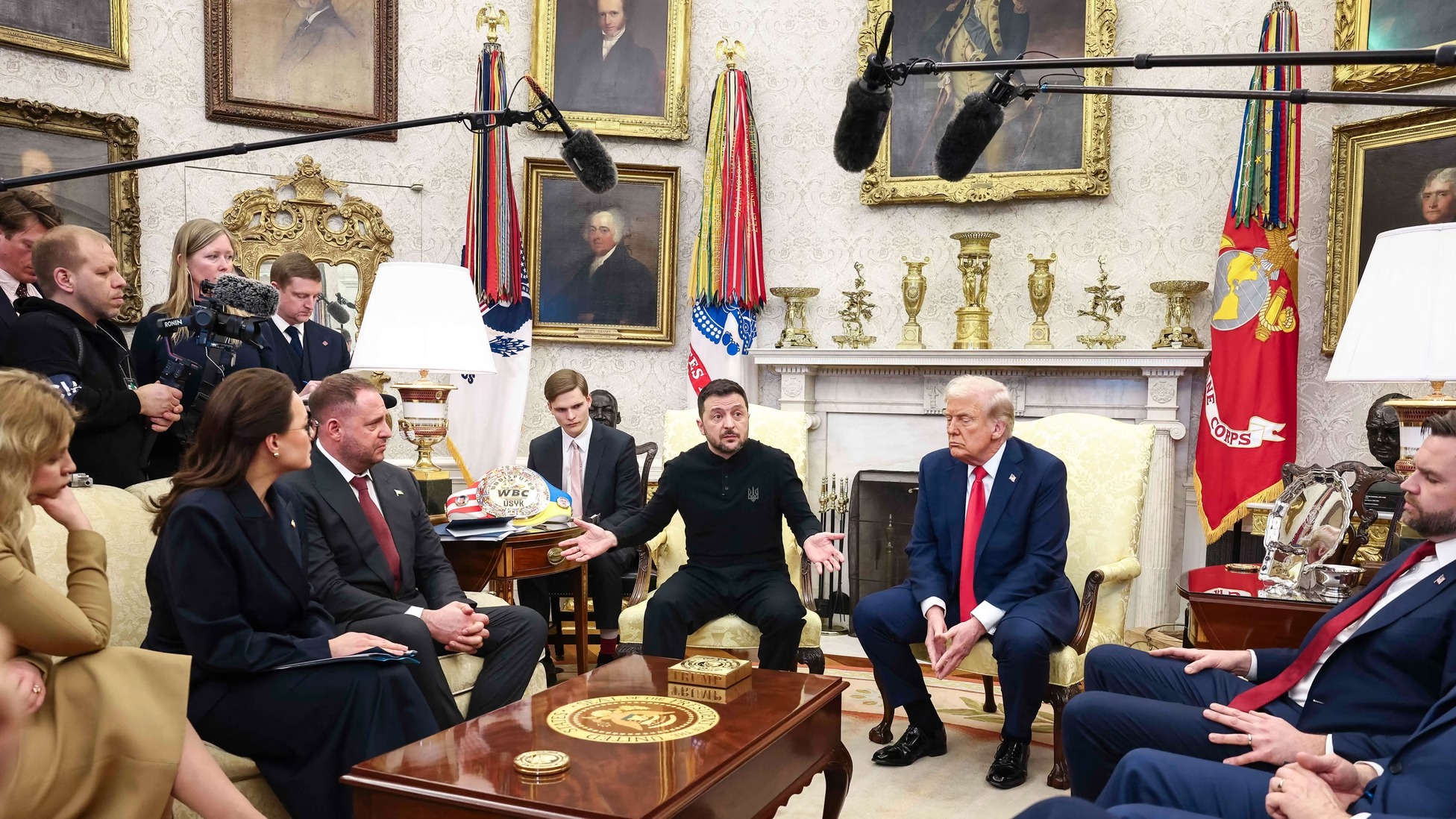
At least the Oval Office meeting held by President Donald Trump and Vice President J. D. Vance with Ukrainian President Volodymyr Zelensky was held in front of the cameras. False friendliness in public by Trump and Vance, followed by behind-the-scenes treachery, would have been much more dangerous to the Ukrainian cause. Instead, Trump and Vance have revealed to Americans and to America’s allies their alignment with Russia, and their animosity toward Ukraine in general and its president in particular. The truth is ugly, but it’s necessary to face it. Yesterday’s meeting gave the lie to any claim that this administration’s policy is driven by any strategic effort to advance the interests of the United States, however misguided. Trump and Vance displayed in the Oval Office a highly personal hatred. There was no effort here to make a case for American interests. Vance complained that Zelensky had traveled to Pennsylvania to thank U.S. ammunition workers, because, Vance charged, the appearance amounted to campaigning for the Democratic presidential ticket. “Let me tell you, Putin went through a hell of a lot with me,” Trump angrily explained. “He went through a phony witch hunt where they used him and Russia, Russia, Russia.” Both the president and vice president showed the U.S.-led alliance system something it needed urgently to know: The national-security system of the West is led by two men who cannot be trusted to defend America’s allies—and who deeply sympathize with the world’s most aggressive dictator. This becomes more and more difficult to absorb.
Through the Cold War period, Americans were haunted by the fear that a person with clandestine loyalties to a hostile foreign power might somehow rise to high office. In the late 1940s, the Alger Hiss case convulsed the country. Hiss’s accusers charged—and it later proved true—that Hiss had betrayed U.S. secrets to Soviet spymasters in the 1930s, when Hiss served as a junior official in the Department of Agriculture. The secrets were not very important; they included designs for a new fire extinguisher for U.S. naval ships. But Hiss himself was a rising star. The possibility that a person with such secrets in his past might someday go on to head the Department of State or Central Intelligence Agency once tormented Americans.
But what if the loyalties were not clandestine, not secret? What if a leader just plain blurted out on national television that he despises our allies, rejects treaties, and regards a foreign adversary as a personal friend? What if he did it again and again? Human beings get used to anything. But this?
It’s not hard to imagine a president of Estonia or Moldova in that Oval Office chair, being berated by Trump and Vance. Or a president of Taiwan. Or, for that matter, the leaders of core U.S. partners such as Germany and Japan, which entrusted their nations’ security to the faith and patriotism of past American leaders, only to be confronted by the faithless men who hold the highest offices today. We’re witnessing the self-sabotage of the United States. “America First” always meant America alone, a predatory America whose role in the world is no longer based on democratic belief. America voted at the United Nations earlier this week against Ukraine, siding with Russia and China against almost all of its fellow democracies. Is this who Americans want to be? For this is what America is being turned into.
The Trump administration’s elimination of PEPFAR, the American program to combat HIV infection in Africa, symbolizes the path ahead. President George W. Bush created the program because it would do immense good at low cost, and thereby demonstrate to the world the moral basis of American power. His successors continued it, and Congresses of both parties funded it, because they saw that the program advanced both U.S. values and U.S. interests. Trump and Vance don’t want the United States to be that kind of country anymore.
American allies urgently need a Plan B for collective security in a world where the U.S. administration prefers Vladimir Putin to Zelensky.
The American people need to reckon with the mess Trump and Vance are making of this country’s once-good name—and the services they are performing for dictators and aggressors. There may not be a deep cause here. Trump likes and admires bad people because he is himself a bad person. When Vance executed his personal pivot from Never Trump to Always Trump, he needed a way to prove that he had truly crossed over to the dark side beyond any possibility of reversion or redemption; perhaps his support for Russia allowed him to do that. But however shallow their motives, the consequences are profound.
In his first term, Trump sometimes seemed a rogue actor within his own administration. The president expressed strange and disquieting opinions, but his Cabinet secretaries were mostly normal and responsible people. The oddball appointees on the White House staff were contained by the many more-or-less normal appointees. This time, Trump is building a national-security system to follow his lead. He has intimidated or persuaded his caucus in the House to accept—and his caucus in the Senate not to oppose—his pro-authoritarian agenda.
The good and great America that once inspired global admiration—that good and great America still lives. But it no longer commands a consensus above party. The pro-Trump party exposed its face to the world in the Oval Office today. Nobody who saw that face will ever forget the grotesque sight.
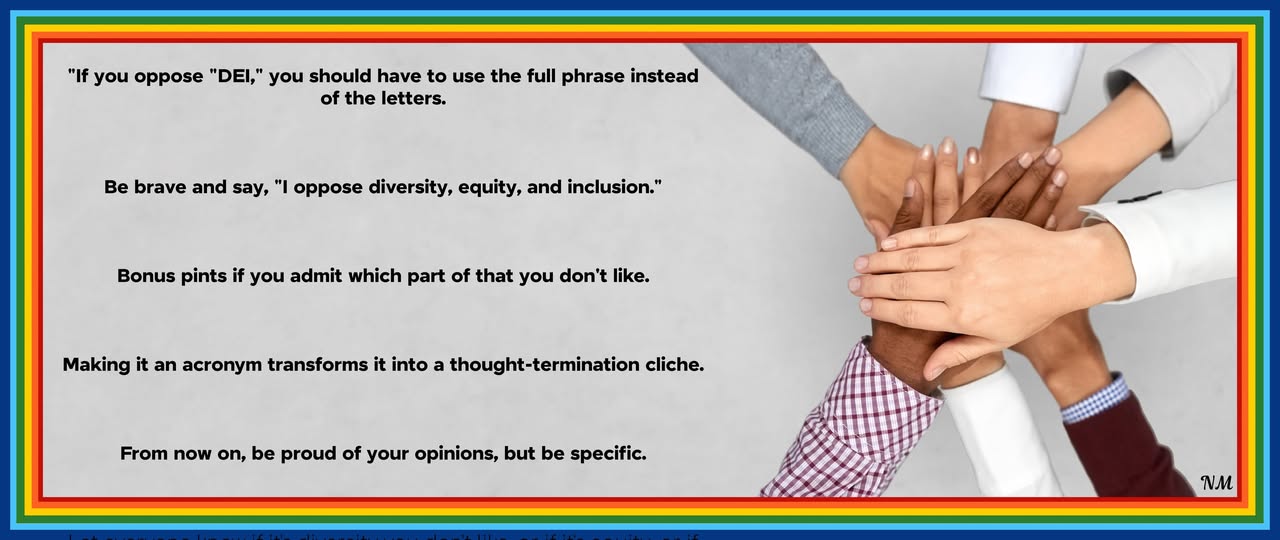
I read the words below on Facebook yesterday but I don’t know who’s the author. I wish I had thought of this! What a brilliant reframe—how an initialism can be a thought-termination cliche—that the truth in what each letter stands for, when hidden from sight within the initialism and how it allows people to more easily show their true colours. Imagine instead of asking some vague question about why someone opposes say, “I’m curious, is it diversity that you don’t like, is it equity, or is it inclusion—and why?”
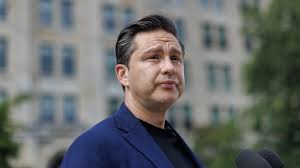
“It’s common in campaigns to remind voters of who likes who.” It will be an interesting to see how that plays out for Pierre Poilievre. He has been endorsed by people close to President Trump — a double-edged sword in Canada.
With his unapologetic conservatism, his vow to fix a “broken” nation, his “common sense” fight against elites and all things woke, his norm-shattering personal attacks against political rivals, his pugilistic use of demeaning nicknames and his open disdain of the news media, Pierre Poilievre, the front-runner to become Canada’s next leader, has become a darling of the American right.
Some of President Trump’s most prominent supporters have publicly showered Mr. Poilievre, the leader of the main opposition Conservative Party, with compliments — a remarkable feat given that Canadian opposition leaders tend to attract little attention in the United States, much less praise. But when Elon Musk, the world’s richest man who is leading an aggressive campaign against the U.S. federal bureaucracy on behalf of Mr. Trump, recently endorsed Mr. Poilievre as Canada’s next leader, Mr. Poilievre found himself in an uncomfortable situation.
Asked at a news conference last month whether he accepted the endorsement, Mr. Poilievre said, “My three-year-old has just told me that he wants to go to Mars, so I guess then Mr. Musk would be the right guy to put him in touch with,” before adding that it would be great if Mr. Musk opened some Tesla factories in Canada.
Mr. Poilievre’s backing by people close to Mr. Trump was always a double-edged sword in Canada, where the U.S. president is popular among hardcore conservatives but not among mainstream voters.
Elon Musk has praised Mr. Poilievre as the best person to become Canada’s next leader.
But that support now risks becoming a liability as Canada confronts a once unimaginable threat: the president of the United States, Canada’s closest ally, repeatedly questioning Canada’s viability as a nation, threatening to annex it through economic force and denigrating its prime minister as a “governor.”
As patriotic feelings have surged in Canada, Mr. Poilievre’s lead has narrowed significantly in several polls. Until a month ago, Mr. Poilievre, 45, appeared to be a shoo-in to become Canada’s next leader after having built a double-digit lead in the polls by channeling national frustration and anger at the deeply unpopular prime minister, Justin Trudeau.
Mr. Trudeau is expected to step down next month as prime minister after his Liberal Party selects a successor, who will automatically become prime minister. A general election is then likely to be held a couple of months later.
“For Poilievre, the biggest challenge is that for the last two years the villain in his story was Justin Trudeau,” said David Coletto, the founder of Abacus Data, a polling firm. “But that villain is now leaving, and there’s a new, bigger, badder villain that is coming from outside the country — and that’s Donald Trump.”
“What Canadians are now trying to figure out is who’s the hero in that story, who’s going to save them and protect them against that threat,” Mr. Coletto added. “And the conclusion that more people are going to choose Pierre Poilievre is now up in the air.”
Mr. Poilievre has responded by toning down his attack-dog persona and by switching to a “Canada First” message that he emphasized at a rally in Ottawa over the weekend. Before hundreds of supporters, Mr. Poilievre spent much of his speech responding to the threat from the United States, vowing to “bear any burden and pay any price to protect our sovereignty and independence.’’
Mr. Poilievre has fully embraced the populist tactics and messages used by Mr. Trump.
Mr. Poilievre’s supporters said he was simply adjusting to external developments and that he remained true to his long-held core conservative principles.
Ginny Roth, a partner at Crestview Strategy and a former communications director for Mr. Poilievre, said that Canada First was “a turning away from a naïve, international liberalism that saw global elites put the interests of their own business and, frankly, coupled with left-wing causes, ahead of the interests of regular working people.”
Ms. Roth attributed Mr. Poilievre and the Conservatives’ dip in the polls to a blip enjoyed by the Liberals after Mr. Trudeau’s resignation announcement, as well as a temporary “rally-around-the-flag” reaction among voters to Mr. Trump’s imposition of tariffs and his annexation threats.
No matter how the polls evolve, Mr. Poilievre’s situation shows how Mr. Trump’s aggressive foreign policy has upended the domestic politics of a major ally, experts said.
“With the Trump administration in power again, wreaking havoc in so many ways, including trade with Canada, it puts Mr. Poilievre in a very difficult position,” said Jonathan Malloy, an expert on Canadian politics at Carleton University. “I think he’s going to have to differentiate himself from Mr. Trump, much more than he was planning to. His opponents, of course, will accuse him of being Trump-lite.”
A career politician, Mr. Poilievre has been known for his combativeness since being elected to Parliament in 2004 at the age of 25. But it is in the last few years that he has embraced the tactics and messages used by Mr. Trump and others, portraying himself as an outsider fighting against a corrupt political, business, academic and media establishment.
He won the leadership of the Conservatives in 2022, after championing more than any other politician the truckers who took over and paralyzed Ottawa, the capital, for weeks to protest anti-COVID mandates. In the past two years, he pummeled Mr. Trudeau and other politicians with a constant barrage of personal insults and attacks that is new to Canadian politics.
Mr. Poilievre has given rivals insulting nicknames, including “Trust Fund Trudeau” to Mr. Trudeau, the son of a former prime minister, and “Sellout Singh” to the leader of the New Democrats, a smaller left-leaning party. Like Mr. Trump, he often says that problems can be solved with “common sense” — a term used by populists to pit ordinary people against a supposedly misguided and corrupt elite, said Emily Laxer, an expert on populism at York University.
While Mr. Poilievre’s policies are based on traditional conservative ideas of small government, free market and lower taxes, his populist tactics are a break from the past in Canada, Ms. Laxer said. “There is evidence of a kind of mimicking of Trump’s messaging and strategy,” Ms. Laxer said. “And certainly, they both have benefited from the polarization of their societies, politically, and they’ve contributed to that polarization.”
Mr. Poilievre’s campaign against what he perceives as woke and the news media, vowing to get rid of the public broadcaster, CBC, has further endeared him to Fox News, Joe Rogan, Mr. Musk and other high-profile supporters of Mr. Trump, who tend to dislike Mr. Trudeau.
Mr. Musk described as a “masterpiece” a video in which Mr. Poilievre, while eating an apple, spars with a reporter questioning him about his use of populism. Bill Ackman, the hedge fund billionaire, posted that Mr. Poilievre was “extremely impressive” and “should be Canada’s next leader,” adding, “Make Canada Great Again.” Mr. Musk responded with a 100 percent emoji.
Mr. Delorey said that the American right’s favorable comments about Mr. Poilievre would not have an effect on Canadian voters. Mr. Poilievre, he said, should stay focused on his message, “on what matters. Who cares if someone likes him or doesn’t like him.”
But Mr. Coletto, the pollster, said that these endorsements and Mr. Poilievre’s attitude toward the American president will be factors in a general election that has abruptly shifted from being about Mr. Trudeau to being about Mr. Trump. “There is a subset of Conservative supporters who actually like Donald Trump, even today, despite everything he’s done,” Mr. Coletto said. “But Poilievre’s got an equally large part of his base that doesn’t.” And during the upcoming general election campaign, Mr. Poilievre’s rivals are likely to seize on the endorsements, Mr. Coletto said, adding, “It’s common in campaigns to remind voters of who likes who.” It will be an interesting.
The tiny Canadian town where 7,000 people found refuge on 9/11
Air passengers who had their planes diverted to Gander, Newfoundland, recall the terror in the skies and the kindness of strangers on the ground
Jim DeFedeSunday August 22 2021, 12.01am BST, The Sunday TimesShareSave
The beaten-up Volvo rattled to a stop in front of Lakewood Academy. The driver climbed out and, along with her son, lowered the station wagon’s tailgate and slid an enormous pot out of the car. Struggling to carry it to the school’s front door, a pair of men lifted it from them and brought it into the building. The mother and son returned to their car and drove off. Hardly a word was spoken.
Rabbi Leivi Sudak watched the scene unfold with intense curiosity. Since arriving in Newfoundland the day before — September 11, 2001 — he was looking for signs as to why he was one of the nearly 7,000 passengers, from 38 international flights, who had been diverted to the small Canadian town of Gander.
Rabbi Sudak was flying from London to New York on that tragic September morning. He planned to pay his respects at the grave of the longtime leader of the Lubavitch movement, an ultra-orthodox branch of Judaism, Rabbi Menachem Mendel Schneerson. Sudak would say his prayers, return to the airport and arrive home in Edgware that night.
Rabbi Leivi Sudak questioned why he had been brought to Gander
Instead he found himself stranded in this Canadian province, where 97 per cent of the population is either Catholic or Protestant and the only synagogue is more than 200 miles away. In his mind the question remained: why did God bring him to this place? “I was constantly looking for reasons,” he now recalls 20 years later. “Why am I here? What is my purpose? What is my function?”
Perhaps the pot held an answer, he thought. He learnt that a local family, who had received a hard-to-come-by permit during hunting season, decided instead of storing the moose they’d killed to get them through the winter, they would use a portion of it to help feed all those stranded passengers.
“They took this precious meat and made this massive stew for the visitors,” Sudak explains. “They’d driven a distance of 100km to deliver it. This was just one example of the outpouring of kindness, of generosity, from these people.”
The stew offered a lesson of charity. But the Orthodox rabbi was still looking for an answer to the question of why he was there. In a matter of days he would have his answer, and as he told me recently it changed his life for ever.
American Airlines Flight 11 struck the North Tower of the World Trade Center at 8.46am on September 11, 2001. Seventeen minutes later United Airlines Flight 175 slammed into the South Tower. At 9.37am American Airlines Flight 77 hit the Pentagon near Washington DC. A fourth hijacked plane, United Airlines 93, crashed into a Pennsylvania field after passengers fought to take back control of the aircraft that the hijackers had intended to crash into the US Capitol building.
Television coverage of the attacks on the World Trade Center
From that moment on, every plane in the air was considered a threat.
“Get those goddamn planes down,” Norman Mineta, then US transportation secretary, shouted to his staff from a bunker under the White House.
The order to close US airspace had never been given before. Every civilian aircraft — 4,546 planes, ranging from private Cessnas to jumbo jets — was told to land immediately at the closest available airport. At the same time all international flights heading to the United States were told to turn back or find another country to land in. Pilots were warned that if they entered US airspace they would be shot down.
Approximately 400 international flights were already in the air during the September 11 attacks, the majority coming from Europe. Some planes turned back, but many continued on, believing that by the time they reached the United States the skies would be reopened.
The Lufthansa captain Reinhard Knoth remembers those initial moments well. Flying an older model 747 from Frankfurt to New York, he had just turned on the autopilot when he picked up scattered radio transmissions between pilots from other airlines. “There’s something happening in New York,” a KLM pilot excitedly announced. “An accident.”
Lufthansa captain Reinhard KnothFLORIAN SIEBECK
Knoth switched to the BBC and listened as they broadcast the first reports of a plane crashing into the North Tower. Knoth and his co-pilot speculated it was probably a small plane and maybe the pilot had suffered a heart attack. Then suddenly the BBC announcer declared that a second plane had hit the towers. Knoth knew this was no accident. A pilot for 30 years, he understood that no crew would deliberately crash their plane into a building. Those planes were hijacked.
He sent a teletype message to Lufthansa headquarters in Germany asking for instructions. Should he turn back? He was reaching a point of no return over the Atlantic — 30 degrees longitude. Once you cross it, you are committed to flying to North America. But he heard nothing, and as the minutes ticked away he crossed that invisible line. There was no turning back now.
His thoughts turned to a different concern. There were 354 passengers on his plane, including Petra Roth, the mayor of Frankfurt, and Werner Baldessarini, the chairman of Hugo Boss. Were any of his passengers would-be hijackers waiting to take over the aircraft? Knoth looked over his shoulder at the cockpit door. It wasn’t very sturdy. And then he realised something else: it wasn’t even locked.
Radar imagery from Gander airport at the time
As Knoth and scores of other pilots continued their long flights toward the US, American fighters were flying sorties over big US cities. If Osama Bin Laden was responsible for the attack — as officials quickly surmised — he had cells operating in Europe. Could those European flights still harbour terrorists? Were they waiting to strike once the planes came close to their destinations? The US wasn’t taking any chances. The order to shoot down any plane entering US airspace remained.
Jean Chrétien, the Canadian prime minister, watched the towers fall on television. His security detail wanted to move him out of the prime minister’s residence and into a secure location. “I declined,” Chrétien says with a dismissive shrug. “We were not going into hiding.”
Recalling that fateful day, Chrétien tells me he always thought the US decision to deny entry to the planes flying in from Europe was too extreme. “We felt it was a bit panicky in our judgment,” Chrétien says. “We decided to keep our sky open. I could tell you that was a very difficult decision. But for us we felt that it was the right thing to do. The planes were in the air and they had to land somewhere.”
In the end more than 250 aircraft, carrying 43,895 people, were diverted to 15 Canadian airports, from Vancouver in the west to St John’s in the east.
One town, however, became synonymous with the effort: Gander, located in the heart of the island province of Newfoundland. Thirty-eight planes were diverted to Gander, delivering 6,595 passengers and crew into a town of barely 10,000 people.
The runway at Gander airport on September 12, 2001REUTERS
In my 2002 book, The Day the World Came to Town: 9/11 in Gander, Newfoundland, I wrote: “For the better part of a week, nearly every man, woman and child in Gander and the surrounding smaller towns — places with names like Gambo and Appleton and Lewisporte and Norris Arm — stopped what they were doing so they could help. They placed their lives on hold for a group of strangers and asked for nothing in return. They affirmed the basic goodness of man at a time when it was easy to doubt such humanity still existed.”
In the 20 years since I first visited Gander to research my book, I’ve kept in touch with the townspeople and the passengers I interviewed (several of whom are portrayed in Come from Away, the hit musical about Gander, now in the West End). As the anniversary of 9/11 looms and the world recalls the darkness that surrounded the worst terrorist attack in US history — which led to the invasions of Afghanistan and Iraq — the memories of those who landed in Gander offer a unique perspective.
Roxanne Loper, 28, was on Lufthansa Flight 438 from Frankfurt to Dallas. She and her husband were coming home with a two-year-old girl they had adopted in Kazakhstan. Without warning the plane dramatically slowed and made a hard right turn. Staring at the television on the back of the seat in front of her, she could see the plane was no longer heading towards the US but instead north towards the nearest point of land in Canada. Was there a problem? Was he trying to reach land because there was something wrong with the plane?
Roxanne and Clarke Loper with little Alexandria in 2001COURTESY OF THE LOPER FAMILY
The pilot made an announcement in German. Loper couldn’t understand what he was saying but she recalls the other passengers gasping in shock. Another passenger leant in and told Loper and her husband the Americans weren’t allowing any planes to enter the US. They were going to land in Canada instead.
“People were scared,” she says. “We knew something bad must have happened but they wouldn’t tell us what it was.” The young couple held their new daughter as prayers murmured through the plane.
Aboard Aer Lingus Flight 105 from Dublin to New York, the pilot was more forthcoming. “Terrorists have struck the Twin Towers,” he explained. “We’ll be landing in Gander. I’ll keep you informed as I learn more. Please stay calm.” The words shot through 67-year-old Hannah O’Rourke. Her son Kevin was a New York firefighter and a member of an elite fire rescue team located in Brooklyn just across the bridge to Manhattan. If he was on duty, Hannah knew he would be in the centre of danger.
George Vitale, 42, was studying for a night school class when the pilot of Continental Flight 23 announced there had been a terrorist attack in the US. “I’m going to be busy, so I’ll talk to you when we land,” he said. “We’ll be on the ground in 15 minutes.” A New York state trooper, Vitale was part of the security detail for the New York governor George Pataki. He felt guilty he wasn’t there with him.
George Vitale with Derm Flynn, the mayor of Appleton, and Tom McKeon
As Loper, O’Rourke and Vitale were imagining the worst, folk in Gander didn’t have time to think. They were told to get ready for planes and passengers — lots of them. School bus drivers, who were in the middle of a strike, laid down their picket signs and readied their buses to ferry passengers from the airport to town. Off-duty air traffic controllers showed up at the tower without being called. Churches, schools and social clubs, such as the Royal Canadian Legion, where passengers would be housed, put out an urgent call for bedding supplies.
In many ways Gander and Newfoundland were both uniquely suited to handle this moment. A part of the British Empire since John Cabot landed there in 1497, generations of Newfoundlanders had developed a steely sense of reliance on one another. In 1949 they voted (by the narrowest of margins) to join Canada. Gander itself was founded in the run-up to the Second World War, after the US and Britain agreed in 1938 to build the largest military air base in the world. Supplies and troops on their way to Europe needed to stop in Gander to refuel. More than 20,000 fighters and heavy bombers, manufactured in the US, stopped in Gander before joining the war effort.
Volunteers in Gander prepare hot meals for passengers
After the war the base was converted to civilian use, allowing passenger planes to refuel there. Time, however, was not kind to Gander. With the advent of the jet engine the need for a refuelling stop evaporated, and the town slowly wilted as Gander lost its purpose for existing. Then 9/11 happened and those long runways that could accommodate jumbo jets were critical.
“Newfoundlanders are a different breed of people,” the Gander town constable Oz Fudge told me. “A Newfoundlander likes to put his arm around a person and say, ‘It’s going to be all right. I’m here. It’s going to be OK. We’re your friend. We’re your buddy. We’ve got you.’ That’s the way it’s always been. That’s the way it always will be. And that’s the way it was on September 11.”
Gander’s town constable Oz Fudge says Newfoundlanders are a ‘different breed’USA TODAY
The first plane to land in Gander that morning was Virgin Air Flight 75 on its way from Manchester to Orlando, Florida, with 337 passengers, mostly kids and parents on their way to Disney World. As the planes landed police officers took up positions around the aircraft, still uncertain what might be happening on board.
Once cleared through security, each planeload of passengers was housed together. Roxanne Loper and her fellow travellers were assigned to the Lion’s Club. Hannah O’Rourke’s plane was dispatched to the Royal Canadian Legion Hall. George Vitale got lucky. His flight was sent to the neighbouring town of Appleton, where many of the locals opened their homes to the plane people, as they were being called. Vitale stayed with the town’s mayor, Derm Flynn. And Rabbi Sudak’s flight was sent to Lakewood Academy, a school just outside Gander in the town of Glenwood. Population 778.
A school bus is used for transport
As they look back on those days, all of the passengers say they couldn’t believe the kindness they were shown. People opened their homes and allowed complete strangers to come in and take showers. When a Gander woman spotted two young ladies walking down the street, exploring the town, she came running out of her house and handed them the keys to her car and told them to feel free to use it. The manager of one of the town’s two department stores emptied her warehouse of toys so members of the volunteer fire department could race through the streets, sirens blaring, delivering gifts to every child who was on a plane.
A party for stranded children
While the world was in turmoil, these passengers had found a bubble where the madness didn’t exist. “I still get a lot of messages, just thanking me and the people of Gander and all the surrounding towns,” Constable Fudge tells me. “I respond to them all. And I’ve talked to a lot of people, and they always ask why we did it. They can’t figure it out. I tell them that for us it’s normal. I’m still not sure what all the fuss is about.”
Alexandria, the child that Roxanne Loper and her husband adopted, turned 22 this year. She has no memory of Gander but knows the story well. “I keep looking back on it,” Alexandria tells me. “Every anniversary I think about what happened. The dark side of that day and then what my parents experienced. My family was subjected to such a large act of kindness in Gander.” Today she is studying early childhood education and wants to be a junior school teacher. “I’ve always wanted a job where I can help someone,” she says.
Alexandria today
Twenty years later and George Vitale remains filled with an enormous sense of guilt. On the tenth anniversary of 9/11 a memorial was opened on the site where the Twin Towers collapsed. Vitale can’t bring himself to visit the memorial, which is not far from his home in Brooklyn. “I just can’t,” he says, his voice breaking with emotion.
His experience in Gander and the friends he made stand in sharp contrast to the tragic events of that day. “I had such a wonderful experience in Gander, and that’s so hard to reconcile with what happened in my own back yard to people I knew that are no longer here,” he says. “That has never left me, the feeling of love by perfect strangers that looked after us. You know, I never experienced anything like that in my life.”
A school gym turned into a shelter
Vitale cries as he speaks. “And what has also never left me is the horrific brutality of the evil perpetrated on innocent citizens.”
No one understood that evil more than Hannah O’Rourke. A day after arriving in Gander aboard the Aer Lingus flight with her husband, Dennis, Hannah learnt that her son Kevin, the New York firefighter, was not only working but was missing. Every morning while in Gander, Hannah walked to a nearby Catholic Church and prayed. When she returned to the Legion Hall, several women would sit with her to keep her company, encouraging her to stay positive. One local woman, Beulah Cooper, would try telling her jokes.
Hannah and Dennis O’Rourke with their son Kevin, centre, who died in 9/11COURTESY OF HANNAH O’ROURKE
Twenty years later the two women continue to talk almost every month. In the years since 9/11 both their husbands have died. Now well into their eighties, the grief they share is rooted in friendship. “Life has to go on, we both know that,” Beulah tells me. “There’s not a lot more you can say. It’s just hard sometimes.”
It wasn’t until Hannah made it home from Gander that her worst fears were confirmed. Kevin’s body was found amid the 1.8 million tonnes of rubble on September 23, 2001. Fire officials believe he was in the stairwell of the North Tower, somewhere between the 65th and 70th floors, when it collapsed. He was 44. Every September 11, Hannah and her family visit Kevin’s grave. They pass around a flask of whiskey and reminisce.
When my book was published, I delivered a copy to Hannah and Dennis O’Rourke. The first anniversary of 9/11 was approaching and this was a difficult time, especially for Hannah, who was uncharacteristically quiet as I sat in their living room. My visit, however, offered her family a chance to remind Hannah of the colourful characters she met in Gander, including Beulah. Sharing those stories brought a smile to Hannah’s face and it was in that moment that I fully appreciated the significance of those days. Because in the midst of perhaps the worst moment in Hannah’s life, the people in Gander provided something she could hold on to that wasn’t sad and painful.
“I know what you are referring to,” Hannah’s daughter, Patricia, tells me. “You can see the lightbulb has dimmed down on her at times. And then like you said, if you bring up something, it just kind of brightens her back up. There is sadness. There is despair but through all of that there are good memories; you hate to say that, but there are good memories of the despair. It’s kind of like in your darkest moment someone shines a light for you and it brings a little brightness to a moment you want to forget.”
American airspace reopened on September 13, 2001, and over the ensuing days the Plane People departed. By that Sunday, September 16, all the passengers were on their way home. Rabbi Leivi Sudak was among the last to leave.
Residents and passengers pose outside the last plane to leave after 9/11
During his time in Gander, Sudak met some wonderful people as well and witnessed incredible acts of generosity, but he still hadn’t found the answer to the question of why he was there. He asked if there were any Jews in Gander he could meet with. On Saturday, September 15, a man in poor health arrived at the school. He shook the rabbi’s hand and introduced himself as Ed Brake.
Only a handful of people in Gander knew the truth about Brake. He was born in Poland to Jewish parents who paid to have him smuggled to England before the start of the Second World War as part of the Kindertransport, which helped nearly 10,000 Jewish children escape the Nazis.
“The chief rabbi of Berlin got on the train as the children are about to leave,” Brake told Sudak. “And he said to them, ‘Children, there are bad times ahead. We don’t know what’s going to be the outcome. You’re going to have to go to another land and you will re-establish yourselves.’”
Adopted by a family heading to Newfoundland, he was given the name Ed, raised Catholic and told never to tell anyone he was Jewish. When Brake asked about his Jewish heritage, he claimed, his adoptive parents became angry, even physically abusive. Even as an adult Brake hid from people that he was a Jew, only admitting his ancestry to his wife and children a few years earlier. For six decades Brake had never stepped into a synagogue or spoken to a rabbi. Until now.
Multiple diverted planes stranded at Gander airport after 9/11GANDER INTERNATIONAL AIRPORT
The arrival of Sudak stirred emotions in Brake he had long suppressed. A friend who knew the truth encouraged him to see the rabbi. In his dreams Brake started hearing the religious music played in his home before leaving Europe. The next night his mother came to him in a dream, a sign he should set aside his fears.
When he arrived at the school, Brake wasn’t sure where to begin. Sudak just encouraged him to say what was on his mind. Brake shared his childhood memories of the Nazis, as well as the small bits and pieces he remembered about his parents, who almost certainly died in the camps. Although he kept his Judaism private, he showed the rabbi his walking stick. On the top of the cane, the part he covers with his hand, he had engraved a small Star of David.
He told the rabbi he came because he wanted to share his story with someone before he died, so that his life would be remembered. After spending the afternoon together, Brake left and Sudak now had the answer to his question.
Brake died on October 13, 2008. The funeral was held at Gander’s Roman Catholic church and he was buried nearby in All Saint’s Cemetery. There is still no synagogue in Gander.
Sudak continues to find meaning in his detour to Gander. “I see people differently,” he says. “I look at people differently.” He explains how he tries to find the good in people. I’m surprised by his response, telling him that as a rabbi I would have thought he would have already been doing that. “Not as consciously as I have since being there,” he admits. In the years following his return to London, he often cites Gander as an example of what is possible in the world. “You have to learn from this,” he tells people. “The message is sacred.”United StatesShareSaveComments(50)
Comments are subject to our community guidelines, which can be viewed here.Nancy McClreNSort by
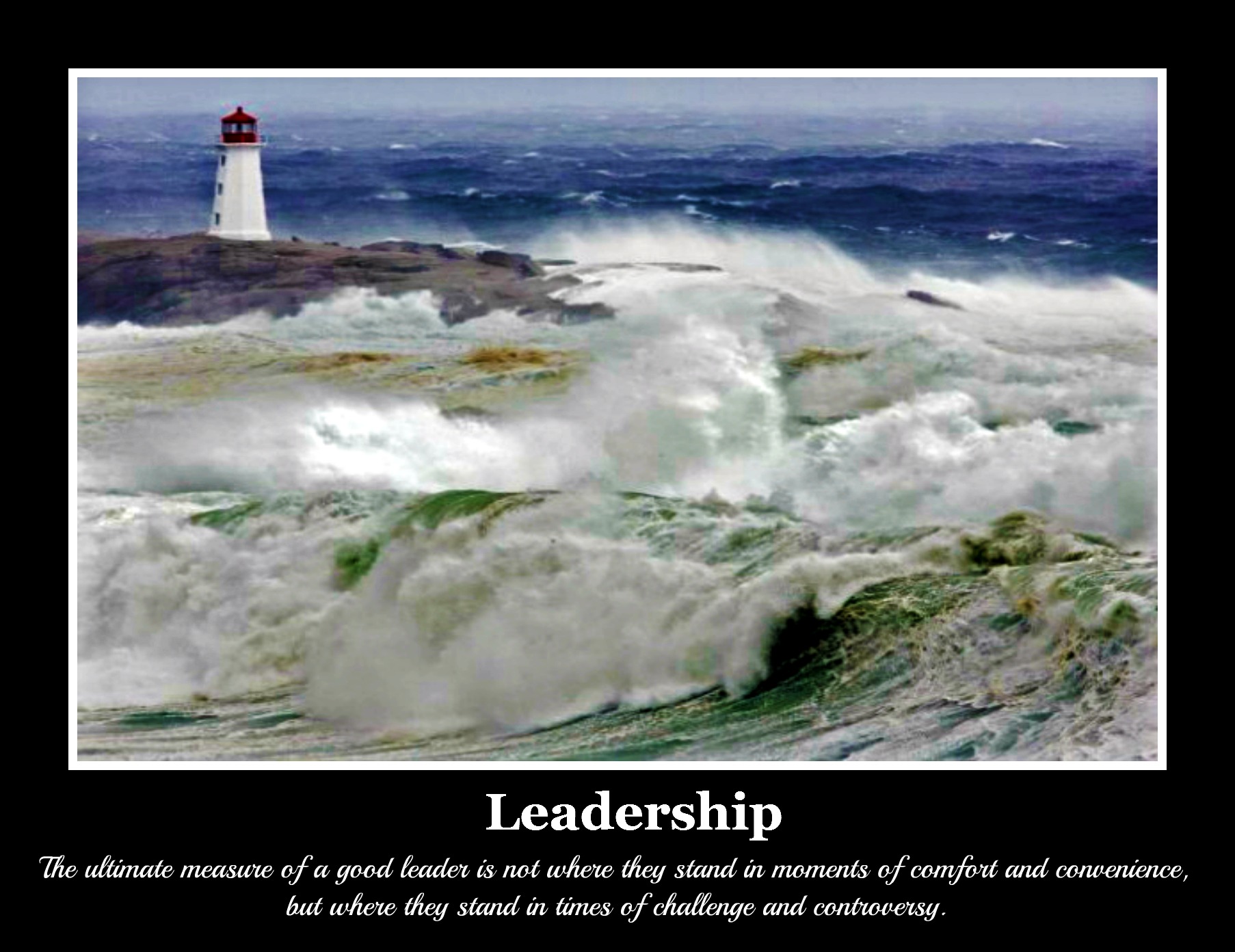
Leadership is a tough quality to define. When sports scouts look at a prospect, they classify leadership as an “intangible.” Leadership is definitely a quality, and while tough to define, it is a trait and you’ll be able to distinguish whether a person has “it” or not.
While leadership is certainly difficult to DEFINE, there are attributes that we can associate with signs of being a leader.
1. Visionary: A leader brings a vision to it’s group. It’s a plan by which others can FOLLOW. This vision brings the followers the emotion of hope and something the followers can strive to achieve. The vision should be clear and the leader should stand up for what the leader believes in.
“A leader is a dealer in hope” – Napoleon Bonaparte
2. Reliable: You don’t want to follow someone that shows up late or doesn’t do what they say they are going to do. In a leader, you want someone that’s reliable, with a message that people can follow. If leaders aren’t consistent in their efforts and their actions it causes followers to begin to doubt the dedication of the leader to the cause.
3. Audacity: It takes guts to be a leader. It’s not for everyone. Some people would prefer to tag along for the ride and that’s fine. Not everyone can or should be a leader.
4. Empowering People: Inherently, people want to do a good job. They want to succeed and make others happy. As a leader, you need to allow people to succeed. By empowering people, the leader isn’t doing the task for the person following the leader, but instead gives them the tools necessary to succeed.
5. Positive: ” A leader doesn’t need to be all about rainbows and sunshine, but there definitely needs to be a boost of positivity especially when tackling a difficult project or the “going gets tough.” An optimist sees the opportunity in every difficulty.” – Winston Churchill
6. Motivating: If you don’t have the previous characteristics, it certainly isn’t very motivating for the follower to follow the leader let alone do a great job. A leader needs a vision, otherwise people don’t have a map and tend to get lost.
I do know that the quote from John Quincy Adams remains key to this …”If your actions inspire others to dream more, learn more, do more and become more, you are a leader”.
“We’re in good hands, folks, real good hands. He cares about the people way up North, that we were trained our entire lives to ignore, trained our entire lives to hear not a word of what’s going on up there. And what’s going on up there ain’t good. It’s maybe worse than it’s ever been… It’s really, really bad, but we’re going to figure it out, you’re going to figure it out. It’s maybe worse than it’s ever been, so it’s not on the improve. (But) we’re going to get it fixed and we got the guy to do it, to start, to help.”
Sometimes things just align. And sometimes synergies and learning and lessons come from unusual places. The past few days have proven that. Two situations, seemingly unrelated have done exactly that.
During the past year and a half I have been working (with others) diligently on a very challenging, almost logistically impossible and ambitious Canada 150 project. I have met with naysayers, hit roadblocks and invested much time and energy in something that I believe in. The Canadian Arctic Aviation Tour 2017 would bring a chance for the people of Northern Canada to truly be part of Canada’s sesquicentennial in 2017. I have talked often of my understanding of the lives of the people of the North but in the past week I have learned I actually knew nothing. Through my first unexpected event I have become a part of the Facebook world of the small, isolated communities of the north. I have learned a lot that truly gives me a new lens for my work, learned that when someone is missing you can’t wait for search and rescue but the community rallies, when you want to make potato salad for your son’s birthday but have no mayonnaise you don’t run to the store but learn that your friends cousin had a jar and maybe they can help, and that every night there are auctions for what seem like easy to access items to us such as a package of Tang or 2 cans of pop. But even more importantly as I have entered their homes through this social media relationship I have been allowed to be part of I have seen the love, the resilience,the true sense of community but sadly the absolute isolation and often despair.
And then this…It has been a weekend of deeper understanding of this country and it’s people. As a long time Tragically Hip fan I was of course watching with millions of others with my tissues in hand as Gord Downey, my favourite poet, spoke to us through his music and his lyrics. But at the end of the concert when he turned to Prime Minister Trudeau and spoke the words above I knew that I would continue my efforts to bring the event I have worked so hard on to the amazing people of the North. Thank you Gord Downey for using your illness and your celebrity to be a social justice advocate for these people.
For myself I am changed forever by what I have learned from this project. A greater understanding and appreciation for ALL Canadians. The possibility of bringing hopes, dreams and opportunities to the people of the North outweighs any difficulty I may face in my efforts. I will continue to work on this amazing event always keeping in mind that it is not the destination but the journey! So…. ‘we are going to get it fixed’ but it isn’t just up to politicians folks. We must ALL have a part in this!
So I have no ‘resolutions’. A resolution seems to have no margin for error; it’s defined as a firm decision to do or not do something. Well there are days my friends that the resolve to perhaps not eat that amazing meal may just not be that important. I’m kind of flawed so I best scrap the perfection plan. Instead I will have things I will ‘challenge’ myself to do. Some may be outrageous and some will not be. In fact I have given a motto to one of my ‘challenges’ for this year; “The thing is so difficult I can not help but attempt it.” Others will be a little more ordinary. Can I allow myself to once again enjoy a love of reading? That is achievable. I just have to allow myself the time. I’m going to be less about more and more about less. If it can be said with less or done with less than so it will be. Will 2016 be my best year ever? Every year I have lived has taught me something and helped me to be the work in progress that I am. What I have learned in 2015 is that the value of family and friends is not cliche…it has in fact saved my life. So my 2016 new words to live by are ambitious and resilient while never losing sight of the ones that got me through 2015; dignity, purpose and most importantly hope.
So… It is 2 weeks till the Federal election and 3 weeks until the Alberta legislature opens. But today it is time for me to say something about the cesspool our electorate has decided to wallow in recently. I do not generally talk about partisan politics on my social media but anyone who knows me is aware I have fairly strong political views. No today is not the day I am going to suddenly speak out about who anyone should vote for. But I am going to speak out about what I have seen in the past number of months since the Alberta election and now during the Federal election. First things first; the economic crisis in Alberta and particularly related to Oil and Gas is a GLOBAL issue; not one caused by the prior PC government, nor exacerbated by the current NDP government. Could the PC’s have done some things differently? Possibly. Should the NDP be approaching this differently? Maybe. But the reality is that we actually don’t know what this Provincial government is going to do until the budget comes out and the Leg sits. So I’ll reserve on that until then. With regard to Federal politics what will be most important is that we all educate yourselves. Everyday I watch people post on social media what they indicate (and maybe believe) is accurate information. PLEASE check to see the source of that information. I can write a ridiculous story that is about one of the party leaders partying with the Pope on a spaceship, dress it up to look legitimate, post it on Twitter, hashtag the right people and within hours it would be shared thousands of times. No matter your views; look to authentic media and actual party information before sharing this propaganda. And please STOP the horrible attacks on people who do share their personal political views. The beauty of living in a democracy is that we can choose who we support but please don’t threaten, attack and malign someone for those views. In the words of the Dixie Chicks…
“It’s a sad sad story when a mother will teach her Daughter that she ought to hate a perfect stranger And how in the world can the words that I said Send somebody so over the edge That they’d write me a letter Sayin’ that I better shut up and sing Or my life will be over….”
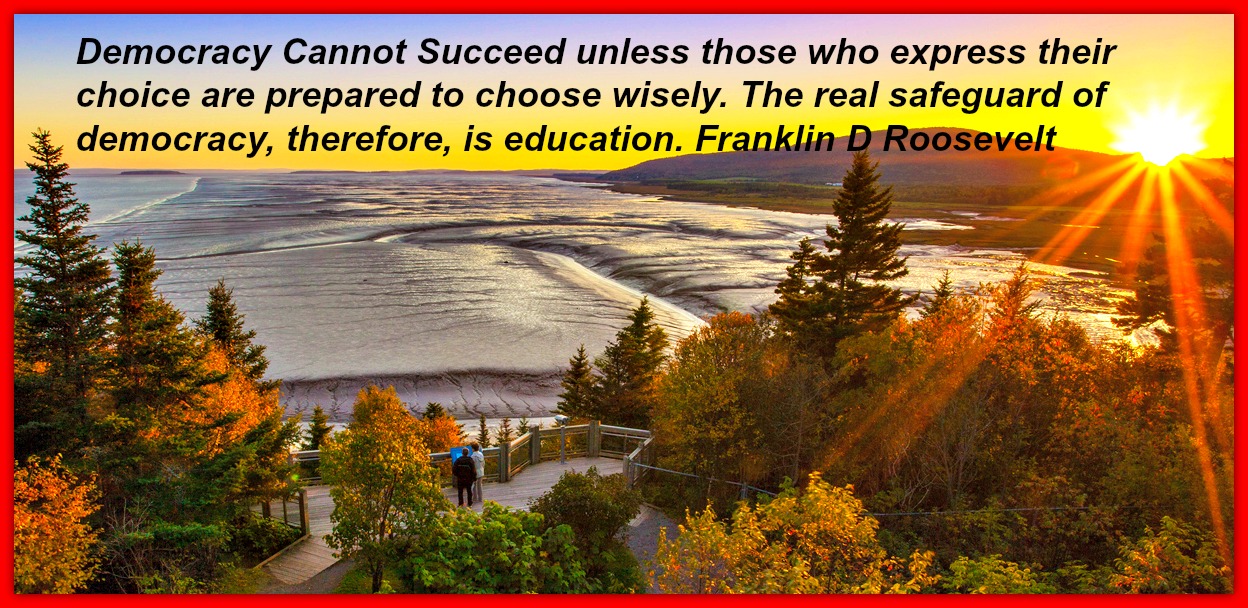
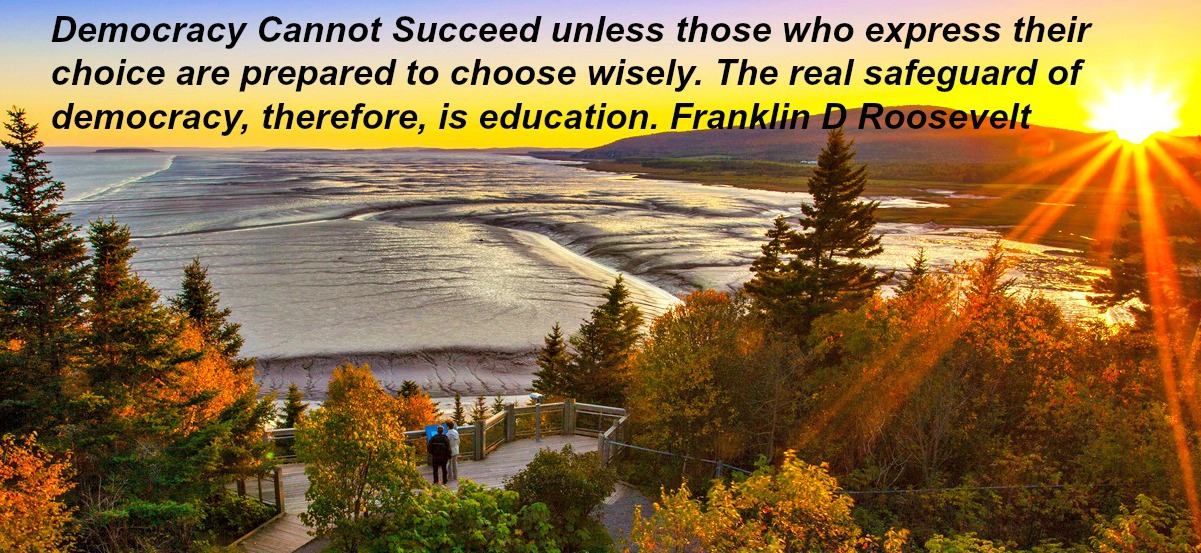
“Democracy cannot succeed unless those who express their choice are prepared to choose wisely. The real safeguard of democracy, therefore, is education. ” Franklin D. Roosevelt So let’s educate and inform ourselves about the choices available to us.





 Leadership is a tough quality to define. When sports scouts look at a prospect, they classify leadership as an “intangible.” Leadership is definitely a quality, and while tough to define, it is a trait and you’ll be able to distinguish whether a person has “it” or not.
 Nancy's Notes