The Noise Doesn’t Sleep

Posted: February 19, 2026 in Uncategorized

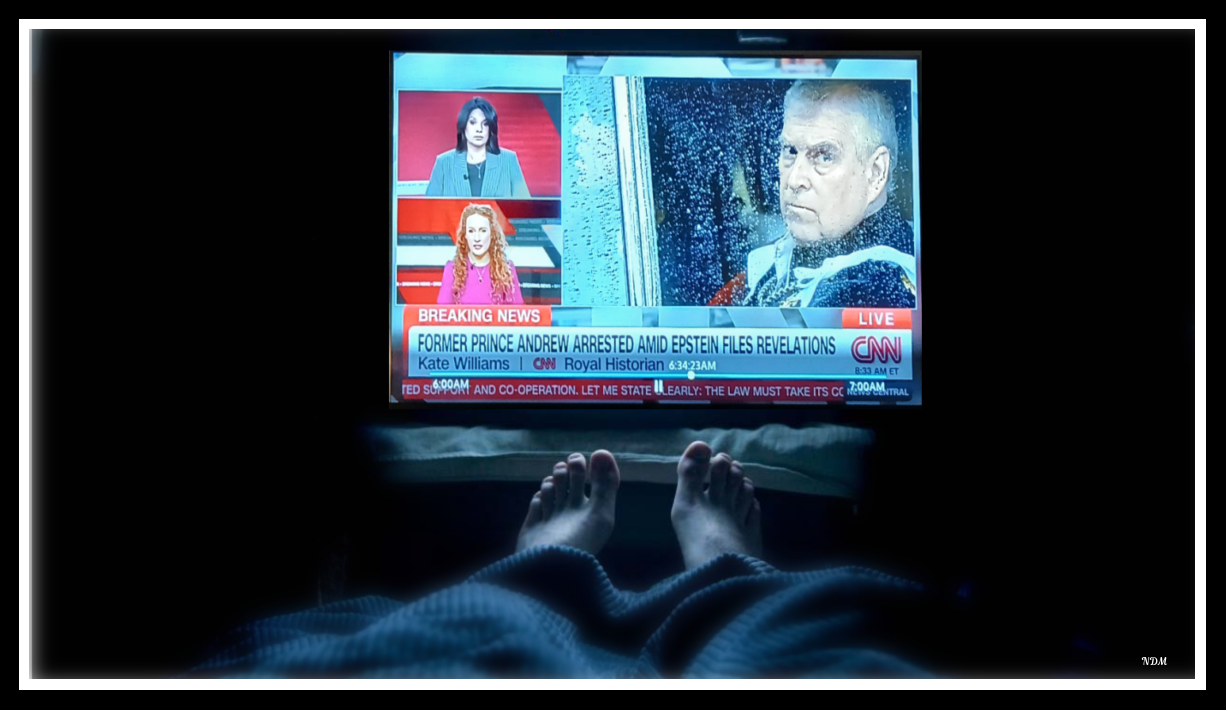
I fell asleep with the television on last night. Not a wise decision in a world that insists on making news while normal people are trying to rest.

At some point in the night, I woke up, not fully awake, not fully asleep, to voices drifting from the screen and two things lodging themselves firmly into my half-conscious brain.

The first: a report that former Prince Andrew had been arrested in connection with the Epstein case. Now, that is not something one processes at three in the morning with clarity, and I will save any deep dive for later, likely in a few days, after coffee, after facts, and after the fog of overnight headlines lifts. But in that strange space between sleep and wakefulness, one thought quietly surfaced: Well… at least somewhere, someone appears to be taking the Epstein file seriously.

Despite the light tone of this post, that matters. Encouraging, even. Though I will admit I hold no particular illusions about how such accountability would unfold in the United States. That, however, is a deeper conversation for another day, and it will come.

Because the second thing filtering into my brain was something entirely different, a dramatic advertisement announcing Donald Trump’s first State of the Union of his second term, scheduled for February 24th. And just like that, sleep was over. I stared at the ceiling, wondering how this could possibly be his first. The man has spoken, declared, rallied, commented, re-commented, repeated, and re-repeated so continuously that the idea of a “first” feels almost philosophical. At what point does constant talking simply become background noise?

Which, naturally, triggered the internal spiral. I have to watch it. No, I absolutely cannot watch it. But how can I write if I don’t watch it? But why would I watch when I already know the script?
But what if something shocking happens? But what if nothing does and I lose two hours I will never get back listening to applause on cue?

Clearly, we all know the choreography. The entrance, the aisle walk, the rising, the clapping, the camera cuts and the solemn nodding. The commentators already drafting their reactions before the first sentence is spoken. Somewhere between politics and theatre lives the State of the Union, part governance, part performance, part endurance test for the rest of us. And yes, I chuckle, because we are, undeniably, living in a ridiculous world.

It also made me think, inevitably, about leadership styles closer to home. Our Prime Minister communicates often, but not always with words, and sometimes more than people realize, yet without the theatrical drumroll. Fewer grand entrances, fewer standing ovations, more steady cadence. Less spectacle, more signal. Different style entirely. As I am someone who has never been accused of using too few words, perhaps there is a lesson in restraint. Then again, perhaps not. We all speak in our own rhythms. Some rhythms require fewer trumpets.

But politics never pauses for long, and yesterday delivered another reminder: the floor crossing in our own Canadian House of Commons.

This is not new. Floor crossings have happened many times since Confederation. Sometimes quiet, sometimes dramatic, always controversial. Conviction, strategy, timing, the explanations change, but the practice does not. Canadian parliamentary life has always included movement across the aisle.

What fascinates, as always, is the reaction. Courageous when it helps your side. Outrageous when it does not. A principled decision one moment, a betrayal the next, depending entirely on where one happens to sit. Canadian politics may be calmer than some, but it has never been free of irony.

And yet, today feels oddly light. Perhaps it is the snow outside, that deep winter stillness wrapping everything in quiet, like a kind of national chicken soup for the soul. The world feels softer in the cold. Headlines seem less sharp. Even political theatre feels, momentarily, muffled by falling snow.

So yes, this has been a lighter reflection than most. I did not expect to wake in the night to royal headlines, and that story, serious, complex, and far from finished, will deserve its own careful examination soon enough.

But for now, here at home, life continues. Snow ended and cold weather warning tempered with sunshine. Coffee is brewing and the television is still talking. The truth is on February 24th I will likely be watching that State of The Union address hands hovering over the keyboard, watching… or not watching… in this strange, serious, occasionally absurd world we all share.

Because in times like these, when the noise is loud, the snow is deep, and the theatre never really stops, sometimes the sharpest clarity comes not from outrage… but from a quiet smile, a steady pen, and the simple refusal to mistake performance for substance.

Wide Awake

Posted: February 17, 2026 in Uncategorized

Canada is not the same country it was even a few short years ago. The world has shifted, alliances are being tested, and the comfortable assumptions we once lived under are fading faster than many expected. Today’s announcement of Canada’s new Defence Industrial Strategy is not simply about military spending or procurement. It is about sovereignty, resilience, and understanding that defence is not just a cost of nationhood, it is part of its foundation.

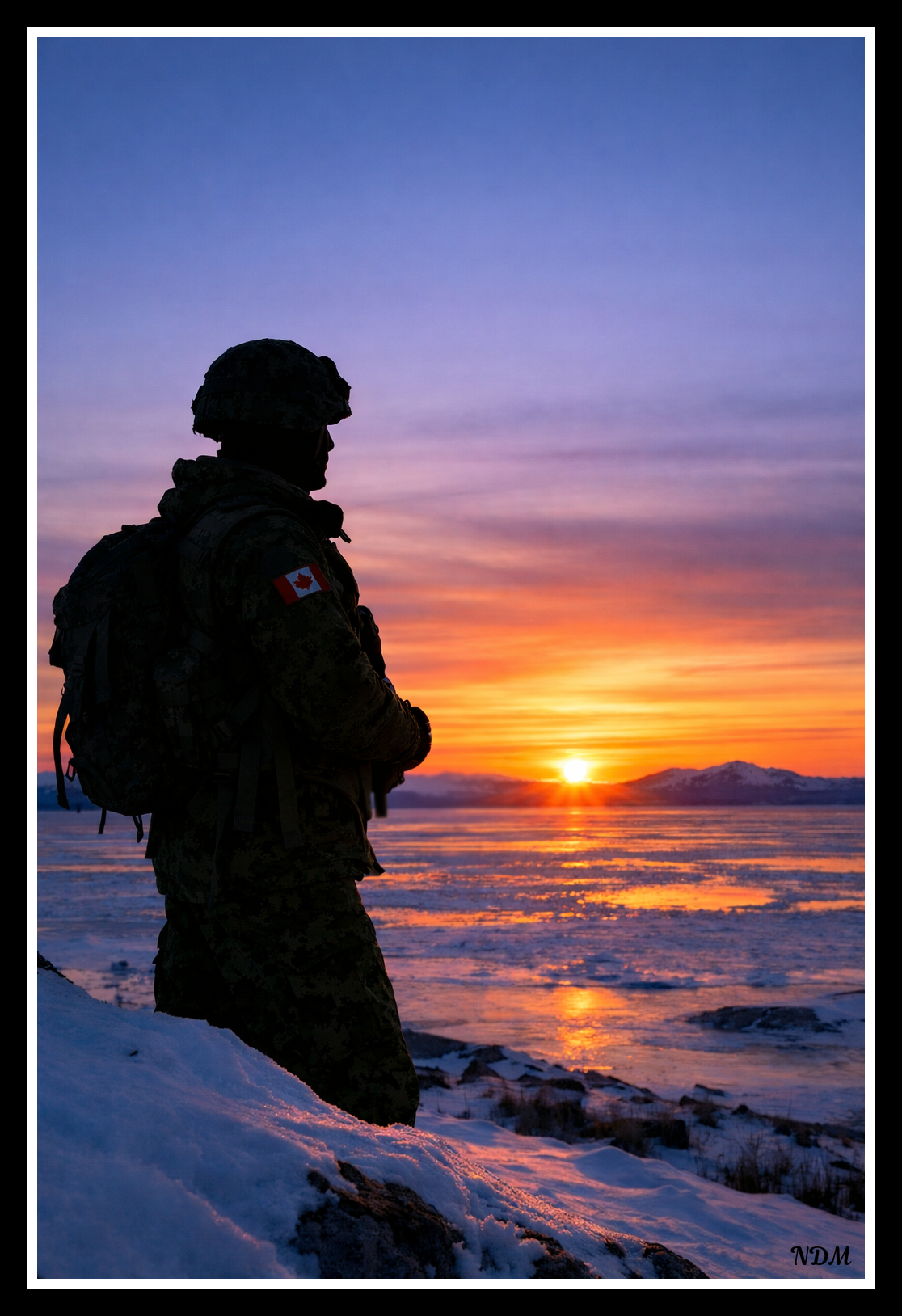
For most of my life, ‘defence’ was something Canadians rarely discussed. We spoke proudly about peacekeeping, diplomacy, and cooperation, but not about readiness, industrial strength, or whether the people wearing our flag on their shoulder had what they actually needed. That silence is ending, and it should.

Much of today’s public conversation gravitates toward what is visible and dramatic. Fighter jets capture imagination. The F-35 versus Gripen debate feels strategic, consequential, even exciting. But a military is not built on aircraft alone. It is built on systems that work, equipment that functions, and the quiet reliability of tools that must perform when everything else fails. A howitzer may not sound impressive. A serviced vehicle does not trend online. Functional communications do not make headlines. Yet these are the bones of readiness, and without them, nothing else matters.

For too long, too much of our equipment has simply aged. Ships, vehicles, bases, aircraft, and even the tools used by our reserves, some dating back generations, have been stretched beyond what should ever have been acceptable. Serviceability is not jargon. It is the difference between preparedness and vulnerability. When Canadians serve, whether at home, in Latvia, in the Arctic, or alongside NATO partners, they deserve equipment that works every time, not just eventually.

I often speak about aviation because it is part of my family’s story, but our connection to service has never been only about airplanes. In my family, there have been soldiers, artillery, pilots, water specialists (engineering corps) and others who served in ways that were not always visible but always essential. That lens shapes how I see this moment. A military is defined not by its most glamorous equipment, but by the strength of every piece working together.

This is why the philosophical shift matters. Canada is no longer focused solely on buying defence equipment. It is speaking about building it, sustaining it, and controlling it. Investing in Canadian industry is not isolation. It is sovereignty. A country that cannot maintain or produce the tools of its own defence slowly becomes dependent, and in today’s world, dependence carries consequences.

But sovereignty does not mean standing alone. The opposite is true. The phrase today that echoes most clearly through the press release and speech is simple but powerful: “like-minded allies.” In a world where the rules-based order is weakening and global instability is rising, who we stand with matters. Canada builds where we are strong, partners where collaboration strengthens us, and buys where necessary, always ensuring Canadian control and Canadian benefit. Strength at home, strength with allies. Both are required now.

That reality is especially true in the North. Canada’s Arctic is no longer a distant, quiet expanse on a map. It is strategic, contested, and central to our future security. Building real Arctic capability means thinking differently about mobility, surveillance, infrastructure, and sustainment in one of the most demanding environments on earth. It means readiness that reflects geography, climate, and the world as it is now.

When I supported Mark Carney last April, it was because the global environment was shifting quickly and Canada needed steady, serious leadership. What none of us could fully predict was just how turbulent that environment would become, nor how clearly Canada would begin repositioning itself within it. No leader delivers everything. No strategy solves every problem. But clarity, discipline, and purpose matter. Not reaction. Preparation.

This strategy is about more than defence. It is about confidence. It is about jobs, industry, innovation, and the realization that Canada can still build, still lead, and still stand firmly on its own feet while standing shoulder to shoulder with trusted partners. Defence capability and economic strength are not separate conversations. They are the same conversation.

Yes, fighter jets matter. Modern aircraft matter. But so do artillery systems, cyber capability, logistics, shipbuilding, space, and the steady rebuilding of readiness across the board. Real security is built piece by piece, system by system, decision by decision, alongside those who share our values and our resolve.

And here is the truth that now sits quietly beneath all of it.

Canada has woken up.

We no longer assume the world will remain stable. We no longer assume others will carry the burden. We are rebuilding readiness, strengthening sovereignty, and turning our attention north, where the Arctic is no longer just a frontier, but a defining responsibility. The realities of the North demand different thinking, different equipment, and preparedness that reflects the world as it is, not as it once was.

In my own life, when I choose the people I trust, the people I stand beside, they do not have to think exactly like me. They may challenge me, question me, even disagree with me. But they must share something deeper. Values, stability and reliability. A sense that when the moment comes, they will stand, not waver.

Nations are no different.

Canada will stand strong, build at home, defend its North, and move forward with “like-minded allies.”

And this time our beloved Canada is wide awake.

Did I Tell You?

Posted: February 16, 2026 in Uncategorized

On this Family Day, I found myself reaching back to Christmas 2011. My oldest son had just graduated high school, my youngest was finishing elementary school, and tucked in with their gifts was something far less exciting to young boys at the time, a poem that I had written them.

I am not sure it meant much to them then. But today, in a world that feels more complicated and demanding, those words feel different even to me. Maybe this is parenting. We plant seeds and hope that someday they take root.

The photos I am sharing are not of the men they are today; they would never agree to that, but of the little boys who once filled our home with noise and laughter. The boys who grew into two fine young men, I could not be prouder of.

We were never a traditional family. Eclectic, unconventional, a little unusual and perhaps that is exactly what family is meant to be. Through my strong opinions and very sharp views of the world, my family has always been there. They listen, they challenge, they tolerate, and somehow we remain anchored to one another.

Our children face a different world from the one we knew. More complex, more uncertain, more demanding. All any parent can do is hope they gave us something steady, a compass, a foundation, a quiet inner voice to guide us when the world feels loud.

Today, I am sharing the poem exactly as I wrote it. Not one word changed.

To My Sons…. Did I tell you?

Now that you are almost grown, I look back and ask myself….

Did I tell you all that I meant to tell you, all that I felt was important?

Did I tell you or was it lost in the shuffle of our everyday lives, the busy full days when I taught and didn’t know it. What did I teach? Was it strong? Was it good? Will it root you in something real that will allow you to grow with a firm and sound foundation?
Did I tell you to love, not with a fair-weather love, but with a love that accepts and cherishes unconditionally? Love not with a quick and passing love, but with a love that is a quiet peace within your heart.
Did I tell you to be thoughtful? Not to be a martyr or doormat to be trod upon, but to be aware of other people and their needs, to meet others with awareness and within your own framework be able to meet them halfway and on occasion go the other half joyfully.
Did I tell you to be courteous, not to display empty manners with no meaning but to live the courtesy born of caring? And to express this caring through the small formalities and customs born of the years.
Did I tell you to be bold? To be not afraid of the unknown, but to live life to the fullest, and meet each new experience with joy and anticipation.
And did I tell you to be cautious? To temper your daring and sense of adventure with good judgement and consideration.
Did I tell you to serve other people if only in a small way? There is growth and satisfaction in being part of something larger than yourself and your life will be richer for knowing this.
Did I tell you to maintain a sense of the past? To recall and uphold all that is best and meaningful in our country and in our society. But never be afraid to speak out where you don’t believe or where there is room for improvement. Work for what you believe, but work in a positive way within a structure of order and reason.
Did I tell you to find a part of nature that speaks to you then know it intimately and well. For some it is a mountain peak, for some a windswept beach. Find your own and in it find your restoration.
Did I tell you to laugh, to dance, to sing? There is a lot in life that is hard, but take it as it comes and find the good…and make time to dance.
Did I tell you to be creative and explore the seed within you? Find your creative spirit and let it grow.
And did I tell you the challenge of being a man-the challenge of balancing your worlds?- the need to achieve and the need to nurture-the need to be strong and the need to be tender-the need to meet the tests that life brings yet always keep love at the centre: letting it be the star by which you set your sail.
Did I tell you these things as we went along the way? If I did then I am humbly grateful. If I did not than you must choose for yourself. If it has meaning than accept it and make it your own. If it does not, discard it. Your life is yours to build as you choose
And did I tell you….That I hope it will be a good life

This Is Who We Are

Posted: February 14, 2026 in Uncategorized

For a few days, my writing stopped, not because there were no words, but because some moments demand silence before they deserve language. Canada has just lived through one of those moments. Like so many across this country, I have been trying to process the weight of it, the grief of it, the humanity of it.

Today is not about the tragedy itself. Today is about what rose in response.

Look at this image. When I first saw it, I thought it might be artificial, something constructed, something symbolic. But it is not. It is real. It is raw. It is what grief looks like when a country stands together.

In this photograph are leaders from different political parties, people who challenge each other daily, who disagree deeply, who debate fiercely. Yet here they stand, hand in hand, united not by ideology, but by humanity. In grief, in respect, in shared responsibility for the people they serve.

This is Canada. This is what Canadians look like when it matters most. We are a country shaped by distance, by cold, by hardship, by geography that has never made life easy. Survival here has always required resilience. But resilience alone does not define us. Compassion does. The choice to stand together does. The understanding that there is a time for debate and a time for unity does. And in this moment, unity came first.

Our Prime Minister reached across political lines. The Leader of the Opposition stood beside him. The Governor General stood with them. Leaders from different regions, with different perspectives and philosophies, came together to say one simple thing to a hurting community: Canada is with you. You are not alone.

It matters not just to those directly affected, but to every Canadian watching, and to the world beyond our borders. Because this is who we are when it counts. Not divided, or political. Just humans in shared grief.

Yes, the debates will return as they should. Democracy demands disagreement. But democracy also demands wisdom, and wisdom means knowing when the fight pauses, when compassion leads, when humanity must come before politics.

This image has already been shared widely, and so it should be. Not as a symbol of sorrow alone, but as a reminder of strength, of dignity and of a country that, in its hardest moments, still chooses unity over division.

Canada is sovereign, resilient, and compassionate.

And in this moment of grief, we are standing together.

I could not be prouder to be Canadian.

The world has long known this about Canada. But if anyone, anywhere, has forgotten, and for those who still do not recognize what civility and grace look like, consider this your reminder.

This Is Who We Are!!

Read The Menu Carefully!

Posted: February 11, 2026 in Uncategorized

Heather Cox Richardson wrote on February 9th something that made me stop and think. As she usually does. Many of you who read me already read her, and if you do not, you should. I am not a historian, nor am I a journalist. I am, at heart, a storyteller who tries to stay grounded in facts and lived reality. Heather Cox Richardson is the historian. She is one of the voices I turn to when I want to understand the deeper roots beneath today’s headlines. And in the past year, one name keeps resurfacing, a name many had barely considered until recently, yet now seems to echo constantly. William McKinley, the so called Tariff King, whose policies fused tariffs, economics, and expansion into a single driving force. Geography followed advantage. Power followed usefulness. And within that machinery sat Puerto Rico.

Puerto Rico was never brought in as an equal. It was absorbed as useful. Yes, Puerto Ricans are American citizens, but Puerto Rico is not a state, it is a territory. Its people cannot vote in presidential elections. They live inside the system, yet without full voice. Citizens, but not treated as equal citizens. Governed, yet not fully represented. Included, but not equal. That reality has never fully disappeared, and it continues to shape how Puerto Rico exists within the American structure today.

Then came the modern reminder. Bad Bunny. I am not here to analyze a halftime show, that is not the point. The point is the reaction, the insistence from some that he is “not American.” A man born in Puerto Rico, a U.S. citizen, still viewed by some as outside, as less than, as not fully belonging. This is not about music. It is about hierarchy. It is about how systems decide who is fully included and who is simply useful.

When I think of Puerto Rico, I think of a beautiful Caribbean island that has too often been mistreated, overlooked, and controlled without equality. And that reflection leads somewhere important. An 1898 edition of Harpers Weekly once showed Uncle Sam plucking “sugar plums,” the desired fruits of empire. They were not candy, they were land, resources, and strategic footholds. Those sugar plums did not vanish, they changed geography, and the gaze moved north.

Today, the desired fruits look different. Oil and gas, fresh water, critical minerals. hydropower, the Arctic including The Northwest Passage. Strategic geography and strategic leverage. The map changed, but the instinct did not. Usefulness first, equality optional. And that is where this conversation reaches Alberta, and ultimately all of Canada. To those Alberta separatists who imagine advantage, strength, or special standing by moving closer to power, look again at Puerto Rico, not symbolically, but practically. A place valued for what it provides, not empowered for what it is, governed within a structure where decisions are made elsewhere, for interests beyond its own.

So let us make this simple. Imagine a restaurant. From the outside it looks exciting, successful, irresistible. You read the reviews carefully and notice a pattern. Only certain people are treated well, others are tolerated for what they bring. Some leave respected, others leave diminished. Would you still go, convincing yourself your experience would be different, that you would somehow be welcomed as an equal. Look again at the sign on the door. It does not say Partners, it says Suppliers. And once inside, you are not seated at the table, you are on the menu.

Heather Cox Richardson does not write about the past to stir nostalgia, she writes to reveal continuity. Tariffs were never just economics, expansion was never just geography, and power has always moved toward what is useful. Trump did not create this instinct, but under this administration the pattern is no longer subtle, and now Canada, in all its regions and resources, is increasingly viewed through that same lens.

The sugar plums of 1898, the desired fruits of that era, did not disappear. They transformed into the resources most valuable today. Energy, water, minerals and access to new geographies, gateways and futures. So Alberta before anyone imagines strength remember it will be without equality, sovereignty without control, and belonging without respect. I implore you to remember that simple truth. And as Mark Carney warned at Davos, if you are not at the table, you are on the menu.

Some research is conducted in laboratories. Some in boardrooms. And then there is the kind conducted from a lounge chair beside the ocean in Mexico, notebook in one hand, listening while the world talks when it thinks no one is studying it. The tide rolls in, the tide rolls out, and along the shoreline patterns form, shift, and sometimes disappear altogether. Over time, even the most unscientific observer begins to notice movement.

Over the past eighteen months, and more specifically across five separate visits to Mexico, through a series of entirely informal and definitely non-scientific conversations, I found myself repeatedly asking the same three simple questions. How do you feel about your president right now? Do you think your president thinks about Canada, and if so, how? And finally, what comes to mind when you think about Canada today? Not exactly Ipsos-level methodology, but surprisingly effective somewhere between the second coffee and sunset.

The conversations spanned five touch points. June 2024, October 2024, June 2025, October 2025, and now February 2026. The demographic was never intentionally selected, yet remarkably consistent. Predominantly age fifty-five plus, roughly sixty-five percent Caucasian, twenty percent Latino, fifteen percent Black. Mostly Canadian and American, with a scattering of Europeans who wandered into conversational orbit, often unintentionally becoming part of the “study.” Not a perfect sample, not even close, but a consistent one. And consistency, even poolside, tells a story.

What emerged was not statistics, but stages. Emotional and perceptual stages. Something between disbelief, adjustment, and political whiplash. Like footprints in the sand, each stage left a trace of where people stood at that moment in time.

Let us call them the Five and a Half Stages of Political Reality.

Stage One: The Comfortable Dismissal (June 2024)
Concern existed, but belief did not. People spoke about political upheaval the way one speaks about a distant storm over the horizon. Interesting, perhaps troubling, but surely not coming this way. Canadians continued buying winter escapes in Arizona and Florida. Americans spoke in hypotheticals. Nothing felt imminent. Nothing felt irreversible.

Stage Two: The Nervous Chuckle (October 2024)
The numbers tightened, and the tone shifted. Jokes became thinner, laughter shorter. Surely, people said, this could not actually happen. Surely the system would hold. Canadians still travelled south, though conversations carried a new edge. Americans began speaking less in hypotheticals and more in probabilities, though still wrapped in disbelief. Trump wouldn’t be that bad.

Stage Three: The Quiet Realization (June 2025)
The hypothetical became reality. The tone did not explode. It sank. This was not outrage. Canadians began saying, I will still go to the U.S. for now, but perhaps not forever. Americans spoke more cautiously, often lowering their voices, as if the political climate had become something navigated rather than debated. Geography began to matter. Border states sounded different from southern states. Urban voices differed from rural ones. Certainty was fading.

Stage Four: The Settled Shock (October 2025)
Realization hardened into acceptance, though not comfort. Canadians who once said they would “wait and see” began saying they would “wait, but not invest.” Some stopped travelling south. Some quietly sold property. Not dramatically or angrily but rather decisively. Among Americans, something unexpected appeared. Fatigue. Not necessarily political opposition, but exhaustion. The emotional volume dropped, yet the weight increased. Even casual conversations began sounding less like debate and more like reflection.

Stage Five: The Reflective Discontent (February 2026)
And now we arrive at the present, sitting beside an ocean that keeps rewriting the shoreline. Across conversations among travellers who vote, who pay attention, who historically leaned conservative, one pattern stands out. Contentment is rare. Pride sounds quieter. Uncertainty sounds louder. Vermont does not sound like Wisconsin. Wisconsin does not sound like Texas. Yet across geography, a shared unease hums beneath the surface.

Three distinct lenses emerged. A Canadian lens, reflecting reaction and changing cross-border behaviour. A European lens, observing from a distance with growing disbelief. And an American lens, revealing not just opinion, but something resembling evolving voter intention and emotional reassessment. This was never polling, but it was unmistakably movement.

Among Canadians, there is a clear alignment with our current national leadership and a growing discomfort with the direction of American leadership. What began as watchful patience has, for many, turned into quiet decision. Fewer winter homes, fewer long stays and fewer dollars flowing south. It’s still not loud nor dramatic. But it is deliberate.

Europeans observe from a distance, no longer trying to interpret, no longer trying to persuade. They watch, they shake their heads, and they move on, often with the calm certainty of people who have already made up their minds.

But it is the American conversations that feel most significant.

From Vermont to Wisconsin to Texas, across geography and ideology, something deeper is shifting. Not slogans. Not outrage. Recognition. A quiet understanding that this is not the country they imagined for themselves. A desire, sometimes whispered, to return to something steadier, something recognizable, something that once allowed them to celebrate their nation rather than explain it.

And perhaps that is the unwritten stage now forming. Not denial, shock or fatigue. Something closer to rediscovery.

The tide is still moving, quietly reshaping the shoreline one small shift at a time. Old footprints fade, new ones press forward, and without announcement the path begins to turn. Across conversations, across geography, across doubt and fatigue, something unmistakable is happening. More Americans are no longer standing still, no longer looking backward, but beginning to choose where they want their country to go next. The direction has changed and this time, they know it.

The Weight Of Remembering

Posted: February 5, 2026 in Uncategorized

It has been another one of those weeks away from the pen. Not because there is nothing to write about. Quite the opposite. There is too much. Too many headlines, too many fractures and too many moments where you stop, look at the world, and realize you cannot quite hold all of it in your head at once. But here we are.

Last night, I was in an elevator in Mexico. As I often do, I asked where people were from. Part curiosity and part instinct. Sometimes it stays light. Sometimes it does not. This time, it did not.

My elevator companion was from the Edmonton area. Ninety years old. Well put together. Clear eyed. The kind of woman who has lived long enough to choose her words carefully. She asked how I felt about what is happening in Alberta. I told her the truth. It breaks my heart.

She began to cry. Deep, uncontrollable sobs. She spoke about having lived a long life believing the world was moving, however imperfectly, toward something better. That there would come a time when she could look at the future her children and grandchildren were inheriting and feel some peace. Instead, she finds herself watching conversations unfold that she never imagined would be happening in Canada, let alone in Alberta.

When the elevator doors opened, she was still crying. She sat down in the lobby, visibly shaken. I sat with her.

That is when she told me her family’s history. Her parents were killed by the Nazis during the Holocaust. She said the story of how she survived is long and painful. She did not tell it and I did not ask. Some histories are not meant to be unpacked between strangers. They are meant to be carried.

What she was grieving was not policy or politics. Not a single moment or issue. It was the feeling of watching memory thin. Of sensing that the lessons paid for in human lives are beginning to feel distant to people who never had to carry them. That what once felt unthinkable is now sometimes spoken without hesitation.

Later, I was sitting by the pool with a couple from Winnipeg that I have come to know over the past few days. He and I talk easily, loudly, about everything and nothing. His wife is quieter, observant. She has been reading a book I had heard about for years but never opened. Sapiens.

So I downloaded it. I am early into it, and parts may be debated forever, but the core idea stayed with me. Humans did not survive because we were the strongest. We survived because we cooperated. Because we created shared stories, shared meaning and shared understanding of belonging.

Those shared beliefs allowed strangers to trust one another. To build communities. To imagine a future beyond themselves.

But every step forward carried a cost. Agriculture brought stability, but also hierarchy and ownership. Structure created order, but also distance. As societies grew more complex, we began to live inside systems of our own making, sometimes forgetting the human purpose beneath them.

I often write about policy and politics. That is where the arguments usually live. But the woman in the elevator was not grieving politics. She was grieving something more fundamental. The slow erosion of connection. The fear that we are forgetting what binds us to one another in the first place.

Before we were provinces or parties or positions on a map, we were people who survived by staying connected. Canada has always drawn strength from that understanding. Not sameness, but belonging. Not agreement on everything, but a shared commitment to one another.

Alberta is part of that story. So is every other corner of our country. And perhaps what many are feeling right now is not rage, but sorrow. Not division, but fear of losing something deeply human.

This post may read as quieter than some of what I usually write. That is intentional. It does not speak to the specifics of what is unfolding in Alberta, in the United States, or in other parts of the world right now. What it speaks to is the ground beneath all of it. The conditions that allow these moments to take hold in the first place. But make no mistake, the time for anything but clear and bold words is almost gone.

My tone will be stronger in the coming weeks. When history starts to feel abstract, people get bold in all the wrong ways. They say things out loud that once lived only in whispers. They drift toward ideas earlier generations buried for a reason. I see it creeping into conversations at home, surfacing across Canada, and echoing far beyond our borders. And the woman in that elevator reminded me that none of this is theoretical. Memory exists because it had to. Because someone survived long enough to warn us.

And some warnings are not meant to fade quietly into history. They are meant to be remembered, clearly, while we still have the choice to listen.

When the bough breaks…

Posted: January 27, 2026 in Uncategorized

Yesterday, my trigger didn’t come from a headline or a breaking-news banner. It came from something far more ordinary. I was doing business work, half-listening to a representative from an energy company in North Carolina, somewhere near Raleigh. He was talking about their storm response, freezing rain, infrastructure damage, and restoration timelines. The kind of technical conversation that usually fades into the background.

At one point, he mentioned crews coming in from Canada.

I stopped for a moment. Of course they’re coming in from Canada. Because that’s what Canada does. That’s what Canadians do. We show up. We send people. We help stabilize systems that aren’t ours, even as words coming out of the White House question our motives, our sovereignty, our usefulness. Even as we’re talked about like a problem instead of a partner.

I shook it off and went back to work. And then he said something else. “The thing about ice is that it continues to cause problems after the storm has passed.” He was talking about freezing rain; actual ice. Not politics, uniforms or ideology. The physical aftermath of a storm that looks finished but isn’t.

And that’s when my hands stopped for real. Because that sentence describes exactly where we are. Over the past few days, words from the White House have led some people to believe the worst might be over. That the temperature has come down. That the tone has shifted. That maybe the storm has passed.

But a lull is not repair. A pause in the storm doesn’t undo the damage already done. And when pressure has been applied long enough, the real question isn’t whether the noise stops. It’s what breaks afterward.

We keep being told to calm down. To stop overreacting. To trust that nothing is really going to happen. That this is all hyperbole, whipped up by traditional media, by content creators, by liberals, by left-wing radicals, by anyone who apparently still possesses a functioning frontal lobe.

I understand how hard it is to be objective about your own country, your own politics, your own leader. I get that. Truly. But an awful lot of rational minds outside the United States, outside the immediate circle of influence of the White House, are seeing this very clearly including our prime minister.

Storms are obvious and loud. Storms are speeches, threats, executive orders, chaos by design. Storms dominate the news cycle and exhaust everyone at once.

The aftermath is different. The aftermath is a consequence. It’s what quietly and invisibly weakens systems until something gives days or weeks later. Power lines fall when the sun comes out. Trees collapse when the wind has died down. Trust fractures long after everyone thinks it’s safe again.

But this storm met a person. Not a uniformed soldier on a battlefield. Not a politician. Que to the image of a registered nurse standing in a VA hospital. Someone whose life was defined by care, by empathy, by service without grandiosity.

When Alex Pretti spoke these words in 2024, he was honoring someone else. “Today we remember that freedom is not free. We have to work at it, nurture it, protect it, and even sacrifice for it. May we never forget and always remember our brothers and sisters who have served so that we may enjoy the gift of freedom. In this solemn hour, we render our honor and our gratitude, onward in gratitude.”

He was not speaking about himself. He did not wear a uniform. He was not imagining martyrdom. He was expressing a shared moral understanding that once anchored the free world. That service creates obligation. That sacrifice demands protection. That freedom depends on care as much as courage.

What makes this moment so painful is not that those words were meant for him. They were not. It is that the values he spoke about collided with systems already under strain, and he paid a price for failures that were never his to carry.

This was not destiny. It was not inevitability. It was the moment when accumulated pressure met a human life.

This may have been when the bough broke. It may be not just the storm itself, but the point where long ignored stress finally snapped something visible. The moment when people could no longer pretend the danger was abstract, exaggerated, or safely contained.

This isn’t just an American question. Is this something people in Canada can see? Can we see how democracies don’t fail all at once, but through accumulation on the branches? Through normalization? Through believing that once the noise quiets, the danger has passed?

It is almost unbearable to consider that the moment when something finally shifted could be associated with someone so empathetic, so grounded, so unwilling to center himself.

Alex Pretti did not live with grandiosity. He lived with care. And if his murder becomes a turning point, it will not be because he was meant to carry that burden. It will be because the free world failed to reckon with the ice that was already accumulating on the branches.

As a Canadian, this lands deeply. We understand winter as a long game. We know that surviving the storm is only half the work. The rest is dealing with what’s been weakened underneath, economically, diplomatically, psychologically. And as someone who has lived through real crises, I know this truth in my bones. The absence of immediate danger does not mean safety has returned.

The storm easing is not the end of the risk. It’s the moment when you find out what broke.

Read It Again

Posted: January 25, 2026 in Uncategorized

When something happens in a faraway land, it is tragic. When it happens in your neighbour’s community, it feels different. And when that neighbour starts telling you they are taking over your house and you have no choice, you had better stop pretending this is theoretical.

Listen carefully. We are hearing the same warnings over and over from content creators, journalists, historians, and political leaders. Maybe it feels repetitive. Maybe people are getting numb. But repetition becomes necessary when the lesson is not sinking in.

George Orwell wrote in 1984: “The Party told you to reject the evidence of your eyes and ears. It was their final, most essential command.”

I know we are hearing this quote a lot lately. That is not because it is fashionable. It is because it is applicable. So please read it again and then again.

If you need evidence, look at what happened in Minnesota yesterday. Then listen carefully to the words that followed from leaders in the United States. The gap between reality and narrative is no longer subtle. It is deliberate.

Another Orwell line should be ringing loudly right now: “Freedom is the freedom to say that two plus two make four.” And yet we are being told that two plus two equals whatever number is politically convenient. Whether it is job numbers, accountability, violence, or blame, facts are not being debated. They are being overwritten.

This may be the most chilling Orwell quote of all: “Power is not a means; it is an end. One does not establish a dictatorship in order to safeguard a revolution; one makes the revolution in order to establish the dictatorship.” Read that again.

Because the chaos and distraction we are living through are not accidental. They are not about solving a border issue. They are not about safety or order. They serve one purpose: to keep people in a constant state of disruption and fear.

When human beings are traumatized, even on a small, personal scale, our ability to think clearly is impaired. Multiply that by millions. Make it daily. Make it international. This is not just political turmoil. It is collective psychological stress. And when people are overwhelmed and emotionally flooded, they stop being able to discern. They stop being able to focus long enough to demand accountability. That is not a side effect. That is the point.

Not everyone has read George Orwell’s 1984 or Animal Farm. Not everyone has read Margaret Atwood’s The Handmaid’s Tale. But you do not need to have read dystopian literature to recognize it when you are living beside it. What is happening in the United States does not stay in the United States. Canada is not a spectator. The democratic world is not a spectator.

What happened in Minnesota was horrific. Alex Pretti should not be reduced to a political caricature or erased by a false narrative. Alex Pretti was a caregiver. Alex Pretti’s life was defined by service. The image of Alex Pretti standing in his scrubs beside a flag-draped coffin on a gurney at a VA hospital, honouring one of his patients, should be seared into our collective memory. That image tells you who he was. The lies that followed tell you who others have chosen to be.

I do not understand guns. I have never understood the obsession with them. But when the right to bear arms is invoked to justify fear, escalation, and death, how do its loudest defenders reconcile that with the outcomes they normalize? How do politicians distort the truth and smear a dead man without recognizing they have crossed from ideology into moral collapse?

Back to Orwell again, this time from Animal Farm: “All animals are equal, but some animals are more equal than others.” That is always where this road leads.

I tried to look at this objectively. I took off the anger and asked myself what I might be missing as I watched the videos from yesterday. I found nothing that justifies what we saw, or what we were told afterward. Nothing.

So I will end with this.

To my United States readers, and to my Canadian readers who support what the U.S. is doing right now, I am asking you, sincerely and urgently, to rethink where this road leads. The constant crisis and constant fear are not making anyone safer. They are making all of us less human.

For the sake of democracy. For the sake of truth. And yes, for the sake of humanity itself, please pay attention!

Canola In The Crossfire

Posted: January 24, 2026 in Uncategorized

I was already working on a post about China this morning. That was the plan. Then, as I was writing, Donald Trump did what Donald Trump does. He once again referred to Mark Carney as “governor,” reviving the 51st-state nonsense, and followed it with a threat of 100 percent tariffs if Canada continues to trade with China. So the ground shifted, and the post shifted with it.

Not because this is new. Not because Canada suddenly discovered China exists. But because there is a persistent bit of foolishness in this country, the idea that Canada has somehow never traded with China before, that any engagement now is reckless, ideological, or a betrayal of who we are. It isn’t.

This is the same Donald Trump who endlessly brags about his “great relationship” with Xi Jinping. The same Donald Trump who boasts about his negotiating prowess and his China deals. The same Donald Trump who presided over one of the largest trading relationships in the world between the United States and China, tariffs and theatrics notwithstanding.

When the United States trades with China, it’s framed as strategy.
When Canada does it, suddenly it’s betrayal. This is not principle. It’s intimidation.

Before we spiral into talk about communism and selling out, it’s worth grounding ourselves in some basic facts.

Canada’s trade relationship with China is not new. By 2017 and 2018, China was Canada’s second-largest trading partner. Canadian exports of goods to China were in the range of twenty-five billion dollars a year. Agriculture and agri-food alone accounted for roughly seven to nine billion dollars annually, driven largely by canola, pork, beef, peas, barley, and seafood.

That relationship did not collapse because Canadian farmers or producers suddenly became reckless. It collapsed after political events, including the 2018 arrest of Huawei executive Meng Wanzhou in Vancouver at the request of the United States, and the retaliation that followed. Canadian producers paid the price for a dispute they did not start.

So when people on the Prairies pay attention to renewed conversations about canola or beef access, it isn’t because they’ve embraced some ideology. It’s because they remember what it cost when those markets disappeared.

There is also a lot of loose talk right now about communism, as if trade itself is an ideological conversion. It isn’t. Canada has managed complicated trading relationships for decades without becoming something it is not. Re-engaging with China under defined terms is not a sudden shift in values. It is a response to reality, particularly at a moment when relying on a single market has become increasingly risky.

And this is where we need to remind ourselves of the “one customer” problem for everyone in Canada. Relying on one customer is like living in a town with only one grocery store. As long as the shelves are full and prices are reasonable, it feels fine. You tell yourself it works. But the day prices jump, or certain items disappear, or the store changes the rules, you don’t suddenly gain options. You just feel the squeeze because there was never a backup.

We’ve known this for a long time. We just preferred not to test it.

I’m very connected to the oil and gas sector, so these conversations aren’t theoretical for me. Just the other day, I spoke with someone who would fit comfortably into what I’d call the Maple-MAGA camp. He was eager to tell me two things. First, that he had proudly signed a separation petition. Second, how angry he was that Canada was “courting a communist country” by talking to China. What he did not seem to register, even as he said it, was that the oil and gas company he works for is one hundred percent Chinese-owned and has been operating in Alberta for quite some time. But the point isn’t the individual. The point is how easy it is to live inside a political story that feels emotionally satisfying while being completely disconnected from the economic reality we already participate in every day.

And this isn’t an isolated case. Chinese investment in Canada’s oil and gas sector, particularly in Alberta, has been significant for well over a decade. At its peak in the early 2010s, Chinese state-owned companies invested tens of billions of dollars in Canadian energy assets. While new investment has slowed, Chinese-owned and Chinese-backed companies continue to operate in Alberta today, approved by successive federal governments, including Conservative ones.

None of this is secret and none of it is new. Mark Carney did not ruin Canada’s relationship with the United States. Donald Trump did not wake up angry today because of canola or beef. He is angry because Canada acted like a country with choices. He lashes out when he doesn’t get his way. He uses tariffs as a weapon, not a policy tool.

My intention this morning was to go deeper into the numbers and the longer arc of Canada’s relationship with China. I was already working on that. But the option to take my time disappeared the moment Donald Trump decided to threaten Canada for doing what the United States itself continues to do.

So this isn’t the post I planned. It’s the one the moment demanded.

I’ll say this plainly. China would not be my first choice as a trading partner if the world were tidy and predictable. But I live in the real one. And in the real one, Canadians still need food on the table, paycheques protected, and an economy that isn’t held hostage to one man’s temper.

Donald Trump’s statement this morning is just the next distraction. He doesn’t want to talk about ICE today. He doesn’t want to talk about pressure at home or slipping public support. So he creates noise and distraction as he always does.

And that’s why anyone who thinks Canada can “lock in” a deal with him right now is fooling themselves. There are no deals. There are only temporary pauses until he decides otherwise, usually late at night, with a phone in his hand and an audience on the other side of the screen.

So yes, Canada has to pivot. And frankly, so do the rest of us. Because protecting this country right now means telling the truth even when it’s messy. It means acknowledging risk instead of pretending loyalty will save us. I am not being alarmist. I am being realistic.
And that’s what truth to power looks like now.