


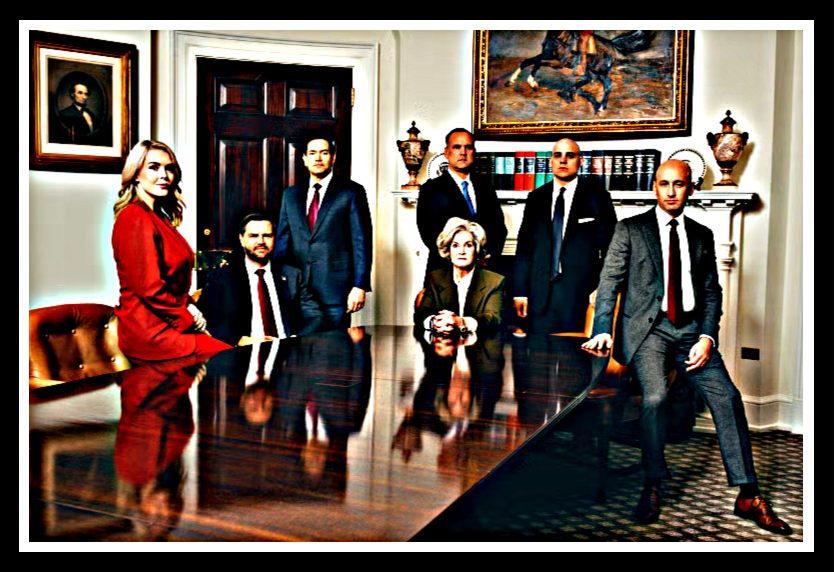
I’ve spent a lot of time lately writing about things that are heavy, personal, and deeply consequential, and while that’s not going to change, every now and then I need a different kind of mental exercise. Something a little lighter and a little more entertaining. Something that reminds me why I enjoy paying attention in the first place. This Vanity Fair photo series does exactly that, because underneath the outrage and the hot takes, there’s something genuinely interesting going on here about strategy, image, and what happens when political presentation is stripped down to its bones.
None of this was accidental. The photographer, Christopher Anderson, wasn’t sprung on the White House without warning. His work was pre-approved. His bio was known. His style was known. He has made a career out of shooting very close images. Close enough to remove the usual polish, and Vanity Fair’s editor described the work as an attempt to cut through what Anderson himself has called the “theater of politics.” So the shock some people are expressing now feels, at best, selective.
Listening to pundits dissect the images, what struck me wasn’t the outrage so much as the misreading. These weren’t meant to flatter, and they weren’t meant to humiliate either. They function more like scans. Almost like x-rays. Not images designed to reassure, but images designed to show what’s there once distance, lighting, and control are no longer doing the work for you.
I’ll admit something here. On a purely emotional level, this delights me. There’s something deeply satisfying about watching people who spend their lives managing image and narrative suddenly confronted with a lens that refuses to play along. Not cruelly nor theatrically but rather precisely. Anderson’s brilliance isn’t just technical; it’s strategic. He shows them not as caricatures, but as they are when the scaffolding is removed. And for someone who pays close attention to power, messaging, and performance, that kind of clarity is genuinely enjoyable to witness.
Take J.D. Vance, photographed against a wall that quietly provides visual reference points. It’s subtle, but it matters. A way of grounding scale and proportion for someone who has spent a great deal of time rhetorically inflating his own presence. The photograph doesn’t argue, doesn’t editorialize, and doesn’t correct him. It simply measures and lets the viewer connect the dots. With these references it is easy to measure his true height.
And then there’s Karoline Leavitt, which is where the conversation predictably veered off course. Yes, you can see evidence of cosmetic work. So what. That’s neither shocking nor particularly interesting. What is interesting is what Anderson didn’t do. He didn’t soften. He didn’t blur. He didn’t smooth away the human texture that appears on every face when a camera gets this close. Anyone who has ever been photographed at that distance knows that skin behaves like skin.
It’s worth noting here that the image you’re looking at has had an HDR filter applied, and you can feel the difference right away. That small change alone alters clarity and mood, which is worth keeping in mind when we talk about what a photograph is, and isn’t telling us. Even light intervention shifts how an image reads, which only underscores how deliberate Anderson’s original choices were.
The result, even so, is striking. She’s 28, but she reads older, not in years but in bearing. Almost matronly, in the sense of discipline rather than age. This isn’t a face inviting dialogue; it’s a face trained for delivery and repetition.
Which brings Donald Trump into the picture, even when he’s not in the frame. Because he has publicly praised Leavitt not just for her performance, but for her appearance, focusing obsessively on her lips and how they “move like a machine gun.” Placed next to this image, stripped of gloss and distance, that comment lands differently. Less like admiration and more like a functional assessment. Less about judgment or insight, more about output.
This isn’t a beauty image. It isn’t about youth or glamour. It’s about role. Should I bother to mention the slight orange tinge to her nose?
Politics usually depends on illusion. In photos using flattering angles, soft light and careful distance. These photographs decline to participate in that bargain. They don’t demean anyone, and they don’t exaggerate. They simply remove the padding and let the structure show. An x-ray doesn’t flatter you, and it doesn’t insult you either. It just tells you what’s going on under the surface.
And before anyone worries that I’ve gone soft or lost my edge, don’t. I’ll be back, as always, with plenty to say about politics provincially, nationally, and globally. This is simply a reminder that sometimes the most revealing political commentary doesn’t come from a speech or a press conference. Sometimes it comes from a camera, a small adjustment, and the uncomfortable realization that once you really look, you can’t unsee how the machine actually works.
 Nancy's Notes