Posts Tagged ‘Canada’

Calm Is Not Inaction

Posted: December 26, 2025 in Uncategorized
Tags: , , , ,

For some people, it’s about shopping and deals and doing Christmas all over again at full speed. When I was growing up, it meant visiting people. We would see what gifts they’d received, sit on unfamiliar couches, and eat again. Today, in our house, it’s much simpler. Hot turkey sandwiches, as many desserts as you want because there are always more than we’ll ever finish, and absolutely no pressure to do anything at all.

And before anything else, I want to say this. Yesterday was a good day. In fact a really good day. Time with my core family. Laughter. Familiar rhythms. I felt gratitude in my whole being as much as in my head. I don’t take that for granted.

It’s from that quieter place that I finally listened to Prime Minister Mark Carney’s Christmas messages this morning. Both of them. One to Canadians and one to the women and men of the Canadian Armed Forces. What struck me wasn’t a soaring line or a sentimental turn of phrase. It was the tone. These were serious messages. Intentionally so. Not bleak nor alarmist. But grounded in the reality that we are living in a moment that does not reward denial or fluff. Historically, Christmas addresses tend to soften the edges, to reassure, to smooth, to wrap things gently. This one didn’t do that. There was a deep vein running through both messages, and it felt deliberate.

Carney spoke about hope and light, absolutely, but always in the context of darkness already acknowledged. He spoke of unity not as a slogan, but as a necessity. And when he addressed the Armed Forces, there was no romanticizing and no abstraction. He spoke about sovereignty and security as things that are not guaranteed but rather defended daily, by people spending this holiday far from home.

What’s been interesting to watch since is how some of the commentary has reacted to that seriousness. There’s been a lot of talk about tone, about how measured it was, how sober, how unadorned. Some have praised it and some seem unsettled by it. And that, too, tells us something.

We’ve become accustomed to leadership that either performs reassurance or manufactures outrage. Loudness is often mistaken for action. Constant visibility is confused with effectiveness. In that environment, calm can look like absence, and restraint can be misread as inertia.

I don’t think that could be further from the truth here. It’s not just that Mark Carney doesn’t suffer fools though I think that phrase fits more than people are comfortable admitting. It’s that he operates in a way many of us have forgotten how to read. We see composure and assume things must be calm. We see deliberation and assume nothing urgent is happening. We hear careful language and decide that nothing meaningful is underway.

None of that is true.

Quiet leadership is not passive leadership. Calm does not mean complacent. And seriousness delivered without theatrics does not mean inaction. In fact, it often signals the opposite. That work is being done methodically, deliberately, and without the need to narrate every step for public consumption.

Carney understands the seriousness of the global moment we’re in. He doesn’t need to name every actor or spell out every threat for that to be clear. Donald Trump’s shadow looms whether spoken or not. Vladimir Putin doesn’t require explanation. Alliances are shifting. Europe is repositioning. Power is being tested. History tells us that when predators circle one another, one eventually consumes the other.

But what I keep coming back to, especially on a day like today is that right now, I care most about us.

Canada has never been strongest when we’re loudest. We’ve been strongest when we’re steady. When we resist the urge to turn inward on one another. When we recognize that domestic turmoil is not a sign of independence or strength, but a vulnerability that others are always willing to exploit.

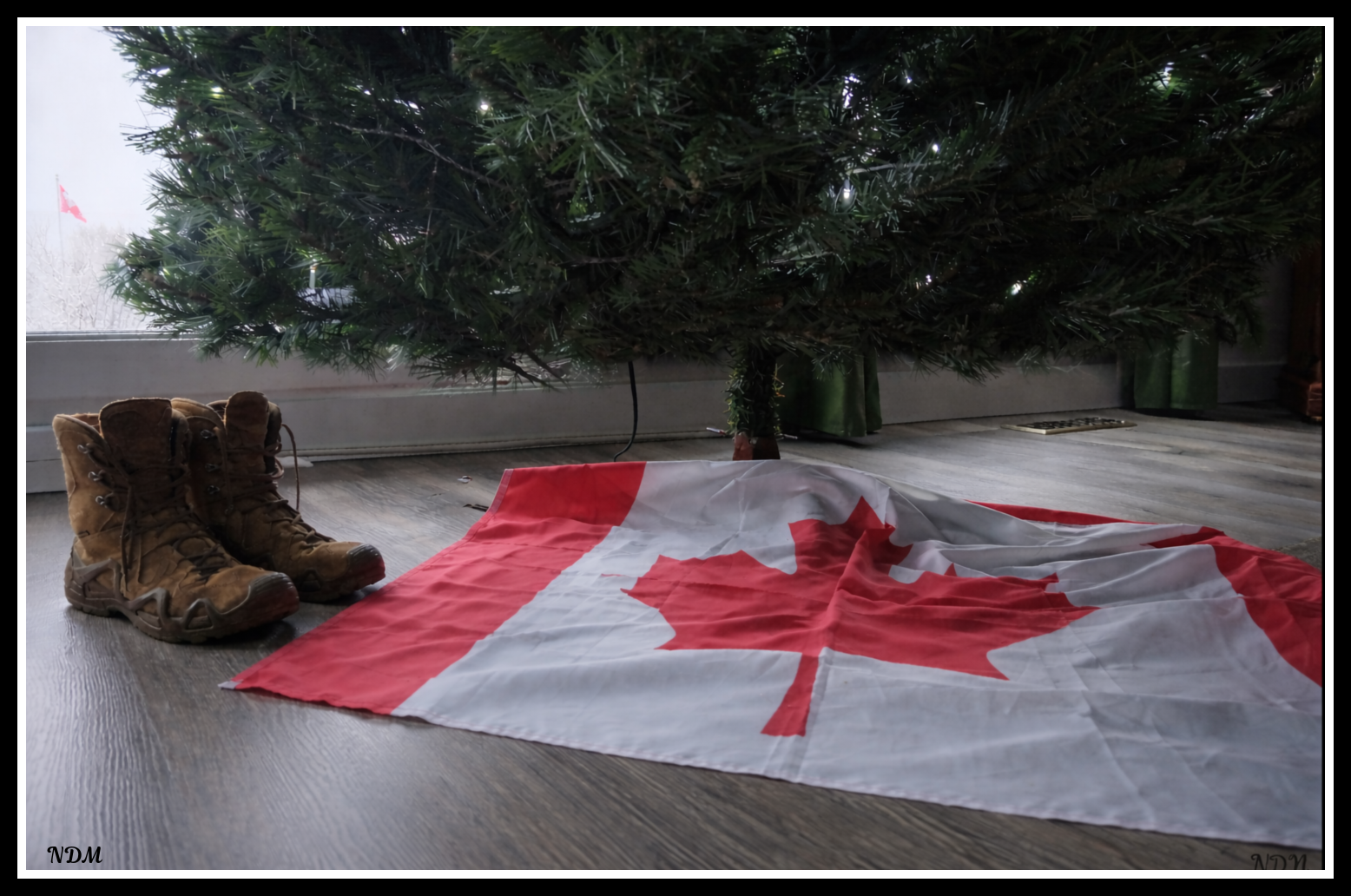
I staged the image I’m sharing here. My son’s very used military boots, an old Canadian flag, the Christmas tree above. What I didn’t notice until after I uploaded it was the flag outside, still flying on the pole in our front yard, visible through the window. The flag wasn’t staged and that part wasn’t a planned statement. There’s a light snow falling this morning, the kind that softens everything without erasing it. Standing there, looking out, it felt deeply emotional in a way that’s hard to explain, quiet, steady, unmistakably Canadian.

That’s why the tone of Prime Minister Carney’s messages matters so much. They weren’t designed to soothe us into complacency or to whip us into fear. They were designed to orient us, to remind us that seriousness is not something to be afraid of, but something to rise to.

And yes, Alberta more than anyone needs to hear this. Not as a rebuke, and not as a lecture, but as a reminder born of lived experience. We do not get through what lies ahead by fracturing. We get through it by recognizing seriousness when it’s offered honestly, even when it isn’t wrapped in comfort or spectacle.

This Christmas, the Prime Minister spoke to Canadians like adults. He didn’t promise ease. He didn’t perform reassurance. He acknowledged reality, and trusted us to sit with it.

On a Boxing Day that’s quiet, full of leftovers, and heavy with reflection, that feels exactly right.

A country this big doesn’t change direction suddenly. It travels there, one decision at a time.

I started my morning with population numbers for Canada in the New York Times. For the first time since 1946 our population is down. Changes that look small enough to dismiss. Is it just a fractional dip, or a a quarterly adjustment? It would be easy to scroll past. But these numbers are flagging something important.

I am fortunate to know many new Canadians. I personally know international students who came to Canada with a plan. It was not through a loophole, nor a fantasy, but with an actual plan. To study, to work and to stay and build their life here. I know people on work visas who did exactly what we told them to do, only to realize the door they were walking toward is now quietly narrowing. They come from all over the world. This isn’t about one country or one culture. It’s about what happens when policy pivots faster than lives can.

I’m not speculating here. Professionally, I know how much anxiety is sitting inside certain industries right now. Real anxiety. Not because executives are worried about optics, but because the labour math no longer works the way it used to. We can scoff at low wage jobs, but the truth is blunt. There are jobs in this country that are not being filled. Not because Canadians are lazy, but because those jobs may be unstable, seasonal, or incompatible with raising a family. Pretending otherwise doesn’t make us principled. It makes us unserious. Often those from other countries are willing to take these jobs with a goal to ultimately better theirs and their families lives.

At the same time, because reality refuses to behave, I also know domestic students who couldn’t find work. So yes, the system was strained. Yes, some promises were oversold. Two things can be true, even if our politics can’t handle that sentence.

What’s still barely being discussed is post-secondary education itself. Most Canadians don’t realize how much our colleges and universities have been financially buffered by international student tuition. Not necessarily out of greed but rather out of survival. Those large international student fees helped keep programs running, facilities open, and tuition for domestic students from climbing even faster. When that revenue drops, and it is dropping, something gives. Programs shrink, staff disappear and costs shift. That’s basic mathematics. And then there’s the demographic fantasy we seem keenly aware of. Canada is not repopulating itself through birthrates. Nothing more complicated than that. We are a vast country with an aging population, and no amount of lecturing about “family values” is going to change that. And let’s stop pretending otherwise. When some people say “we should just have more babies,” they’re usually picturing a very specific kind of Canadian family. I had two children. That replaces exactly two people. I do not expect my sons’ partners to reproduce on command to soothe someone else’s demographic anxiety.

Now I want to talk specifically about National defence. We have said, repeatedly, that Canada needs to grow its military. Global threats are increasing, not receding, and much of the current instability has been accelerated by the man south of the border. For the first time in generations, both our southern and northern borders are strategically fragile. You don’t protect a country with slogans. You protect it with skilled, trained people and in numbers that work.

As you know an industry important to me is aviation. We already face a pilot shortage both civil and military. Airlines are competing with the air force for talent, and the pipeline is thin. And aviation has always understood something politics and people sometimes forgets. An airplane has never cared about the colour or ethnicity of the pilot flying it. It only cares whether the person in the seat is trained, competent, and ready. Physics is brutally fair that way.

If we continue drawing potential military pilots into civil aviation or fail to build the pipeline at all, that’s not a cultural debate but rather a capability gap. And you don’t fill cockpits, secure borders, or respond to crises with wishful thinking.

This is why it’s so frustrating when immigration gets reduced to irritation. The Facebook drama when someone didn’t quite catch your order at a Tim Hortons drive-thru. Yes, communication matters. Yes, standards matter. But confusing momentary annoyance with national strategy is like judging an airline’s safety record based on whether you liked the coffee on your flight.

And this is where I suspect our Prime Minister’s thinking actually is. Not in slogans nor in extremes. But in the uncomfortable middle, where immigration, defence, education, labour, and global instability all collide. The real work isn’t choosing “more” or “less.” It’s designing a system that actually supplies the people we know we need, in the places we know we’re vulnerable.

This isn’t an argument for open borders. It’s an argument for adult policy.

Because Canada does need more people. But like any long journey, growth without direction is just motion. You need a route. You need capacity. And you need to know why you’re heading where you’re headed, before you find yourself miles down the road wondering how you got there.

Last week in the House of Commons, Canada’s Secretary of State for Sport, Adam van Koeverden, delivered a speech that was sharp, funny, and painfully accurate. And for everyone still defending Pierre Poilievre and the style of politics he has perfected, it was a reminder of exactly what that legacy is in the words of MP van Koeverden.

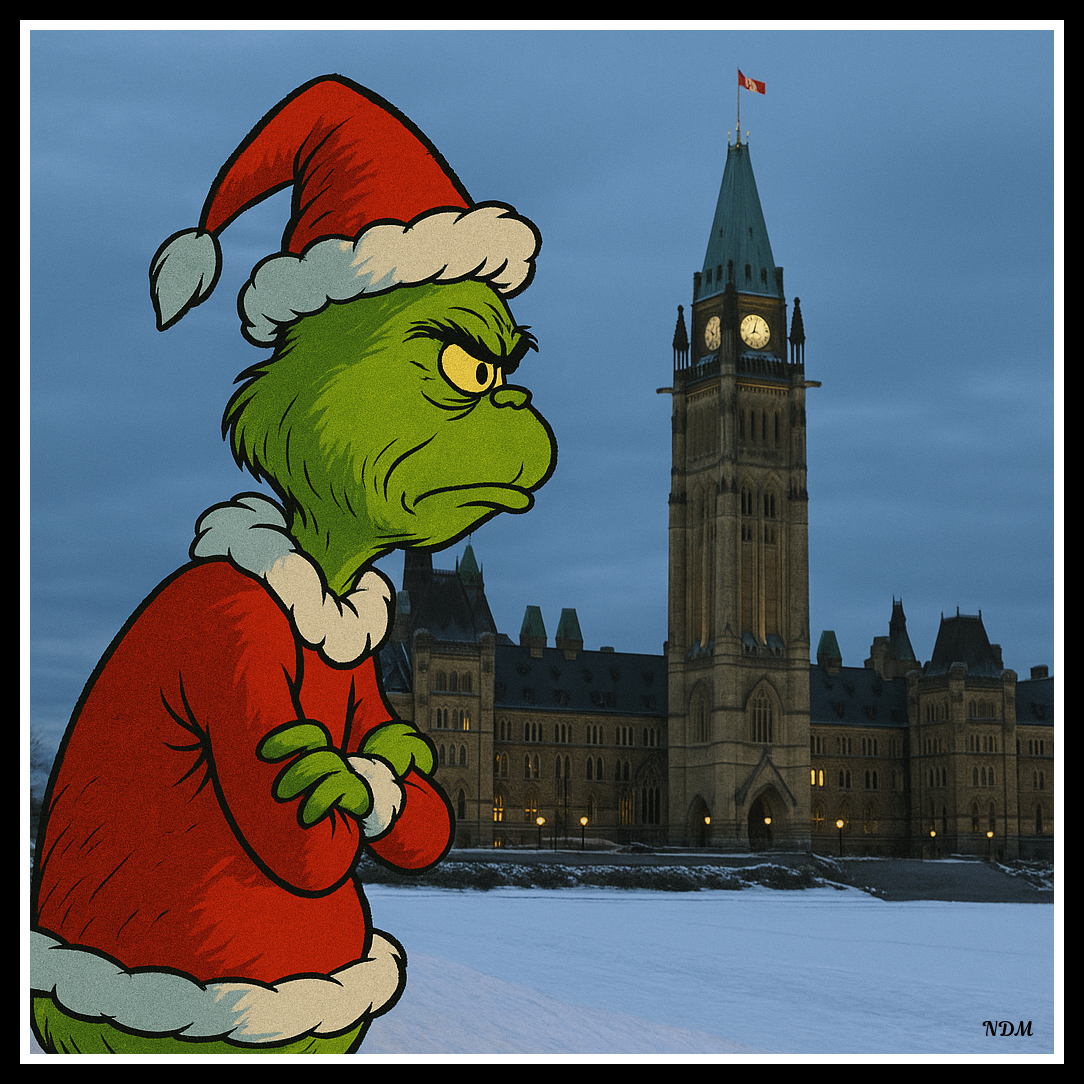
“Mr. Speaker, remember when the Grinch tried to steal Christmas? He drove all the way up to the top of Mount Crumpit because he had everything that he needed, and he was going to throw the gifts that the Whos deserved because he thought they didn’t deserve to have nice things. It’s kind of like the leader of the Conservative Party, Mr. Speaker. For 25 years, he’s had dental care because he’s had a job here in the House of Commons, so he votes against dental care for 9 million Canadians. He’s got secure housing. He lives comfortably at Stornoway in government-owned housing, so he votes against affordable housing for millions and millions of Canadians. My Christmas wish is that the leader of the Conservative Party comes back in January with a heart that’s grown three sizes and tries to help a Canadian for once in his 21 years.”

That is Poilievre’s political biography in a paragraph. He is a man who has enjoyed every structure of public stability while dedicating his career to denying those same supports to everyone else. And rather than come back after he “won” or, let’s be honest, acquired his Alberta by-election in a riding that any Conservative could win in a coma, did he return with a better attitude? A vision? A grown heart? Anything?

No. He returned with the exact same tone, and the same fixation on Justin Trudeau that his followers can’t seem to let go of, despite the fact that Trudeau isn’t even in politics anymore. It has become some kind of reflexive obsession, a default setting they can’t reset, and it would almost be funny if it weren’t so detached from the reality the rest of us are living in.

For the continued supporters of Pierre Poilievre note that in 21 years he has not produced a single original idea. Nothing substantive, nor visionary. Nothing that withstands even casual inspection. Ask his supporters to name a policy, and they can’t. They can only tell you who they dislike. The only people insisting he’s “leadership material” are perched so far on the right flank of conservatism that competent global diplomacy looks like a threat to them.

Meanwhile, the same voices who accuse the Liberal government of being “socialist” conveniently forget that Canada’s core social programs that they likely embrace, such as unemployment insurance, public healthcare, old age security, and the Canada Pension Plan are exactly the kinds of systems they claim to oppose. And let’s not forget the single biggest fiscal challenge of the past five years, COVID. I would pay good money to see the statistic showing how many small government Conservatives cashed their CERB cheques without hesitation. Canadians across every political stripe were grateful for that “socialist” support when they needed it. Funny how ideology melts when the deposit hits the account.

Because here’s the uncomfortable global truth. There is no Conservative leader right now who would receive the level of international respect Mark Carney does. Could one emerge? Possibly. But the only route to international visibility available to the current Conservative movement is alignment with Donald Trump’s authoritarian worldview and Vladimir Putin’s destabilizing ambitions. That’s the company they’ve chosen.

And that should worry all of us. Leadership in 2025 is not just about the economy. It’s about safety. Economic strength collapses without geopolitical stability. Trade dies without trusted alliances. Investment evaporates when partners can’t count on you. Safety is the foundation of everything, and right now, Conservative politics offers no path to a safer Canada.

Meanwhile, we have a Prime Minister who is respected internationally, who is navigating one of the worst tariff crises in decades, and who does understand the complexity of global economics. Mark Carney is not perfect, no leader is, but he has the credibility Canada requires at a moment when credibility is currency.

And yet, the Conservative Party marches forward behind a man whose political compass points only toward resentment and reduction. A man who has had every benefit of public life yet opposes extending those same benefits to the people who fund them. A man who believes anger is a national strategy.

But unlike the Grinch, this story doesn’t end with a heart growing three sizes. In fact, if anything, every year he sounds more like the guy standing on the hill screaming about the downfall of Whoville while offering exactly zero ideas for how to fix it. A man who wants power with all the enthusiasm of someone who’s never bothered to figure out what he’d do with it once he had it.

Perhaps, perhaps, the spell is weakening. There is growing speculation that January could bring not just a new parliamentary session but a new Conservative leadership race. And if the Conservative leadership team has any instinct for political survival, they see the writing on the wall.

But then comes the real question. If not Poilievre… then who?

Andrew Scheer? You could replace him with a lump of coal and get more heat. A rising star? From where? This caucus has hollowed itself out. Jason Kenney? No love lost there, but compared to today’s far-right chaos, he now looks moderate, (don’t worry I’m not fooled). This says everything about the state of the party.

Adam van Koeverden’s Grinch analogy landed because Canadians recognize themselves as the Whos down in Whoville. Just trying to build something together while a man on the mountaintop insists we don’t deserve it. But unlike the Grinch, this story doesn’t end with a heart that grows.

And if that’s the best the Conservative Party can offer in a moment this dangerous, then it’s not a government in waiting. It’s a loud distraction for people who’ve stopped looking for real solutions.

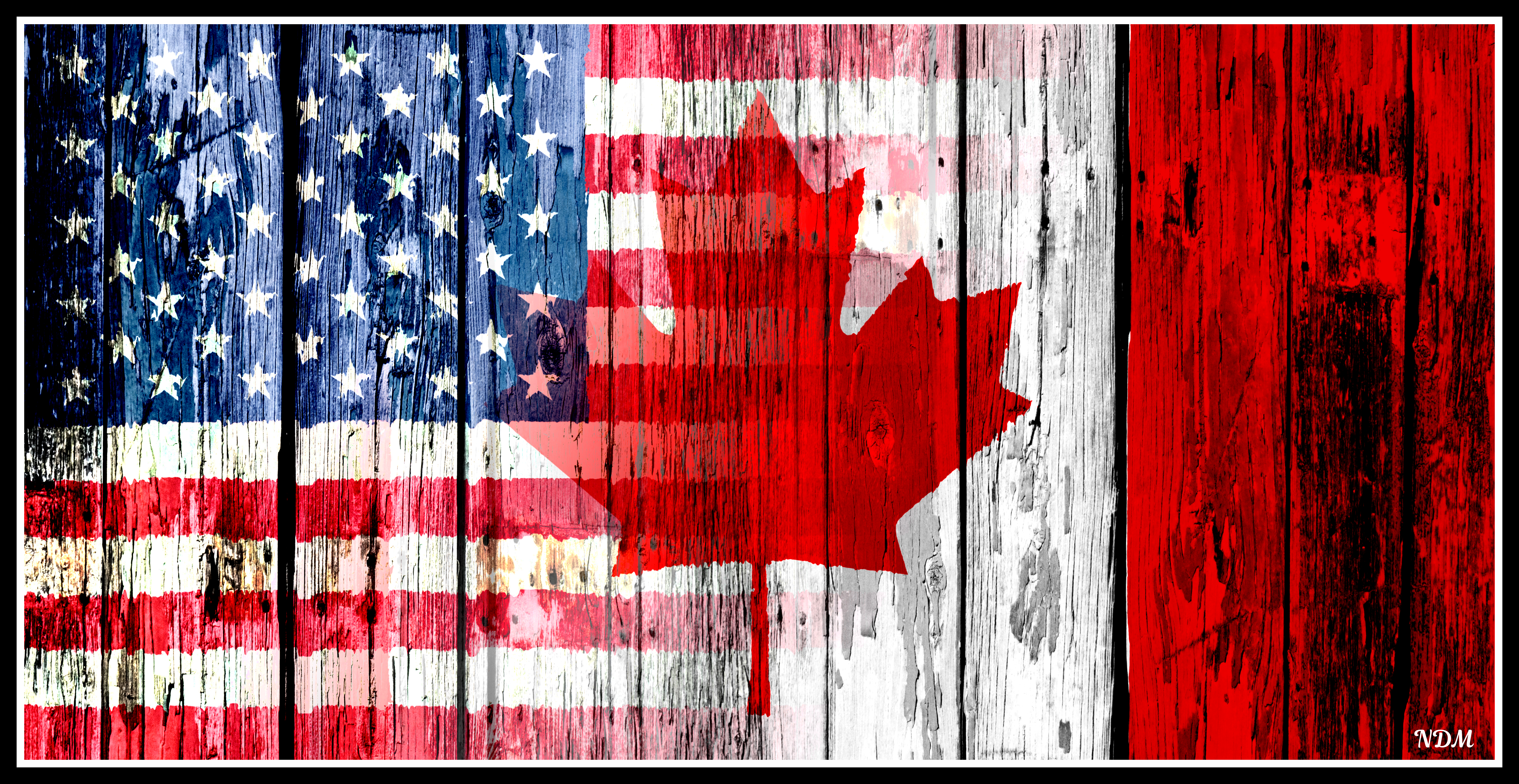
People keep telling me I’m “not writing from a Canadian perspective”. So let me be uncomfortably blunt: everything I write, whether it’s about Washington, Moscow, Venezuela, or the moon, is through a Canadian lens. Because in 2025, there is no such thing as an American crisis that stays on the American side of the border. What happens there reaches us in real time. Economically, militarily, socially, digitally and emotionally.

Anything I write about the U.S. is about Canada. And this week, the danger became impossible to soften.

Two months ago, Pete Hegseth stood before senior U.S. military leaders and said the quiet part out loud, not hinted at, not theorized, not coded. No, he declared, “We don’t fight with stupid rules of engagement. We untie the hands of our war fighters to intimidate, demoralize, hunt, and kill… Just common sense, maximum lethality, and authority for war fighting.”

Maximum lethality. Untie the hands, intimidate, demoralize, hunt, andkill. That is not doctrine nor strategy. That is permission.

So when the world watched the evolving, contradictory explanations around the second strike on a drug boat, one that looks chillingly like a war crime, none of us should be surprised. The guardrails are gone. They told us they were removing them. They said it right into the cameras.

And as Canadians we’re supposed to shrug and say, “U.S. politics are weird right now”? This isn’t “weird.” This is destabilization and destabilization doesn’t need a passport to cross borders. My nephew, who served his entire career in the Royal Canadian Air Force and now continues with them in a civilian role wrote something earlier this year that I keep returning to. I’m paraphrasing, but he described standing on a tarmac in Afghanistan watching Star Spangled Banner draped coffins being loaded onto a plane. He talked about serving beside Americans who lived, laughed, fought, bled, and grieved as brothers, never caring what flag was on your shoulder as long as you showed up. He believed, deeply, that those same American generals would never obey an order to turn their military against Canada. He believed it was unthinkable. And in March, I believed that too. But this is not March. And the United States is not the same country it was even eight months ago.

Last night’s National Security Strategy should have stopped the world in its tracks. Instead, it barely caused a ripple because we’ve all become numb to shock. But we cannot afford numbness. Not here in Canada. Not when the document refers to Canada, explicitly, as a vassal state. If you look up that term, it means the following. ‘A state that has a mutual obligation to a superior state or empire, similar to a subordinate in a medieval feudal system.’

This is how Trump’s America now views Canada. Not as an ally. Not as a partner. Not as a neighbour with whom it shares the longest peaceful border in the world. But as a subordinate with obligations to an empire.

Read that again. And if you still think Trump is a “good guy,” and that the far-right radical politics sweeping across North America are some kind of righteous populist uprising, then you’re reading the wrong post and the wrong blogger or exactly the one you needed.

People often tell me that my writing calms them. But today, I don’t think I can do that. Today is not about calm. Today is about clarity. About looking at the shift happening south of us, militarily, politically, psychologically, and understanding that Canada is not insulated.

And yes, of course we need to pay attention to what’s happening right here at home, not to hide from the global picture, but because what’s unfolding in Alberta is part of that global picture. The erosion of institutional trust, the attacks on journalism, the flirtation with authoritarian rhetoric, the manufactured chaos, it all mirrors, almost perfectly, what we saw in the U.S. before their political centre collapsed. And the truth is, action always begins closest to home. We can’t fix the entire world, but we can damn well protect the ground we’re standing on. If we don’t get our house in order here, if we don’t recognize the direction these currents are pulling us, then political chaos becomes a gift to anyone who sees Canada not as a nation to respect, but as a chess piece to be moved.

And as much as this fear sits in my chest like a stone, I remain grateful, profoundly grateful, that Mark Carney is the one steering the ship in this moment. Steady when the world is lurching. Calm when our neighbour is convulsing. Focused when others are consumed by rage, impulse, and decline. But leadership can only work when a country understands the stakes.

I wish I could tell you everything will be fine. I wish I could offer comfort instead of warning. But the truth is that Canada is vulnerable. Not because we are weak, but because the reality around us has changed faster than we have been willing to admit.

And the most dangerous thing we can do right now,  as Canadians, as Albertans, as people who love this country, is pretend that the ground beneath us isn’t shaking. I am still optimistic. I wouldn’t write any of this if I weren’t. I believe in us. I believe in what we can be. I believe in our capacity to meet the moment. But optimism is not the same as denial. And today, the truth is simple and unavoidable: When an unstable superpower drops its guardrails, every nation in its shadow had better wake up. Because history does not wait for those who refuse to see it coming.

Alberta’s Road Ahead

Posted: November 30, 2025 in Uncategorized
Tags: , , , ,

Today, I’m reaching out to a group that might not think of me as “their” voice, but I believe you are. I write from a progressive point of view, yes, but I am not far left and never have been. I am a centrist, maybe philosophically a little left, and most people who follow me are the same: grounded, pragmatic, and driven by fairness over ideology.

But this post isn’t for the usual audience. It is specifically for those Albertans who once proudly called themselves progressive conservatives or small-c conservatives, people who understood conservatism as careful stewardship, not chaos; community, not division; country, not grievance. I need you to hear this before Alberta follows the path unfolding south of us. And to my regular readers, who know I work hard to be fair and fact-driven: I’m asking you to put party labels aside. Think instead about your philosophy, your values, the things you believe when you think about your family, your neighbours, and the country we share. Because I need to say this plainly: the word “conservative” tastes bitter in my mouth these days. Not because of its history, that I respect, but because of what extremists have turned it into.

And I know many of you feel the same. You are not extremists. You are not separatists. You are not Christian nationalists. You are not part of this radical takeover. You represent the Alberta I know and love, and you deserve to hear the truth about what is happening inside the party you once believed in.

What happened at the UCP AGM in Edmonton this weekend was a defining moment. In truth the moment it became undeniable that the UCP is not simply “right-leaning.” It is controlled by an extreme-right faction whose language and goals mirror the dangerous movements tearing the United States apart. And they are not hiding it anymore. Their conversations about divisiveness and separation aren’t fringe now, they are escalating. And we need to be honest about why as even Danielle Smith has lost her audience. She will not be leading this party forward. She is now a liability to the very forces she once empowered. And that leaves Alberta staring down something far worse than “better the devil you know,” because what’s waiting in the wings is far more radical, far more determined, and far more dangerous.

That reality hit me hard during the recent discussions around the pipeline memorandum of understanding between Alberta and Canada. Let me be blunt: that pipeline, framed that way, is never going to happen. And the separatists know it. They are shifting, regrouping, and preparing their next move.

But here is where you need to stop, breathe, and listen. Those separatists do not define this province. Not now. Not ever.

And this circles us back to Forever Canadian. When Thomas A. Lukaszuk and team launched the Forever Canadian campaign, I knew we were responding to something real. But this weekend hit me like a freight train with the realization of just how vital that work was, and how vital it still is. We proved something timeless, something that matters more than ever and is especially true to the quote from Margaret Mead. “Never doubt that a small group of thoughtful, committed citizens can change the world. Indeed, it’s the only thing that ever has.”

Forever Canadian wasn’t loud. We didn’t have deep pockets. What we had were real Albertans who wanted this place to remain part of Canada. Our strength wasn’t in noise. It was in purpose, unity, and integrity.

So yes, right now it may look like the separatists have the upper hand. But loudness is not strength. Money is not legitimacy. Coordination is not public support. A fringe is still a fringe, even when it shouts.

As we wait for the constitutional ruling that will determine whether this extremist faction can legally push a separation agenda, I need to speak personally. This is not the Alberta I expected to live in during the later chapters of my life. And I refuse to watch it fall into the hands of people whose vision would tear this province apart. This weekend left me asking, over and over; what can I do? I can write which I do. I can speak,often boldly. And I will not sit still and watch this happen. I still have something to give. Maybe more than one thing and I am ready to take on whatever tasks are needed to keep this province whole, sane, democratic, and Canadian.

And I believe with absolute certainty that most conservatives do not want what is happening inside their party. So I am asking, genuinely and urgently, please speak out. If what you saw this weekend unsettled you or frightened you, you are not alone. And you do not have to stay silent. We have a decision to make about the future of our province and it has to be made now.

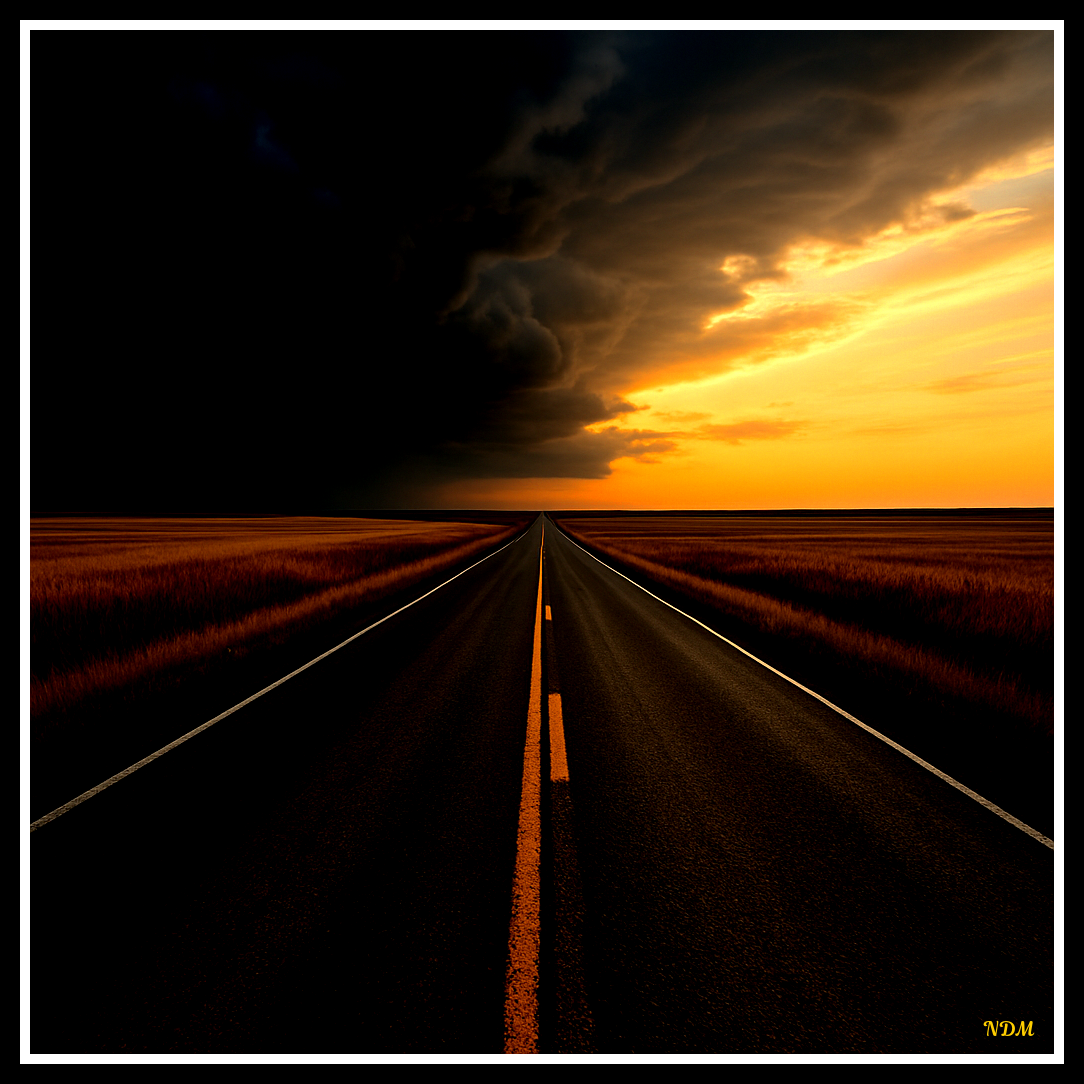
Forever Canadian was never a one-time campaign. It was the first line of defense. Now we must choose whether it was a moment or whether it becomes a movement. I know where I stand. And after this weekend, I know exactly why we must stand together again. This moment feels like a long Alberta prairie road, the storm rolling in on one side, sunlight fighting on the other. We can still choose which way we go. But we have to choose now.

Between a rock and a hard place! Yesterday was quite a day. Alberta and Ottawa, two traditional sparring partners, suddenly stood shoulder-to-shoulder long enough to sign an energy memorandum of understanding, not a memorandum of agreement. One does not magically turn into the other. Canada has a long, proud tradition of signing MOUs with great pomp, flair, and photo ops… only for the “U” to quietly pack its bags and never become an “A.” Depending on who you talk to, this is either a long-overdue breakthrough, the beginning of the end for environmental policy, or proof that Mark Carney “finally caved.” I’ve heard it all, I live in Alberta, my husband works in oil and gas, everyone knows I believe strongly we have an obligation to the environmental protection of the planet, and trust me, no one here is quiet.

But the claim that Carney “threw the baby out with the bathwater”? Please. The baby’s fine (so far). The tub isn’t filled. The faucet isn’t even turned on yet. This MOU was political choreography. Alberta needed to feel seen, Danielle Smith needed a headline, and Carney needed to show he understands the economic stakes. But the moment the ink dried, the real work shifted westward. Because nothing, and I mean nothing, is moving without British Columbia and the Indigenous peoples of B.C. agreeing to it. And that is not something Alberta can yell its way through.

Now, here’s where I land, and I’ll be honest, it’s not a simple place. I understand the economic argument. Alberta has been told “transition” for decades while carrying a massive share of this country’s revenue. And yes, we need new markets; relying on the United States as our one and only customer was a naïve strategy. Alberta has failed to promote alternative energies and that needs to be part of any conversation. I have serious environmental concerns, and they’re not small ones. Carbon capture has promise, but promise isn’t proof. Pipeline safety on a rugged coastline isn’t a slogan; it’s math, engineering, and risk that must be measured, not wished away. If someone wants me to believe this can be done safely, they’d better bring more than talking points. I’m open to listening, but not to blind faith.

And that’s why today’s announcement feels less like a yes or a no and more like a “well, let’s see.” A private sector proponent still has to appear. A major projects process has to be navigated. A reworked carbon pricing agreement has to materialize. And Indigenous nations, including coastal nations, have to consent. They can’t be pressured, nor bypassed and must have consent.

Meanwhile, in B.C., the reaction has already ranged from skeptical to incredulous. Some communities want growth; others see this as Alberta’s reward and B.C.’s risk. And let’s be honest: that’s not a dynamic that sells well at the best of times.

Add to that the internal fallout, including a cabinet resignation rooted in environmental alarm, and it’s clear this isn’t just a provincial fight. It’s a national conversation wrapped in competing long-term visions, with no easy consensus and no shortcuts.

And here’s where I am this morning, and I’m not going to pretend it’s comfortable. Economically, I understand why Alberta wants this. We need new markets. We need to stop pretending the United States is a stable or reliable customer. An additional pipeline to tidewater could give us leverage we haven’t had in decades. I’m not blind to that. I live in a province built on this industry and married to someone who works in it. But the environmental risks are real. Not theoretical, not hysterical, real. A coastline spill would be catastrophic. And no politician waving a pen in Ottawa or Edmonton changes the fact that Indigenous nations have both constitutional standing and international protections under UNDRIP. Without their consent, this project doesn’t just slow down it stops. Add to that a little practical reality check: There is no proponent. Oil prices aren’t high enough to attract one. And until someone with billions of dollars raises their hand, this entire conversation is a hypothetical one presented as momentum.

Meanwhile, just last week the Premier of B.C. said they would consider increasing capacity on the existing Trans Mountain pipeline, a project already built, already operating, and already moving barrels west. Somehow that wasn’t treated as the headline opportunity. And maybe it should have been.

Carney and the country are in a hard place. A place between economic urgency and environmental responsibility. Between national ambition and on-the-ground reality. Between wanting to move forward and recognizing all the reasons we should not. I still believe Carney knows what he’s doing. I just hope this doesn’t cost him more inside his own caucus on the way through, because the stakes for this country, economically, environmentally, politically, are too high to lose steady hands now.

And so for the moment, I’m doing what most Canadians are doing: watching and thinking and waiting. Trying to find that landing spot between hope and worry. It’s not easy, it’s not neat, and it’s not resolved. I feel on the edge of something, uncertain of its shape, and unwilling to look away.

Here’s what Mark Carney did today.

In a rapidly shifting global landscape, the Prime Minister announced the launch of a new Major Projects Office (MPO) headquartered in Calgary (any comments Premier Smith), with additional offices opening in other major Canadian cities. Backed by legislation already passed this June, the MPO is designed to fast-track nation-building projects, ports, railways, clean energy initiatives, and critical mineral developments. It will create a “one project, one review” approach, reducing approval times to a maximum of two years while upholding environmental standards and Indigenous rights.

Even more, the MPO will help structure financing through the Canada Infrastructure Bank, the Growth Fund, and the Indigenous Loan Guarantee Program, alongside private capital and provincial partners. In other words: real planning, real coordination, real jobs, real growth.

That’s leadership. It’s about building something Canadians can see, touch, and benefit from. It’s about the future.

And meanwhile, here’s what we got from the Leader of the Opposition. Pierre Poilievre stood at a podium and gave Canadians a 30-minute “tough-on-crime” sermon, complete with dramatic tone, perfect salt-and-pepper hair, and rehearsed theatrics. His message? Fear. He painted pictures of home invasions at 2 a.m., of parents forced into split-second life-or-death choices, of a system that punishes victims instead of criminals.

Now, crime is real. The trauma of an intrusion, the fear of glass shattering in the night, that’s real too. I don’t dismiss it. But my greatest fears aren’t criminals breaking into my home. I’m more afraid of tornadoes ripping across the prairie, wildfires swallowing forests, and hurricanes flooding communities. I’m more afraid of global instability, Gaza, Ukraine, and the uncertainty of a world where Trump makes decisions that affect Canadian lives. I’m more afraid because my own son serves in the Canadian Armed Forces, and I know exactly what “instability” can mean for families.

Poilievre doesn’t go there. He doesn’t want to. Because that would mean confronting Trump, confronting climate, confronting complexity. Instead, he leans into American-style “stand your ground” rhetoric, promising to rewrite Canadian law to make lethal force a presumed right.

And to me that is NOT leadership, that’s mimicry. We don’t need to become a northern knockoff of the United States. Their gun culture, their obsession with armed self-defense, their endless cycle of mass shootings, that’s not who we are.

Pierre knows who he’s talking to. He’s speaking to his Conservative base, shoring up support after losing his seat in Ottawa and facing a leadership review. He’s not speaking to Canadians as a whole. And that’s the difference.

When I listen to Mark Carney, I don’t hear someone only talking to Liberals. I hear someone talking to Canadians. He compromises where necessary. He thinks before he speaks. He takes the 10,000-foot view, not the 10-foot spotlight. He knows that being Prime Minister isn’t about playing to the bleachers. It’s about carrying the weight of a nation, even when it means taking on allies, critics, or his own party.

Poilievre, meanwhile, is stuck in performance mode. He hammers away at the one note. But when you only stare at the narrow circle beneath your feet, you miss the horizon. And right now, Canada’s horizon is where the real challenges lie.

Where does he stand on Gaza? On Ukraine? On Trump’s tariffs? On Canada’s economic sovereignty? We don’t know. And I suspect that’s intentional. It’s safer for him to stick with crime monologues than to risk alienating his base by talking about the big picture.

So let’s be clear about what happened today: Mark Carney announced a nation-building office to accelerate infrastructure, clean energy, and jobs. Pierre Poilievre delivered a half-hour performance about fear.

That’s the contrast. One builds, one blusters. One leads, one performs. And I, for one, don’t feel safe leaving Canada’s future in the hands of a performer. Because when the storm clouds gather, and they already are, I want a leader, not an actor waiting for applause. I choose hope over despair.

August 3, 2025

Posted: August 10, 2025 in Uncategorized
Tags: , , , ,

UPDATE: It is important to note that I wrote this to explain the structure of the process. There are many aspects of it that should be revisited and one that I often mention in more detailed conversations around the exclusion of Hydro power in the calculation. So take this as a very general explanation as it was intended.

Equalization payments 101. I’m beginning to believe a lot of citizens skipped grade six. Jason Stephan, MLA for Red Deer and member of Alberta’s Treasury Board, posted today about what he viewed is the money Alberta ‘sends’ to Quebec saying it’s “too bad Quebec didn’t separate.”

Let’s just pause on that for a second. A sitting MLA who is responsible for provincial finances is wishing a founding province had left Confederation. Because of taxes? That’s not just a cheap political shot. That’s a fundamental misunderstanding of how Canada works. And how the equalization system works.

And unfortunately, he’s not alone. So let’s try this one more time at a grade six civics level, since that seems to be where the understanding stopped. Equalization isn’t Alberta sending cheques to Quebec. It’s not a personal donation to daycare in the Maritimes.

Here’s the truth. Canada is a country, not a profit-sharing corporation. Let’s think of it like a big family. Alberta is the high-earning sibling who makes good money, works hard, maybe brags about it a bit too much at Thanksgiving. New Brunswick? That’s the older relative. Wise, tough, but not pulling in as much these days. Quebec? Well, Quebec is the family member who insists on doing everything their own way but still shows up for supper.

And like any decent family, we try to make sure everyone has what they need, even if we don’t all contribute the same amount.

That’s where equalization comes in. Here’s how it actually works. The federal government collects taxes from across the country (and yes, Alberta pays a big chunk because we earn more. Please know that’s not punishment, it’s math). Then, based on a formula, it gives equalization transfers to provinces that don’t have the same ability to raise their own revenue. That means more help for places like New Brunswick, PEI, and Manitoba so they can offer public services at reasonably similar levels and tax rates. Provinces like Newfoundland for example have been both the successful family member and the one that needed some help on occasion.

And just to be crystal clear Alberta does not send money directly to other provinces. No one’s mailing cheques from Edmonton to Quebec City. Equalization payments come from the federal government to each provinces.

And about that formula? It can be reviewed. And it has been including during the Harper years. So if Jason Stephan thinks it’s broken, maybe he should dig into those files before continuing the negative narrative. While he’s at it, maybe he can get a memo to Premier Danielle Smith because if there’s one thing this Premier loves more than chaos, it’s finding someone else to blame for it.

Canada is not a zero-sum game. Every province brings something to the table. Not all bring cash and thank God, because if money were the only measure of worth, we’d be a pretty soulless country.

Right now, we’re dealing with global instability, trade tensions, economic insecurity, war, and climate pressure on everything from food to fuel. The job right now is to take care of our own. That means defending each other, not dividing each other.

If we need to revisit how the family handles its finances, then fine we will. But not in the current situation our country (family) is in. And not because one provincial politician needs a distraction from his own lack of solutions.

Maybe Quebec is the kid who’s still living at home, expects dinner on the table at six, and reminds you regularly they might move out if the menu ever changes. Alberta is the sibling who just landed a big promotion and can’t stop telling everyone else how to run their lives. Annoying? Absolutely. But guess what? They’re both still family.

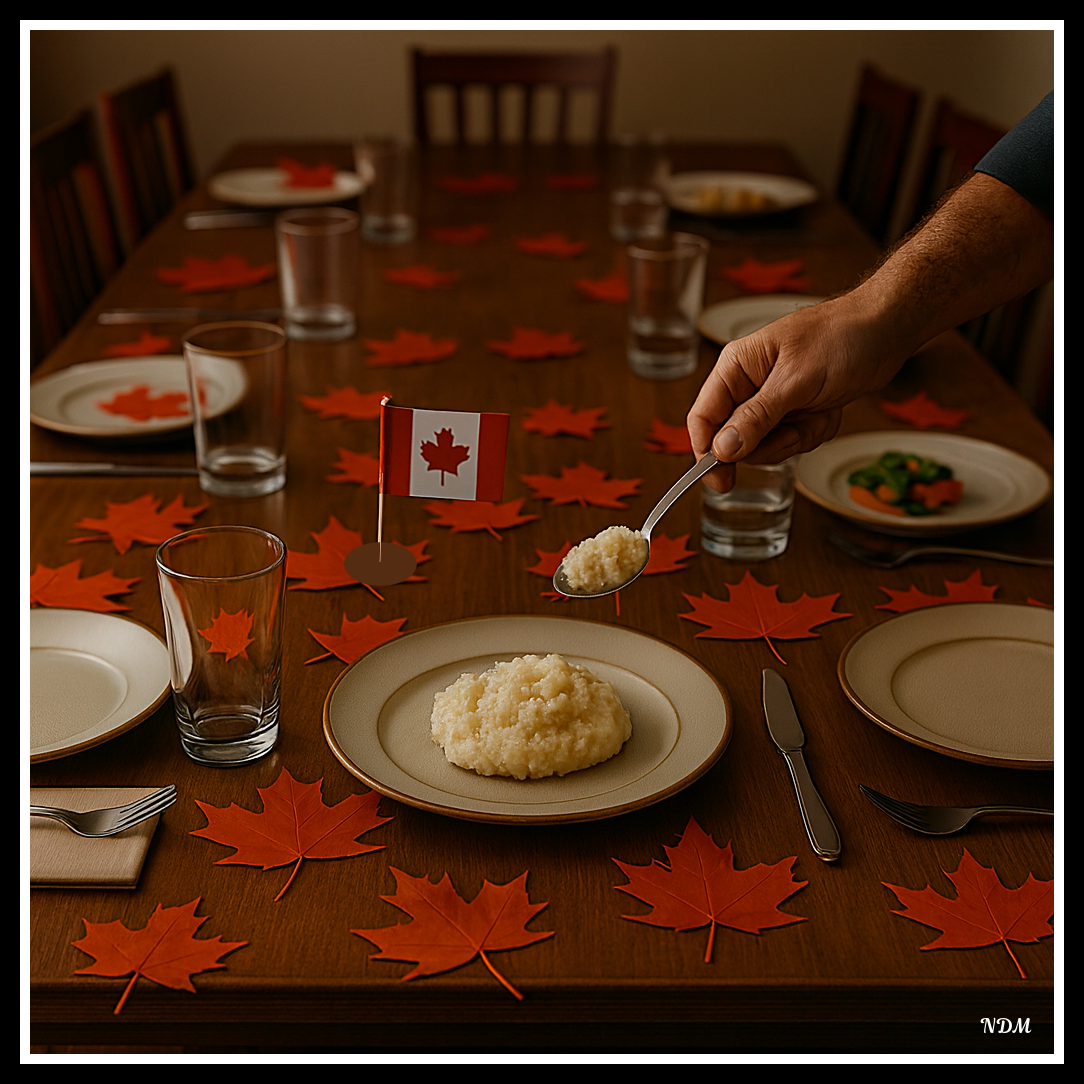
Because in the end these provinces are all part of this amazing country and in my view we are family. And like any real family, we all have a seat at this table. No one gets to kick anyone else out.

We argue. We pass the potatoes. We fight over who has to do the dishes. But we also make sure everyone’s plate has something on it. That’s not weakness. It’s the strength of the system.

So if the way we split the bill needs a second look, we’ll do that. Together. Like grown-ups. But let’s not confuse family finances with family values. Because from this citizens point of view we make sure everyone gets dinner on their plate. We argue, we grumble, and sometimes we roll our eyes at each other. But we don’t cut anyone out just because it’s politically convenient.
We show up. We share. We do the work. That’s what being Canadian actually means.

July 26, 2025

Posted: August 3, 2025 in Uncategorized
Tags: , , , ,

I might have to start getting up at 4 a.m. (or start doing lives, because Trump’s tantrums don’t respect my posting schedule)

I’ve discovered something. My commitment to writing thoughtful posts the night before and publishing them at 7 a.m. is becoming less of a routine and more of a liability. Because, between 10 p.m. and sunrise, Donald Trump inevitably throws another tantrum, drops another truthless screed, or tries to dismantle international relations. It’s exhausting. But here we are again.

I had a whole post lined up, and then Trump declared he was “done negotiating” with Canada. And now people are asking me, “Nancy, do you still think Mark Carney is the right one to handle this?”

Yes. I stand exactly where I stood. Carney is the only one in this country who has both the credentials and the composure to deal with Trump basically by not ‘dealing’ with him at all. Because, as I’ve said before and I’ll keep saying: you don’t negotiate with crazy. You route around it.

And that’s exactly what Carney is doing. Let’s not forget what he said the night he became Prime Minister. I’ve quoted it before and I’ll paraphrase again: ‘the Canada–U.S. relationship as we knew it is over.’ And maybe that’s what some of us are still struggling to accept. Maybe I am too.

A few weeks ago, I posted an image of a cracked road that resonated widely. Well, that crack? It’s now a full-blown canyon. And unless something, or someone, removes the unstable force at the center of it, we’re not crossing that bridge any time soon.

Now, here’s what you didn’t hear in Trump’s tantrum: according to credible sources, the real trigger was money. Trump demanded what’s been described as a “one-time loyalty fee” from Canada, a price to be paid for tariff relief. Call it a handshake. Call it a favour. Call it what it is: extortion.

And Carney? He told him to pound salt. Or, more accurately, he told him no, the Canadian way: quietly, firmly, and repeatedly.
Trump didn’t take it well.

And that’s why we’re here. This wasn’t a trade breakdown. This was a mobster getting snubbed by a banker who saw the scam coming ten miles away. The threats and the 35% tariff bluff are because Carney wouldn’t buy in.

And here’s something Canadians and Americans need to understand: when Trump says he’ll “have all these deals in place,” they’re not negotiated agreements. They are imposed conditions. One-sided ultimatums dressed up as diplomacy. There’s no give and take. No mutual interest. Just a string of threats, followed by declarations of success when the other party either folds, or walks.

Please, for the sake of truth and sovereignty, don’t take him at his word. Don’t listen to the noise. Do your due diligence. Read real sources. Get the straight goods on what he’s actually done, not what he claims to have done. Because the words are meaningless. The record is what matters.

Meanwhile, Carney’s been building the bypass: finalizing the Canada–Mexico Trade Corridor, with no American permission slip required, locking in historic agreements with the EU and Japan, launching Canada’s Energy and Transportation Sovereignty Corridor, connecting provinces and territories coast to coast to coast, and preparing retaliatory tariffs and a Buy Canadian strategy that actually hits Trump where it hurts, his electoral map.

Trump has taken a detour to Scotland, where even his ancestral homeland wants no part of him. He renamed a golf course after his mother, hoping to buy affection. It didn’t work. The cliffs, the castles, the wind-swept resistance, they said no. The land of fierce rebellions and long memory doesn’t forget. To my ancestors from those highlands: thank you. You did us proud.

Now, tucked into this week’s schedule is another meeting we should all be watching: Trump is expected to meet with representatives of the European Union. I’m hoping they hold the line, as they’ve publicly indicated they would, in standing by Canada in this process. Whether they stand firm or bend will speak volumes. At least, it will to me. So let’s put a sticky note on that one. Bookmark it and watch it. Because the outcome of that meeting could quietly shape the next chapter in all of this.

And as for Canada? We’re not backing down. We’re not bending.
And if being “tough and nasty” is what it takes to defend our sovereignty? Then yeah, we are. Nicely. I am happy to have that handle. Because Canada doesn’t do fealty. We do strategy. We do dignity.

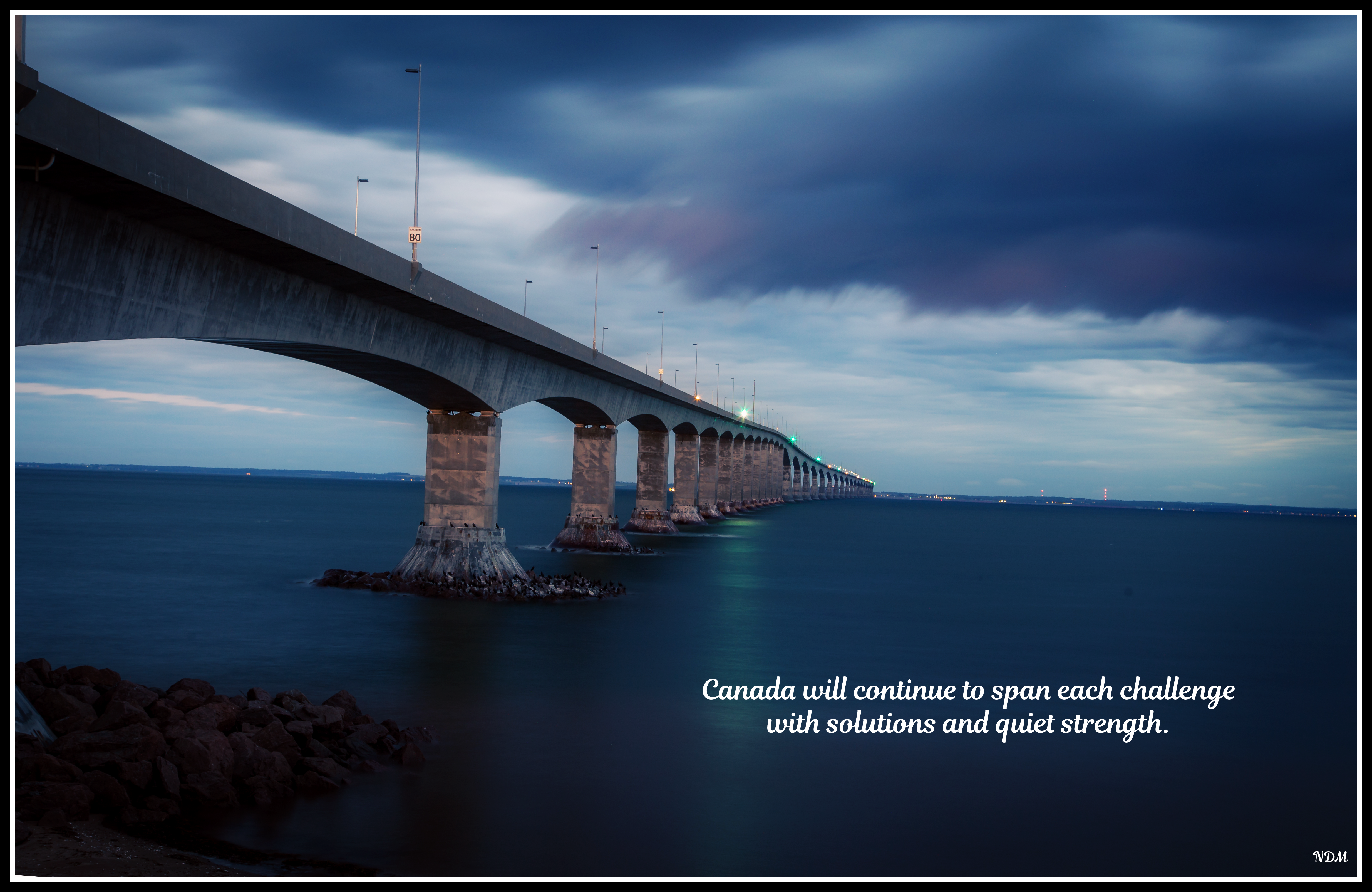
We’re already partway across a long, solid span, something real, something built to last. It stretches across deep waters, connecting more than just provinces. It represents who we are: a country that doesn’t flinch when the crossing gets tough. We’re not at the other side yet. But the pillars are strong, the direction is clear, and we’re moving forward. One kilometre at a time. No turning back now.

BeautifulSunsetthankful               

 “As we express our gratitude we must never forget that the highest appreciation is not to utter words,                                   but to live by them. ”  John F. Kennedy

So on a last minute trip to Walmart today to buy an oversized roasting pan for my oversized turkey a gentleman in the check out line behind me said,  “Thank you for the work you do for our community.  I really appreciate it.  Politicians work hard for their constituents and are under appreciated.  Have a wonderful Thanksgiving.”  I was pleasantly surprised by his comment and although I don’t know him I am very grateful for his words.  This last few weeks have been difficult politically (and I get it times 2). There have been some controversial issues and sometimes disagreements.   What am I grateful for?  The fact that I live in this amazing country where I have the freedom to choose my own point of view, honour another persons opposing views and move forward.  I’m grateful for my amazing family; a husband who works hard to support his family and children who make me proud.  I am grateful for the gift of parents who taught me the value of service, hard work and open mindedness.  I am thankful for my mentors who have forged roads I can now travel.  I am grateful for my friends and sisters who are always there; to pick me up, to raise me up and to walk beside me.  I am grateful for the wonderful community of Drayton Valley but remain grateful for my Maritime roots. Gratitude means thankfulness, counting my blessings, noticing simple pleasures, and acknowledging everything that I receive. It means learning to live my life as if everything were a miracle, and being aware on a continuous basis of how much I’ve been given. Gratitude shifts my focus from what my life lacks to the abundance that is already present. In addition, behavioral and psychological research has shown the surprising life improvements that can stem from the practice of gratitude. Giving thanks makes people happier and more resilient, it strengthens relationships, it improves health, and it reduces stress.  Gratitude helps those who practice gratitude to be more creative, bounce back more quickly from adversity, have a stronger immune system, and have stronger social relationships than those who don’t practice gratitude. To say I feel grateful is not to say that everything in my lives is necessarily great. It just means I am aware of my blessings.
I try(not always successfully) to practice giving thanks to appreciate life more fully and to use gratitude to help put things in their proper perspective. When things don’t go my way, I try to remember that every difficulty carries within it the seeds of an equal or greater benefit. In the face of adversity I ask myself: “What’s good about this?”, “What can I learn from this?”, and “How can I benefit from this?”  This is more often than not a challenging exercise for me.  But as I  become oriented toward looking for things to be grateful for, I find that I begin to appreciate simple pleasures and things that I previously took for granted.  Today, I will start bringing gratitude to my experiences, instead of waiting for a positive experience in order to feel grateful; in this way, I’m on my way toward becoming not just grateful but maybe; just maybe a master of gratitude.