Posts Tagged ‘love’

I have been sitting with this for a few days because I caught myself almost slipping. I saw a video that was polished, emotionally satisfying, and perfectly aligned with what I already believe. And for a moment longer than I am comfortable admitting, I did not rush to check it, not because it felt wrong, but because it felt right. When I did stop and look more closely, it unraveled quickly. It was not factual nor real. It was AI-generated. What stayed with me was not that I was fooled, that happens to many, but that I almost did not want to check.

Around the same time, I was looking at a political meme. It did not scream fake and that was the problem. It was not exaggerated or over the top. It looked reasonable, measured and plausible. And when I slowed down and actually examined it, the pattern was familiar. Some parts were true, some were half true, some were misleading, and one piece was simply false. The conclusion itself was opinion, presented as fact. It was easy to believe precisely because it was not extreme.

I have been aware of this for a long time. Nearly fifty years ago, I read Subliminal Seduction, a book about advertising and influence, and it made clear how easily we can be guided without realizing it. What has changed since then is scale, speed, and reach. Modern misinformation works if it does not shout. It quietly borrows credibility from partial truths and waits for us to fill in the rest.

It also helps to name something that often gets blurred together. Misinformation is false or misleading information shared without intent to deceive. Someone passes it along because they believe it is true. Disinformation is different. It is false or manipulated information shared deliberately, to influence, provoke, or polarize. Most people are not acting in bad faith. But some systems and campaigns absolutely are. And social media does not care which is which. It rewards reach, speed, and reaction.

This matters even more right now because I know what is coming. Over the next few weeks, you are going to see me focus three ways. The Alberta Prosperity Party’s separatist petition launches on January 2. You will also see me to continue to focus on American politics, because what happens there does not stay there. Congress and the U.S. Senate return on January 5. Our House of Commons does not return until January 26 and I will be watching closely.

Just last night, I watched a conversation unfold about the Alberta referendum where people were confidently claiming that only those born in Alberta should be allowed to vote, often citing Quebec as precedent. That simply is not true. In Canada, provincial and federal voting eligibility is governed by election law. You must be a Canadian citizen, be 18 years of age or older, and be a resident of the jurisdiction where you are voting. Being born in a province has never been a requirement. Yet the claim spread easily because it sounded plausible and fit a narrative some people wanted to believe.

As I look toward 2026, one of the greatest challenges outside of the extremist people leading these dynamics is how social media will be the primary battleground. Not long policy documents or traditional advertising, but short, repeatable, emotionally charged content designed to move faster than facts can keep up. I know this has already happened. I know it is happening now. And I know it will accelerate.

This is part of why I am paying such close attention. There is documented American money and influence behind the Alberta Prosperity Party. And if you are somewhere else in Canada know that this is just the beginning. This is not just organic disagreement or neighbour to neighbour debate. It means tactics refined elsewhere are being imported here. These include emotional framing, repetition, aggressive meme culture and coordinated amplification, often referred to as bot farms. These are networks of automated or semi automated accounts designed to flood feeds until messages feel familiar, urgent, and inevitable.

Add to that the rapid improvement in AI generated images and video, which has accelerated noticeably even in the past year, and it becomes genuinely difficult to tell what is real unless you slow down and look closely. None of this means everything you will see is fake. But much of it will be designed to bypass critical thinking rather than engage it. One clarification matters here. Not everything misleading is AI generated, and not everything that involves AI is misleading. AI is now an integral part of legitimate, authentic businesses and daily work. What deserves scrutiny is how content is manipulated, amplified, and pushed at scale.

I write opinion pieces. But I try very hard to ground my opinions in verifiable facts. Not everyone does. Some people are careless, some are chasing attention and some are actively trying to provoke and polarize. But even the best content creators can be fooled.

The uncomfortable truth is that if something confirms what we already believe, we are less likely to question it, less likely to check the source, and far more likely to share it quickly. That is not a left problem or a right problem. It is a human one. I include myself in that deliberately, because credibility is not about never being wrong. It is about being willing to pause, check, and correct.

So here is the lens I want you to use, the same one I am forcing myself to use. If something feels too perfect, pause. If it aligns flawlessly with your worldview without friction, pause. If it is just a meme with no sourcing, pause. Ask who is saying it, what is missing, and whether you believe it because it is true or because it agrees with you.

This may not be the most emotional post I write, but it may be one of the most important. Democracy does not erode only when people lie. It erodes when truth becomes optional and close enough starts to feel good enough. The most effective misinformation does not ask you to believe something false. It asks you to stop asking questions.

The holidays are over. The volume is about to go up. I am not willing to outsource my thinking, not to algorithms, not to memes, and not to my own desire to be right.
The end of a year always invites reflection, but this one feels different. Many of us are closing the chapter on a year we did not expect to be closing this way.

One year ago when when I thought forward to 2025 I anticipated a year of changes but not to the degree that we are seeing. Some days I feel the Handmaids Tale was a mandatory read for the supporters of Project 2025. Of course there were personal joys this year. Moments of connection, love, laughter, pride. They do not disappear just because the world feels unsteady. But it can be hard to savour them fully when what is happening globally weighs so heavily. Holding onto joy right now can feel like work. Looking toward to the year ahead with uncomplicated anticipation is hard.

So instead of pretending otherwise, I want to be measured. To pause. To take stock of where we are, and what we can actually do from here.

Twelve years ago, as one year turned into the next, I wrote on my blog something that has stayed with me. “Life is short. The risk to remain perched in my nest is far more detrimental than the risk it takes to fly.”

At the time, that was personal. It was about growth, intuition, and the danger of hiding in places that feel safe but quietly diminish us. It was about learning to act with intention and trusting that forward motion mattered. What has changed is not the truth of that insight. What has changed is the moment we are in. Today, remaining perched is no longer just a personal choice. It is a civic one.

As we move into January, the stakes become clearer. In Alberta, a separatist signature campaign begins on January 2nd, and the familiar machinery of online amplification and disinformation surfaces. Much of that content and money is originating from outside Canada. At the same time, the United States Congress and Senate return on January 5th (I’m still hoping some spines grew over the break), while our own Members of Parliament do return on January 26th. These early weeks matter. They will shape the tone, the tactics, and the pressure points of what comes next, at a moment when Canada’s sovereignty is no longer theoretical, but actively being tested.

We need to be cautious with the information we will be inundated with. Not everything loud is true, and not everything repeated is real. Discernment is no longer optional. It is a responsibility.

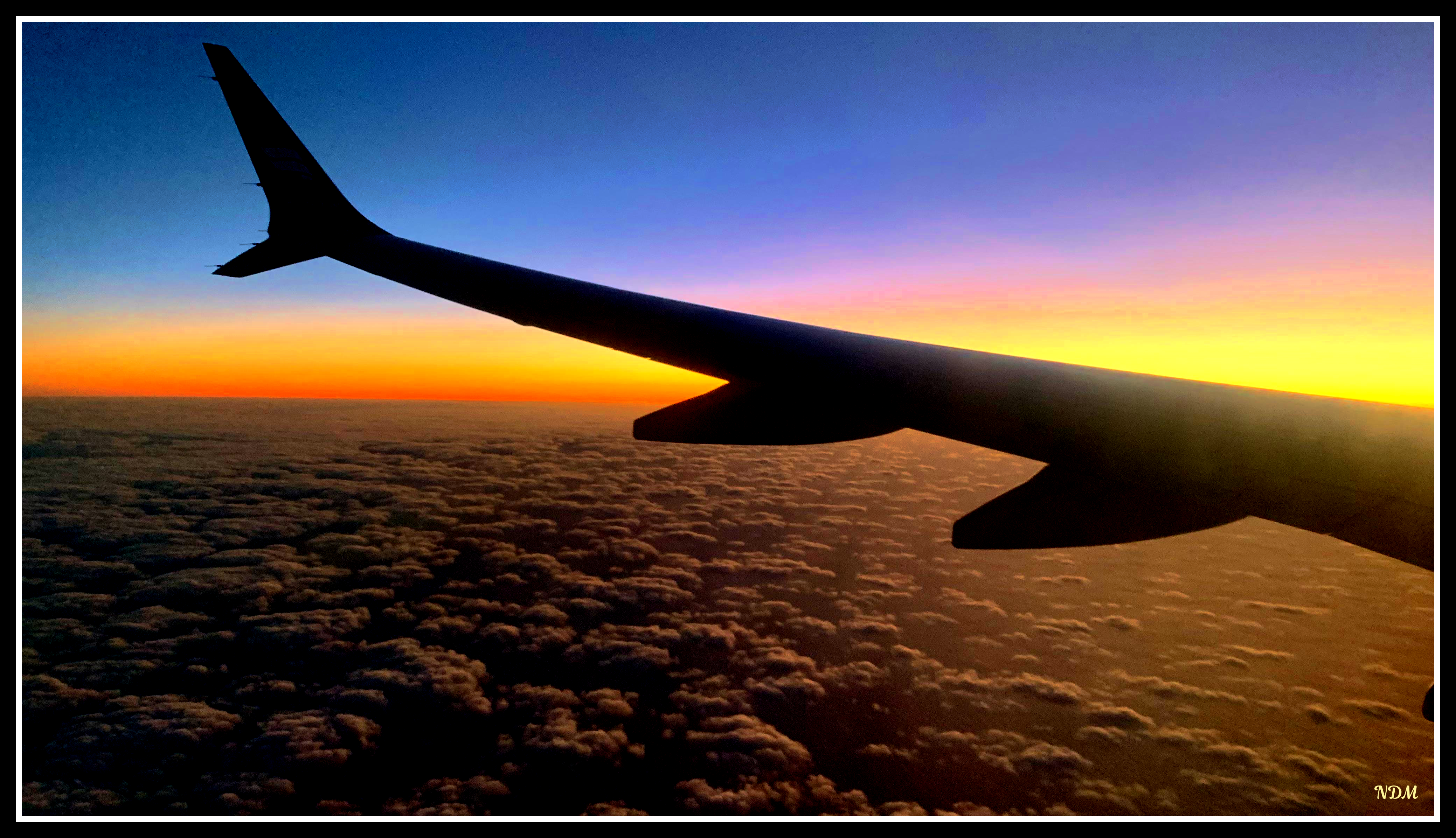
I have learned over time that perspective matters, and it will matter even more in 2026. Sometimes we will be looking at events from far above, trying to understand patterns, systems, and history. Other times we will be standing right on the ground, dealing with the real consequences of decisions made far away. We need both views. Clarity comes from knowing when to zoom out, and when to pay close attention to what is happening right in front of us.

Last night, someone I respect deeply said something to me, quietly and without drama, about what they would be willing to do if things truly came to a point where Canada’s sovereignty was compromised. It surprised me, not because it was extreme, but because it was measured and thoughtful, rooted in a lifetime of understanding what responsibility actually means. That will stay with me as I enter the new year. It reminded me that seriousness and commitment still exist and so does the willingness to stand up when it matters.

I do not know how much time I have on this earth. None of us does. But I know this. I am not leaving it without knowing I did every damn thing I could to make a difference. In 2026, that means being a little bolder and a little more connected to my civic duty. I hope those who can will do the same. I am not asking anyone to abandon their life. I want you to care for your family. I want you to protect your livelihood. I want you to hold onto the personal joys that no amount of political chaos can take from you. I will not confuse gratitude with complacency. Individual effort only matters if it contributes to something larger.

So if you have never written a letter to an elected representative before, write one now. If you have never questioned a headline, start. If you have stayed silent because you thought your voice did not matter, let this be the year you test that belief.

Standing on the final day of the year, this feels less like an ending and more like a pause. The kind that comes just before something begins. It feels as though the entire orchestra is taking its seat. Some of the music may sound like joyful. Familiar and uplifting. Other moments may feel far heavier, closer to music played in times of mourning or reckoning. Most likely, it will be a mix of both. What is clear is that the music is building and the crescendo is growing. It will not simply fade out on its own.

I appeal to my readers. Please do not stay perched!

As the clock moves toward midnight and this year gives way to the next, time does not pause with us. Whatever comes will arrive whether we are ready or not. The year ahead will test us, not just individually but collectively. How we respond, how quickly we pay attention, and who chooses to step forward when it matters will shape what follows.

This is not a moment for spectatorship. Time is already moving. What we choose to notice and respond to still matters.

Where Humanity Takes Flight

Posted: December 11, 2025 in Uncategorized
Tags: , , , ,

So my conversation today isn’t supposed to be about politics. Well, yes it is, and no it isn’t. What it’s really about is humanity, compassion, decency, and the expectations we set for the people who lead us and for the people we choose to be.

Some of you know me through the stories I tell. I’m not a historian or a journalist, I speak from lived experience, from the people and places that shaped me. And today, even though I said I wasn’t going to talk about politics, how can I talk about how we treat other human beings without landing there?

With yesterday’s talk of requiring five years of social media history just to enter the United States, it became clear that many of us, myself included, won’t be visiting anytime soon. Honestly, I’m not sure I’ll miss it. I’ve been to Disney more times than I can count; I’ve walked New York; I can survive without Vegas.

What I can’t survive without is my sense of humanity, and today I was reminded of where it comes from.

I grew up in Moncton, a small city in New Brunswick. In the 60s and early 70s it looked overwealmingly white, like so many communities across Canada. The exception was the steady stream of students from around the world who came to learn to fly at my father’s flight school. That was my normal. As a teenager I was pumping avgas, dispatching flights, and working around those students. I grew up in a hangar full of languages, accents, hopes, and dreams. I didn’t understand then what a gift that was.

A few months after my father passed away in 2008, a letter arrived from one of those former students, Israel Ameh of Nigeria. I hadn’t known him at the time he trained in Moncton, I had already left Moncton, but his words captured exactly who my father was and what humanity can look like when lived fully and without prejudice.

Here is his letter, unchanged: “I came to Canada from Nigeria in 1982 to learn how to fly. Even before I got here I felt like I knew Mr. McClure as he tried to make my voyage to Canada as trouble-free as possible. When I arrived at the Moncton Train Station on August 2nd 1982, Don sent his Cool Station Wagon to pick me up. He made the MFC become like… a revolving family setting and as I needed to take different courses, I did not think twice about where to return for those courses. When I returned in 1988/89 and got my Flight Instructor rating, Don helped me get my First and second jobs. His recommendation also made securing a Work Visa easy. I ended up marrying from Buctouche making the Moncton area part home. In 2008, I found Don’s email address on the Internet and sent him a thank you letter which was unfortunately returned due to a bad email address. When I learnt of his passing, it was a sense of tremendous loss that I did not get to thank him for all he did in my life. Mr. McClure, I know you can still read this and I want to say THANK YOU for being such a wonderful person. You practised equality and globalisation with sterling vision before it became fashionable. To many of us, you were like a father. I still remember a talk you gave to me in 1985 about AIDS and why us young men had to be aware and cautious. Other students laughed at the time but it made me into a better man. From the provinces of Canada, Libya, Nigeria, UK, the Carribeans, Nepal, India, Pakistan and all other places that sent men and women to you to turn into Pilots, I think I speak for all of them when I say the world lost a Great Man. Rest in Peace Don, but I know that if they have airplanes in Heaven, you will be helping run an efficient operation and checking up on the airplanes and asking why they are not up flying just as you did to keep us on our toes; but most of all, thank you for changing the life of an 18 year old from an African village.”

That letter, especially that last line, tells you everything about my core. And it’s why, when I hear Donald Trump speak of Haiti or Africa or Afghanistan as though the people from those places are somehow lesser, it hits like a gut punch. It dishonours the young men and women I grew up around. It dishonours my father. And it dishonours that young man whose life changed because someone treated him with dignity.

Trump, born with every advantage, has no understanding of what it means to build your life by strength, opportunity, and gratitude. No understanding of being a guest in another country. No understanding of leadership grounded in humanity. This isn’t left or right. It’s about whether we widen the circle or shrink it until only people who look like us get to belong.

Most of you reading this already get that. But maybe someone, somewhere, will feel something crack open. Because there are cracks everywhere right now, cracks in the asphalt, cracks in the façade of cruelty-as-strength. But dear God, don’t let this be the world our children and grandchildren inherit. Not a world sliding backward into suspicion and hate toward anyone who doesn’t look like us.

If an 18-year-old from an African village could take flight because someone believed in him, then surely we can choose humanity.

Surely we can chart a better course, one where compassion, not fear, keeps us airborne.

September 11

Posted: September 11, 2025 in Uncategorized
Tags: , , , ,

Twenty-four years. I remember every moment.

I had just sent my older son off to school. My younger one was a toddler, wandering around the kitchen while I stood at the island with paperwork spread everywhere, the TV set propped on the counter. And then the news alert saying the first tower was hit. Like everyone else, I was watching when the second was hit. I didn’t sit down. I just stood there, trying to keep my little one occupied, trying to absorb something that would change all of us forever.

My dad was still alive then. I called him from Calgary, his voice steady from New Brunswick, but we both knew this was different. He was a man who lived by service, signing on with the Royal Canadian Air Force in 1941, then dedicating his life to his community and volunteerism. We spent much of that day talking and processing what we had seen and heard. That day reminded me just how fragile the world could be, and how deeply our choices matter. The loss of innocence for the generation before me was the Second World War. For me, it was September 11, 2001.

My sister and her husband live in Gander, Newfoundland and like most of the community opened their hearts when the planes arrived. My brother in law was an air traffic controller, but more importantly a very active member of his community. And that small community of fewer than 10,000 took in almost 7,000 stranded passengers. If you don’t know that story, you don’t know one of the proudest chapters in Canadian history. They fed, housed, clothed, and comforted complete strangers. They showed the world what it means to be human.

That day was also a reminder of the Canada–U.S. relationship. In modern history, outside of the Second World War, there has been no moment when we stood more firmly with our American friends. We didn’t hesitate. Because geography placed us side by side, but history, sacrifice,and human decency kept us there.

It was John F. Kennedy, speaking in Canada’s House of Commons in 1961, who said it best:

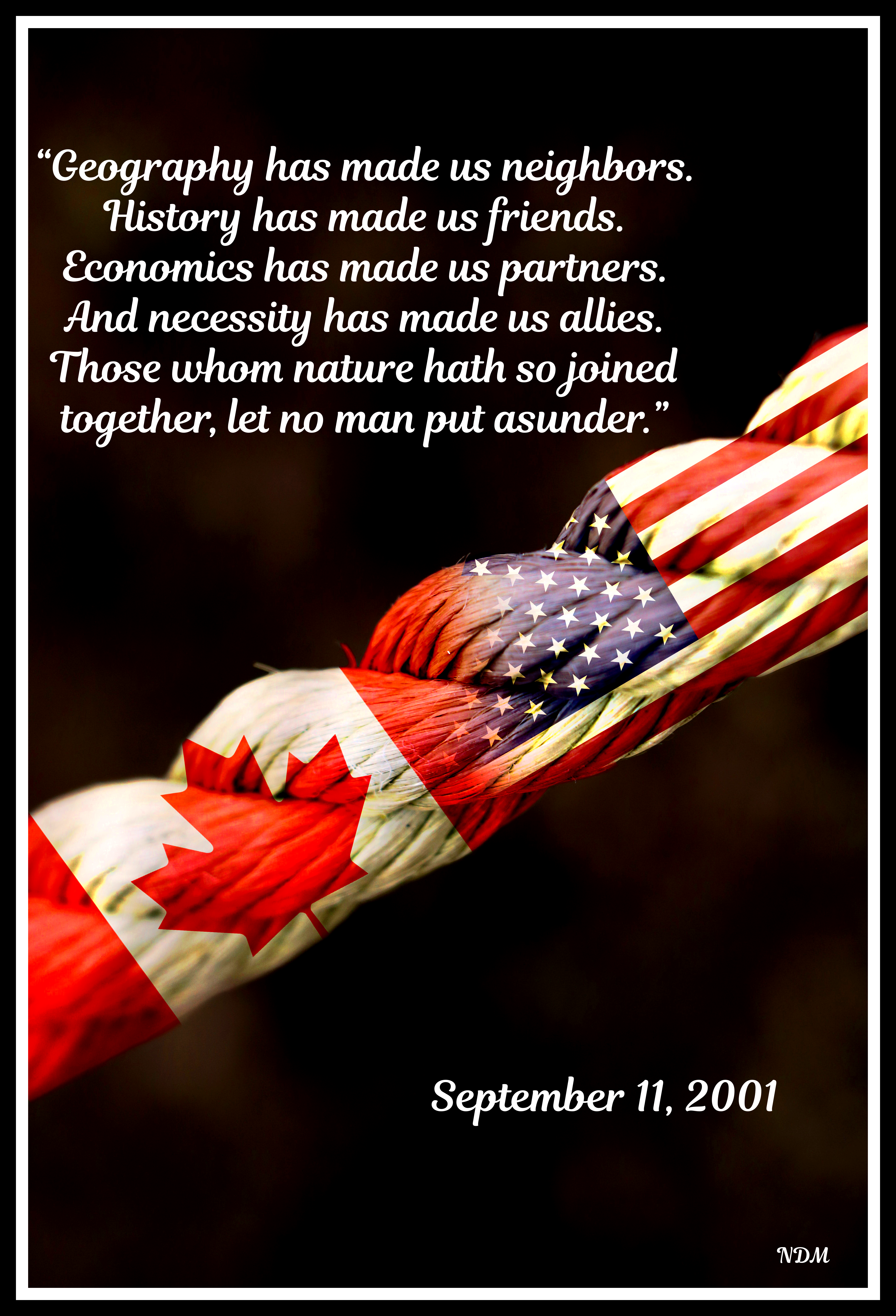
“Geography has made us neighbors.
History has made us friends.
Economics has made us partners.
And necessity has made us allies.
Those whom nature hath so joined together, let no man put asunder.”

That is what I hold onto today. Because I look at where we are now, at the toxic politics, at the self-serving narcissism of one man determined to tear countries apart rather than bring them together, and I think: my God, what a loss. The Department of War is not strength. Defense is strength. Community is strength. Humanity is strength.

For those too young to remember 9/11: this isn’t about the loss of shampoo bottles in your checked luggage or the inconvenience of airport security lines. It’s about the moment when thousands of lives were ended in real time, on live television. It’s about the day when every school teacher in North America looked at their classroom differently, wondering how to explain the unexplainable to terrified children. It’s about the trauma imprint, on parents, on kids, on communities, that still lingers close to a quarter century later.

I think of my own children and how that fear landed in our home. The phone calls to family. The way the air itself felt heavier. The stunned silence on streets and in the grocery store. I believe as I speak these words, I can still feel what it felt like. And as I write, I try to honour both the factual pieces of that day and the raw human pieces of how we felt.

That is why Gander matters. That is why our shared history matters. We rose to support our American neighbours not because of politics, but because of humanity. Because Canadians understood instinctively that the border was invisible when people were in need. And we acted on it.

And yet, walking through every single day now, watching the constant erosion of our shared ideals, the loss of that relationship between the United States and Canada feels even more hurtful. The U.S. once needed and wanted the world’s help. Now, under leaders who confuse bravado with strength, it acts as though it doesn’t. That breaks something in me. Because for all our differences, for all our arguments, the bond forged in tragedy should have been unbreakable.

But bonds only hold if we choose to honour them. The lesson of September 11th isn’t just about vigilance; it’s about unity. It’s about ordinary people doing extraordinary things in the face of fear. It’s about our country who opened its arms to stranded strangers and made them neighbours.

I miss being able to call my dad to talk about the things going on in our world, to hear what he would say. And yet, I’m also glad he isn’t here to see the anger and division that have followed. What I know is this: there are still people fighting for our country, not with weapons, but with words, service, and courage. They are the counterweight to war. The living proof of Kennedy’s words.

We say we will never forget. And we shouldn’t. Because forgetting isn’t just about losing memory; it’s about losing ourselves. And if September 11th taught me anything, it’s that the opposite of fear is not comfort, but action.

On that day, our innocence shattered, but our humanity showed. Today, our politics are bitter, but our capacity for decency still exists. It’s up to us to defend it, fiercely, to make sure geography and history continue to bind us, and to refuse to let any man, no matter how powerful, put it asunder.