Posts Tagged ‘mental-health’

Beyond The Pale

Posted: December 16, 2025 in Uncategorized
Tags: , , , ,

There are so many things happening right now that make it hard to know what truly matters, or what deserves attention. I try to keep my writing rooted in Canadian context. In our values, our humanity, and our political reality, and yet we all know that so much of our public conversation gets tugged off course by the behaviour of the President of the United States. It creates this constant state of “pending,” waiting for the next outburst, the next shockwave, the next moment that should never be normal but somehow becomes part of the daily noise.

But this time, the noise has become something else entirely. Last weekend in Los Angeles, a man and his wife were killed by their adult son, who had long struggled with addiction and mental illness. Their celebrity is not the relevant point here. This is, at its core, a human tragedy before it is anything else and it is one that cuts deeply because it speaks to something I know too well.

Very few people know this about my family, but with my husband’s permission, I will share this. In June 2020, my husband’s only sister, in fact only sibling was murdered in her own home by her adult son, who had battled mental illness and addiction for years. Cold Lake, Alberta, where this happened, is an Air Force base community. Although retired at the time, both my sister in law and her ex-husband had served their country in the Canadian Armed Forces and had remained in Cold Lake because of their deep connection to that community.

Everything that followed, the hearings, the grief, the confusion, the guilt, the hollowed out days, was its own kind of hell. Unless you’ve lived inside that nightmare, you cannot understand the full weight that lands on a family’s shoulders, or how impossible it is to reconcile love with tragedy.

So when I look at the Reiner family, I don’t see celebrity. I don’t see politics. I see human beings, stunned, grieving, horrified, ashamed, questioning themselves, replaying every moment where they wonder if something, anything, could have gone differently. That is what this kind of tragedy feels like. It is not something any family imagines they will ever have to say aloud. We certainly didn’t.

Most people, even many who support Donald Trump, seem genuinely appalled by the comments he made about Rob Reiner in the immediate aftermath of this unimaginable loss. And for good reason. When Charlie Kirk was murdered, there was strong criticism directed at anyone who even hinted that such violence was justified. And rightly so. That is the morality line a healthy society should hold.

So how can a President of the United States justify criticizing Rob Reiner’s family in their darkest hour? If cruelty was wrong then, how is it suddenly acceptable now?

“Beyond the pale” is the phrase I’ve heard repeatedly these last few days, and for once it feels accurate. It was cruelty for sport. And then he doubled down on it. Clearly there is no political ideology that excuses mocking a grieving family. Not conservative, not liberal, not anything.

Rob Reiner was known to most of us as “Meathead” on All in the Family, or as the director of films like Stand By Me, A Few Good Men, The Princess Bride, When Harry Met Sally, and Spinal Tap. Yes, his political views were strong. Many people disagreed with them. None of that matters today. A man and his wife were murdered, and their surviving family is shattered.

And yet the loudest, most powerful political voice in the United States chose, at this moment, to dehumanize them.

When people ask, “Why didn’t the family fix it?” I can only say this: you have no idea how hard families try. For years. For decades. With professionals, without professionals, with hope, without hope. Addiction and severe mental illness are not solved by parental willpower. They are battles that break families long before the worst day arrives.

Rob Reiner’s family is no different than ours was in 2020. They lived in pain, trying everything they could. And now they face a grief that will never fully heal.

This goes beyond politics. It goes beyond partisanship. It goes beyond anything a reasonable society should tolerate. Donald Trump crossed a moral line, maybe worse than any he has crossed before . And I say that as someone who has lived the reality of this kind of tragedy, who knows the shame, the confusion, the judgment, and the quiet, desperate question: What more could we have done?

There is no forgiveness for attacking a family in that moment. And I believe, truly, that this will be a defining point for many people, even among his supporters. Some moments reveal a person’s character in ways that cannot be dismissed, spun, or excused. This is one of them.

So let me finish with this:
If anyone tries to tell me that this is still about “the good things Trump is doing,” or that there is some political justification for this behaviour, then you’ve just met your match. This is the moment where I’m done entertaining those arguments. There is a line between disagreement and cruelty, and he stepped so far past it that there’s no coming back.

And if this moment doesn’t make people rethink their loyalty, then nothing will, because if cruelty toward the grieving isn’t a deal-breaker, what on earth is?

Politics across the globe feel dangerous in a way that is hard to articulate without sounding alarmist, but alarmed is exactly what we should be. The world is sitting on a fault line. Every major decision made by the global superpowers reverberates across continents, supply chains, borders, households, and families. No one is insulated. And while Canadians have a uniquely deep economic and geographical relationship with the United States, this moment isn’t just about us. It’s about the entire world and its future.

Today we learned that the head of NATO expects the alliance to be formally at war with Russia within the next five years. I’m not unpacking that intelligence or the what-ifs around it. But I am acknowledging the obvious: three of those years will unfold under Donald Trump’s second presidency. And that reality, paired with what we’re seeing in front of our eyes, has pushed me to talk about something I’ve deliberately avoided.

I have a close family member living with a memory-loss disease. I’ve never said that publicly because it hurts, because naming it out loud makes it real, and because I’ve never wanted to use their struggle as a metaphor. But over these past months, as politics have escalated into something darker, I’ve found myself unable to ignore parallels in patterns of behaviour I’ve personally witnessed and the behaviour we see, daily, globally, from the President of the United States.

To be clear, I am not making a diagnosis. I’m not a doctor. I’m not suggesting equivalency. One is a loved one who lived a good, quiet life and deserves compassion and safety and never acts from a place of cruelty or evil. The other is the most powerful person on Earth. But I am talking about recognizable human patterns, changes in speech, changes in focus, erratic storytelling, unshakeable belief in invented narratives, emotional volatility, unusual physical mannerisms, and moments that simply do not match past behaviour.

Back in Trump 1.0, we all witnessed the erratic late night tweets, the mood swings, the wild pivots, the sudden tangents, behaviour that became part of the spectacle, part of the chaos-for-show that defined his first term. It was volatile and unnerving, but it was still framed as “Trump being Trump,” an exaggerated performance wrapped in grievance and bravado.

But it wasn’t until recent months that people began using the word “sundowning” in a more serious way, pointing to his increasingly disorganized late-night Truth Social posts, sharper emotional swings, moments of confusion that couldn’t be brushed off as theatrics, and most of all, the growing certainty with which he clings to things that simply aren’t real. For those of us who have lived with someone who truly does experience certain changes in behaviour and ‘imaginings’ the parallels are impossible to ignore. The volatility, the slipping coherence, the absolute conviction in invented narratives, once you’ve seen these patterns up close, it is deeply unsettling to watch echoes of them play out on a global stage.

In my family’s case we made the heartbreaking decision to place our loved one somewhere safe, supported, respected, and protected. They hold no power, no weapons, no military chain of command and yet we knew we had to make that decision. They require care, patience, and stability. And they deserve that.

Now imagine a similar pattern of behaviour, but the individual holds the largest nuclear arsenal on the planet, commands 1.3 million active-duty service members, and is treated by his closest advisors as flawless and unquestionable. Imagine that person at the centre of a geopolitical world already teetering, and imagine that no one around them is willing, or able, to intervene.

That terrifies me. And it should terrify every Canadian, every ally, every democracy. Not because we dislike his politics. Not because we preferred Biden. But because unchecked power combined with unchecked behaviour is historically catastrophic.

And yes, there were legitimate questions about Biden’s age and capacity. Some of that should have been more transparent. But Biden, for all his flaws, did not glory in cruelty. He did not fantasize about retribution. He did not weaponize the military against political enemies. The comparison is not equivalent.

As Canadians, including those of us in Alberta, we must choose leaders who will not normalize this, who will not run to Mar-a-Lago for approval, who will not bend the knee for trade favours or photo-ops. Mark Carney was never going to “manage” Donald Trump, because Trump is unmanageable. Only those closest to him can intervene. That is the point and the danger. No one is doing that.

I also know I’m not alone in this world. We are living in a time where more and more families are navigating memory-loss diseases. Millions of people understand these behavioural patterns because they live with them every single day. And yes, I know many people are waiting for the full release of the Epstein files and the Caribbean boat incident, and those disclosures absolutely matter. But just as urgent is something far closer to the present: there needs to be a full, unambiguous disclosure of this man’s cognitive and neurological assessment, not another distraction about how “perfect” his heart supposedly looked or another deflection about cankles. Transparency about his actual capacity is not a luxury; it is a global safety issue.

Something is happening, and the people around Donald Trump are doing nothing. That is what keeps me up at night. That is why I am breaking my silence about my family’s situation. Because I know what these patterns look like up close. And when I see echoes of those patterns in the Oval Office, backed by absolute power, global instability, and a circle of enablers?

Yes, it terrifies the hell out of me.

September 11

Posted: September 11, 2025 in Uncategorized
Tags: , , , ,

Twenty-four years. I remember every moment.

I had just sent my older son off to school. My younger one was a toddler, wandering around the kitchen while I stood at the island with paperwork spread everywhere, the TV set propped on the counter. And then the news alert saying the first tower was hit. Like everyone else, I was watching when the second was hit. I didn’t sit down. I just stood there, trying to keep my little one occupied, trying to absorb something that would change all of us forever.

My dad was still alive then. I called him from Calgary, his voice steady from New Brunswick, but we both knew this was different. He was a man who lived by service, signing on with the Royal Canadian Air Force in 1941, then dedicating his life to his community and volunteerism. We spent much of that day talking and processing what we had seen and heard. That day reminded me just how fragile the world could be, and how deeply our choices matter. The loss of innocence for the generation before me was the Second World War. For me, it was September 11, 2001.

My sister and her husband live in Gander, Newfoundland and like most of the community opened their hearts when the planes arrived. My brother in law was an air traffic controller, but more importantly a very active member of his community. And that small community of fewer than 10,000 took in almost 7,000 stranded passengers. If you don’t know that story, you don’t know one of the proudest chapters in Canadian history. They fed, housed, clothed, and comforted complete strangers. They showed the world what it means to be human.

That day was also a reminder of the Canada–U.S. relationship. In modern history, outside of the Second World War, there has been no moment when we stood more firmly with our American friends. We didn’t hesitate. Because geography placed us side by side, but history, sacrifice,and human decency kept us there.

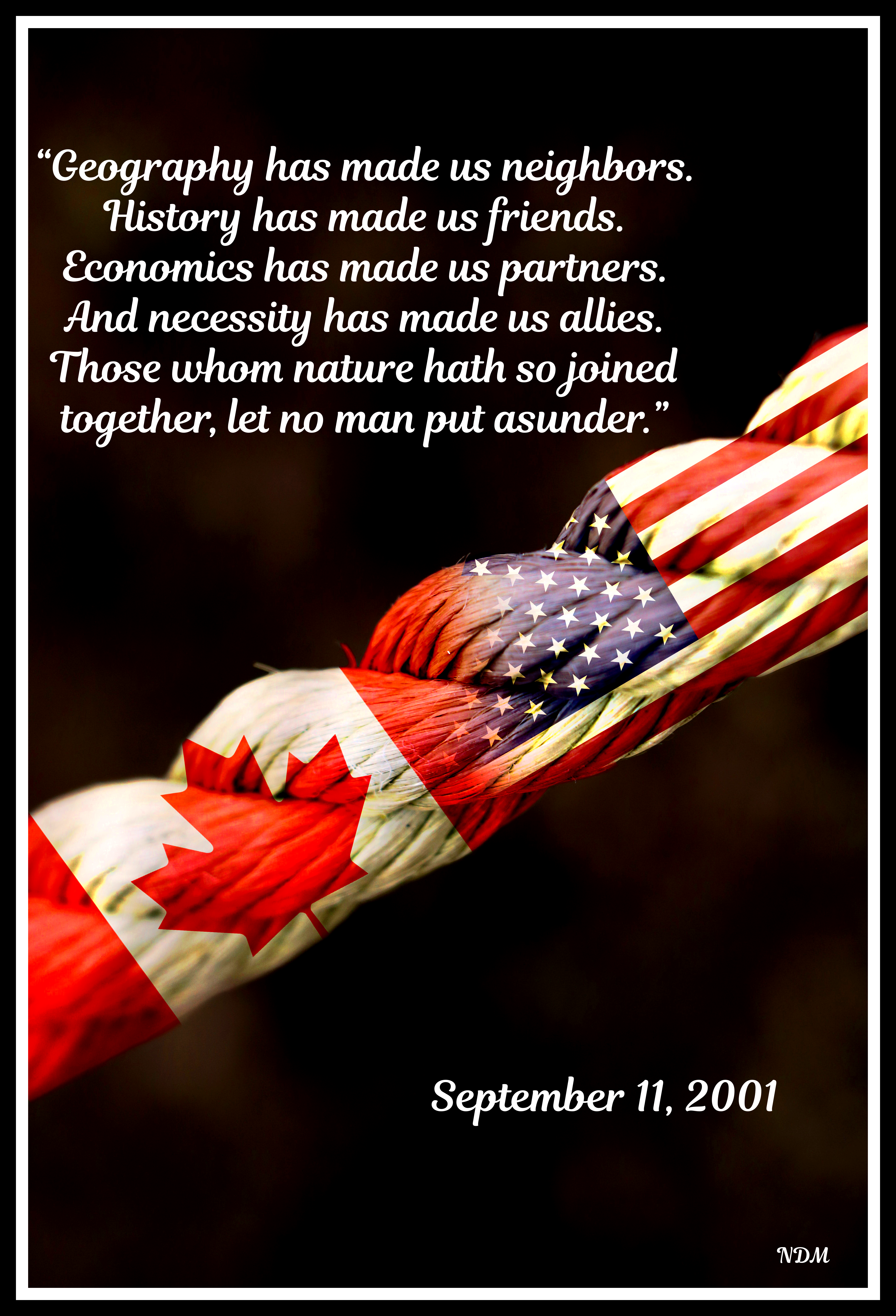
It was John F. Kennedy, speaking in Canada’s House of Commons in 1961, who said it best:

“Geography has made us neighbors.
History has made us friends.
Economics has made us partners.
And necessity has made us allies.
Those whom nature hath so joined together, let no man put asunder.”

That is what I hold onto today. Because I look at where we are now, at the toxic politics, at the self-serving narcissism of one man determined to tear countries apart rather than bring them together, and I think: my God, what a loss. The Department of War is not strength. Defense is strength. Community is strength. Humanity is strength.

For those too young to remember 9/11: this isn’t about the loss of shampoo bottles in your checked luggage or the inconvenience of airport security lines. It’s about the moment when thousands of lives were ended in real time, on live television. It’s about the day when every school teacher in North America looked at their classroom differently, wondering how to explain the unexplainable to terrified children. It’s about the trauma imprint, on parents, on kids, on communities, that still lingers close to a quarter century later.

I think of my own children and how that fear landed in our home. The phone calls to family. The way the air itself felt heavier. The stunned silence on streets and in the grocery store. I believe as I speak these words, I can still feel what it felt like. And as I write, I try to honour both the factual pieces of that day and the raw human pieces of how we felt.

That is why Gander matters. That is why our shared history matters. We rose to support our American neighbours not because of politics, but because of humanity. Because Canadians understood instinctively that the border was invisible when people were in need. And we acted on it.

And yet, walking through every single day now, watching the constant erosion of our shared ideals, the loss of that relationship between the United States and Canada feels even more hurtful. The U.S. once needed and wanted the world’s help. Now, under leaders who confuse bravado with strength, it acts as though it doesn’t. That breaks something in me. Because for all our differences, for all our arguments, the bond forged in tragedy should have been unbreakable.

But bonds only hold if we choose to honour them. The lesson of September 11th isn’t just about vigilance; it’s about unity. It’s about ordinary people doing extraordinary things in the face of fear. It’s about our country who opened its arms to stranded strangers and made them neighbours.

I miss being able to call my dad to talk about the things going on in our world, to hear what he would say. And yet, I’m also glad he isn’t here to see the anger and division that have followed. What I know is this: there are still people fighting for our country, not with weapons, but with words, service, and courage. They are the counterweight to war. The living proof of Kennedy’s words.

We say we will never forget. And we shouldn’t. Because forgetting isn’t just about losing memory; it’s about losing ourselves. And if September 11th taught me anything, it’s that the opposite of fear is not comfort, but action.

On that day, our innocence shattered, but our humanity showed. Today, our politics are bitter, but our capacity for decency still exists. It’s up to us to defend it, fiercely, to make sure geography and history continue to bind us, and to refuse to let any man, no matter how powerful, put it asunder.

Life is short

Posted: August 12, 2025 in Uncategorized
Tags: , , , ,

Life is short…I am writing this as one of my highest-level appeals. Please, I implore you to pay attention.

On November 6th, when the U.S. election ended, I spoke to the people closest to me about what it meant for our world. Intellectually, I knew the dangers. I talked about them often. But deep down, I didn’t believe we would end up here. I was upset enough to stop writing about politics for months. I hoped it wouldn’t come to this.

But here we are. Donald Trump, and let’s stop sugarcoating this, is a dangerous man. I believe he is a psychopath. If he is capable of genuine love, perhaps some child or grandchild will tell me so. I cannot comprehend a human being with such a lack of compassion, such an absence of moral core, without some clinical explanation.

And now we have the National Guard moving into Washington, D.C. We don’t know exactly what’s next, another city, another country? On Friday he will be in Alaska, where the only thing separating Russia and North America is a narrow strip of the Bering Strait. Trump is set to meet with Vladimir Putin there. That’s not just a photo op. And it terrifies me. What exactly will Trump promise him? What would he give away? We know Putin doesn’t respect Trump, but he can use him. And that’s more dangerous.

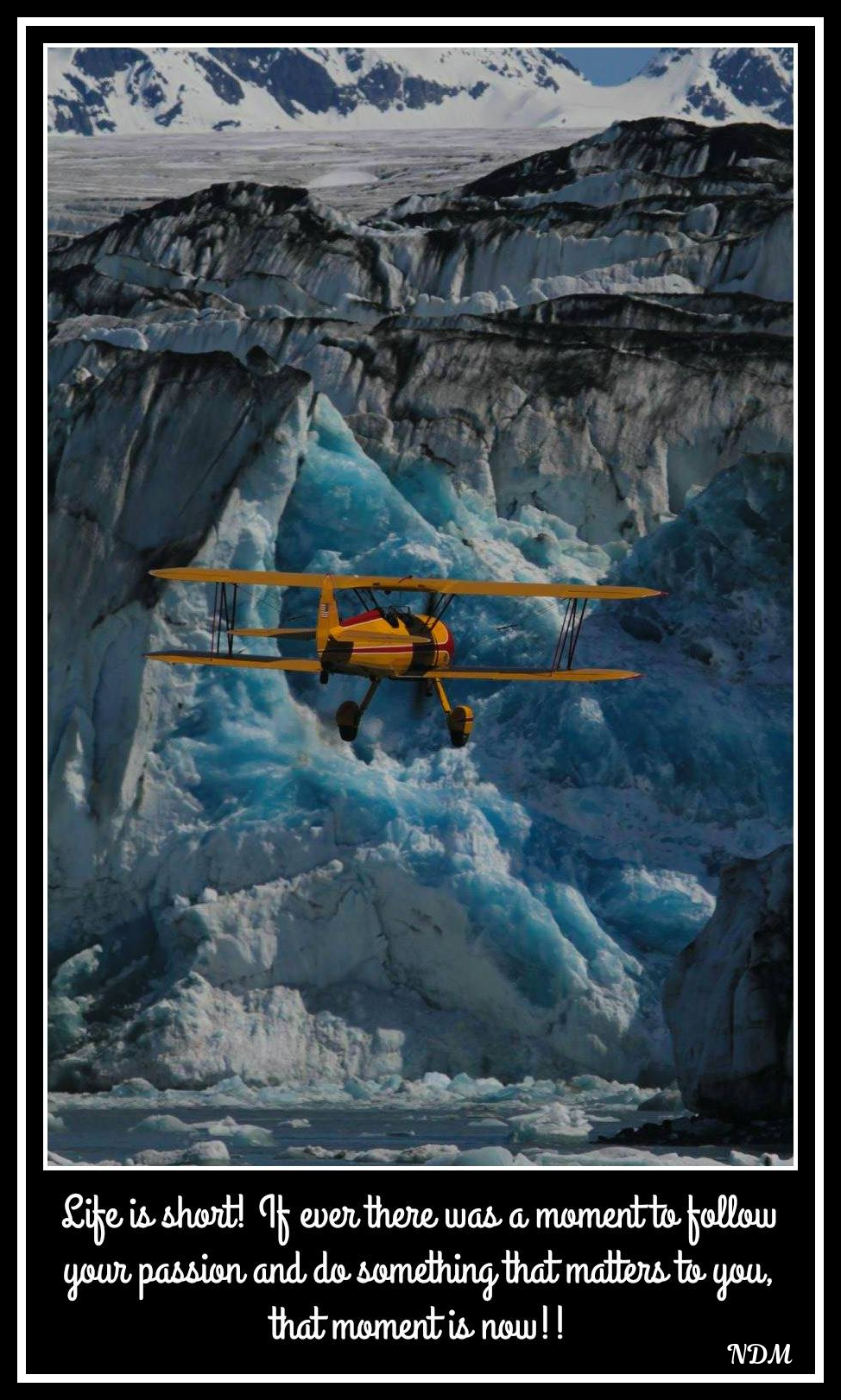
The picture I’m using for this post comes from Alaska, but it’s not just any Alaska picture. It’s my late friend Marcus Payne, flying his beloved aircraft over his homeland’s ice fields. Marcus was a Renaissance man of unbelievable talent. He wasn’t just an airshow pilot and TV personality, he was a U.S. Air Force veteran, a lawyer, a Washington lobbyist, a missionary, and an environmentalist. And oh, the political conversations we had. We lost him tragically nine years doing what he loved, but I can tell you, we would have had a lot to talk about now. He believed in living with purpose, and he understood how fragile both our environment and our democracies are. That’s why this image matters, because the stakes we face are as sharp and real as the glacier walls beneath his wings.

For my fellow Albertans flirting with separatism, listen carefully: if you think Alberta could somehow be better off alone, you are wrong. You will not be strong enough, no matter how much oil and gas you have, to stand against the American machine. You will lose control over your resources. You will lose your say in how they are managed. And you will be at the mercy of leaders who would happily trade your future for their personal gain.

I’ve written post after post asking people to explain how Pierre Poilievre would operate in today’s geopolitical climate, the one Mark Carney is currently navigating. I’ve yet to see a single thoughtful, detailed answer. Publicly, I get slogans. Privately, I get messages that range from nonsensical to outright frightening. But not once has anyone been able to describe how Poilievre would handle Trump, Putin, or China while safeguarding Canada’s sovereignty.

Although I always write from the heart, with passion, urgency, and the hope that people will better inform themselves, this time is different. This one is affecting me more deeply. No one likes to think about being in the last part of their life. But I never imagined I’d be in this stage terrified for the world I’m leaving behind for my children, grandchildren, and everyone who comes after. My need to speak up is more urgent than it has ever been. I will not let anyone say I stayed silent. I will not have it said that I didn’t try to help people understand how critical our situation is.

I know it’s hard to know what we can do. People ask me all the time, “But what can I do?” Maybe my words here don’t feel as effective as they could be. After all, most of my readers already think like I do. But if you have friends in the U.S., or anywhere else in the world, share this with them. We need to go beyond “I hate Trump” or shallow political insults. We need to talk about what his leadership really means.

These are not just distraction tactics from Trump. It’s his lifetime pattern. Call it narcissism if you like, but it’s something far beyond the everyday kind.

So, who still stands by him? In my view, there are four groups:

1. The MAGA base, statistically more likely to be less informed or less educated. That’s not an insult, it’s reality. But it’s also no excuse. 2. Christian fundamentalists who are sometimes organized under banners like The Family, who push a narrow, rigid worldview into public policy. Their vision of morality is less about compassion and more about control. 3. Billionaires (and “billionaires-lite”) they care only about increasing already obscene fortunes, no matter the human cost. and 4. Republican lawmakers who have abandoned any vision of what is right, and sold their integrity to cling to power.

And to those lawmakers, I ask again: did you not think of your daughters when women’s rights were stripped away? Where are you as education and research to benefit your grandchildren is erased. And how can you ignore that the United States is beginning to look more like The Handmaid’s Tale than the “land of the free”? And to the daughters and sons of these lawmakers, the millennials, the Gen Xers, please speak up. Maybe hearing it from you will pierce the armour of power and greed. Someday those lawmakers will be on their deathbed, and will their final words be, “My God, I ignored my own child so I could hold onto my seat”? How pitiful.

We are standing at a point where silence is complicity. Our voices have to be loud, so loud they can’t be ignored, so loud they carry across borders and into the rooms where decisions are being made. Every single person’s voice matters, no matter how small you think your reach is. I, for one, will use mine in every way possible. If my role in this fight is to write these words, to push, prod, and occasionally shove people into paying attention then I will keep doing it. Not because I like shouting into the void, but because I refuse to be like one of those legislators lying on my deathbed thinking, I didn’t do enough.

Hope and defiance can live in the same breath. Hope says there is still time to change things. Defiance says we will fight like hell to make sure we do. So write, speak, march, vote, shout, actually whatever your voice looks like, use it. Because the worst thing we can do right now is nothing. And nothing is exactly what those in power are counting on.