Posts Tagged ‘pierre-poilievre’

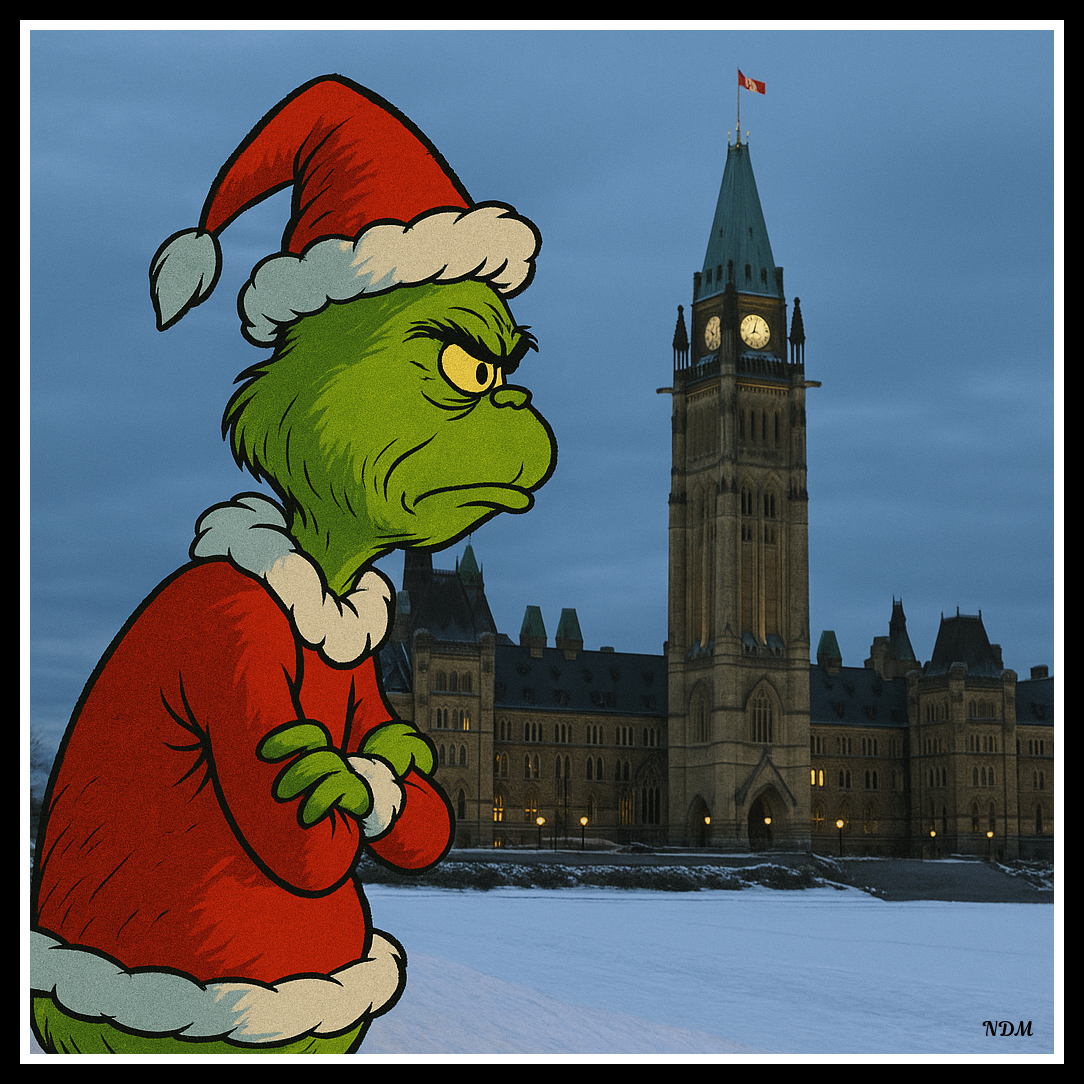
Last week in the House of Commons, Canada’s Secretary of State for Sport, Adam van Koeverden, delivered a speech that was sharp, funny, and painfully accurate. And for everyone still defending Pierre Poilievre and the style of politics he has perfected, it was a reminder of exactly what that legacy is in the words of MP van Koeverden.

“Mr. Speaker, remember when the Grinch tried to steal Christmas? He drove all the way up to the top of Mount Crumpit because he had everything that he needed, and he was going to throw the gifts that the Whos deserved because he thought they didn’t deserve to have nice things. It’s kind of like the leader of the Conservative Party, Mr. Speaker. For 25 years, he’s had dental care because he’s had a job here in the House of Commons, so he votes against dental care for 9 million Canadians. He’s got secure housing. He lives comfortably at Stornoway in government-owned housing, so he votes against affordable housing for millions and millions of Canadians. My Christmas wish is that the leader of the Conservative Party comes back in January with a heart that’s grown three sizes and tries to help a Canadian for once in his 21 years.”

That is Poilievre’s political biography in a paragraph. He is a man who has enjoyed every structure of public stability while dedicating his career to denying those same supports to everyone else. And rather than come back after he “won” or, let’s be honest, acquired his Alberta by-election in a riding that any Conservative could win in a coma, did he return with a better attitude? A vision? A grown heart? Anything?

No. He returned with the exact same tone, and the same fixation on Justin Trudeau that his followers can’t seem to let go of, despite the fact that Trudeau isn’t even in politics anymore. It has become some kind of reflexive obsession, a default setting they can’t reset, and it would almost be funny if it weren’t so detached from the reality the rest of us are living in.

For the continued supporters of Pierre Poilievre note that in 21 years he has not produced a single original idea. Nothing substantive, nor visionary. Nothing that withstands even casual inspection. Ask his supporters to name a policy, and they can’t. They can only tell you who they dislike. The only people insisting he’s “leadership material” are perched so far on the right flank of conservatism that competent global diplomacy looks like a threat to them.

Meanwhile, the same voices who accuse the Liberal government of being “socialist” conveniently forget that Canada’s core social programs that they likely embrace, such as unemployment insurance, public healthcare, old age security, and the Canada Pension Plan are exactly the kinds of systems they claim to oppose. And let’s not forget the single biggest fiscal challenge of the past five years, COVID. I would pay good money to see the statistic showing how many small government Conservatives cashed their CERB cheques without hesitation. Canadians across every political stripe were grateful for that “socialist” support when they needed it. Funny how ideology melts when the deposit hits the account.

Because here’s the uncomfortable global truth. There is no Conservative leader right now who would receive the level of international respect Mark Carney does. Could one emerge? Possibly. But the only route to international visibility available to the current Conservative movement is alignment with Donald Trump’s authoritarian worldview and Vladimir Putin’s destabilizing ambitions. That’s the company they’ve chosen.

And that should worry all of us. Leadership in 2025 is not just about the economy. It’s about safety. Economic strength collapses without geopolitical stability. Trade dies without trusted alliances. Investment evaporates when partners can’t count on you. Safety is the foundation of everything, and right now, Conservative politics offers no path to a safer Canada.

Meanwhile, we have a Prime Minister who is respected internationally, who is navigating one of the worst tariff crises in decades, and who does understand the complexity of global economics. Mark Carney is not perfect, no leader is, but he has the credibility Canada requires at a moment when credibility is currency.

And yet, the Conservative Party marches forward behind a man whose political compass points only toward resentment and reduction. A man who has had every benefit of public life yet opposes extending those same benefits to the people who fund them. A man who believes anger is a national strategy.

But unlike the Grinch, this story doesn’t end with a heart growing three sizes. In fact, if anything, every year he sounds more like the guy standing on the hill screaming about the downfall of Whoville while offering exactly zero ideas for how to fix it. A man who wants power with all the enthusiasm of someone who’s never bothered to figure out what he’d do with it once he had it.

Perhaps, perhaps, the spell is weakening. There is growing speculation that January could bring not just a new parliamentary session but a new Conservative leadership race. And if the Conservative leadership team has any instinct for political survival, they see the writing on the wall.

But then comes the real question. If not Poilievre… then who?

Andrew Scheer? You could replace him with a lump of coal and get more heat. A rising star? From where? This caucus has hollowed itself out. Jason Kenney? No love lost there, but compared to today’s far-right chaos, he now looks moderate, (don’t worry I’m not fooled). This says everything about the state of the party.

Adam van Koeverden’s Grinch analogy landed because Canadians recognize themselves as the Whos down in Whoville. Just trying to build something together while a man on the mountaintop insists we don’t deserve it. But unlike the Grinch, this story doesn’t end with a heart that grows.

And if that’s the best the Conservative Party can offer in a moment this dangerous, then it’s not a government in waiting. It’s a loud distraction for people who’ve stopped looking for real solutions.
Between a rock and a hard place! Yesterday was quite a day. Alberta and Ottawa, two traditional sparring partners, suddenly stood shoulder-to-shoulder long enough to sign an energy memorandum of understanding, not a memorandum of agreement. One does not magically turn into the other. Canada has a long, proud tradition of signing MOUs with great pomp, flair, and photo ops… only for the “U” to quietly pack its bags and never become an “A.” Depending on who you talk to, this is either a long-overdue breakthrough, the beginning of the end for environmental policy, or proof that Mark Carney “finally caved.” I’ve heard it all, I live in Alberta, my husband works in oil and gas, everyone knows I believe strongly we have an obligation to the environmental protection of the planet, and trust me, no one here is quiet.

But the claim that Carney “threw the baby out with the bathwater”? Please. The baby’s fine (so far). The tub isn’t filled. The faucet isn’t even turned on yet. This MOU was political choreography. Alberta needed to feel seen, Danielle Smith needed a headline, and Carney needed to show he understands the economic stakes. But the moment the ink dried, the real work shifted westward. Because nothing, and I mean nothing, is moving without British Columbia and the Indigenous peoples of B.C. agreeing to it. And that is not something Alberta can yell its way through.

Now, here’s where I land, and I’ll be honest, it’s not a simple place. I understand the economic argument. Alberta has been told “transition” for decades while carrying a massive share of this country’s revenue. And yes, we need new markets; relying on the United States as our one and only customer was a naïve strategy. Alberta has failed to promote alternative energies and that needs to be part of any conversation. I have serious environmental concerns, and they’re not small ones. Carbon capture has promise, but promise isn’t proof. Pipeline safety on a rugged coastline isn’t a slogan; it’s math, engineering, and risk that must be measured, not wished away. If someone wants me to believe this can be done safely, they’d better bring more than talking points. I’m open to listening, but not to blind faith.

And that’s why today’s announcement feels less like a yes or a no and more like a “well, let’s see.” A private sector proponent still has to appear. A major projects process has to be navigated. A reworked carbon pricing agreement has to materialize. And Indigenous nations, including coastal nations, have to consent. They can’t be pressured, nor bypassed and must have consent.

Meanwhile, in B.C., the reaction has already ranged from skeptical to incredulous. Some communities want growth; others see this as Alberta’s reward and B.C.’s risk. And let’s be honest: that’s not a dynamic that sells well at the best of times.

Add to that the internal fallout, including a cabinet resignation rooted in environmental alarm, and it’s clear this isn’t just a provincial fight. It’s a national conversation wrapped in competing long-term visions, with no easy consensus and no shortcuts.

And here’s where I am this morning, and I’m not going to pretend it’s comfortable. Economically, I understand why Alberta wants this. We need new markets. We need to stop pretending the United States is a stable or reliable customer. An additional pipeline to tidewater could give us leverage we haven’t had in decades. I’m not blind to that. I live in a province built on this industry and married to someone who works in it. But the environmental risks are real. Not theoretical, not hysterical, real. A coastline spill would be catastrophic. And no politician waving a pen in Ottawa or Edmonton changes the fact that Indigenous nations have both constitutional standing and international protections under UNDRIP. Without their consent, this project doesn’t just slow down it stops. Add to that a little practical reality check: There is no proponent. Oil prices aren’t high enough to attract one. And until someone with billions of dollars raises their hand, this entire conversation is a hypothetical one presented as momentum.

Meanwhile, just last week the Premier of B.C. said they would consider increasing capacity on the existing Trans Mountain pipeline, a project already built, already operating, and already moving barrels west. Somehow that wasn’t treated as the headline opportunity. And maybe it should have been.

Carney and the country are in a hard place. A place between economic urgency and environmental responsibility. Between national ambition and on-the-ground reality. Between wanting to move forward and recognizing all the reasons we should not. I still believe Carney knows what he’s doing. I just hope this doesn’t cost him more inside his own caucus on the way through, because the stakes for this country, economically, environmentally, politically, are too high to lose steady hands now.

And so for the moment, I’m doing what most Canadians are doing: watching and thinking and waiting. Trying to find that landing spot between hope and worry. It’s not easy, it’s not neat, and it’s not resolved. I feel on the edge of something, uncertain of its shape, and unwilling to look away.

Here’s what Mark Carney did today.

In a rapidly shifting global landscape, the Prime Minister announced the launch of a new Major Projects Office (MPO) headquartered in Calgary (any comments Premier Smith), with additional offices opening in other major Canadian cities. Backed by legislation already passed this June, the MPO is designed to fast-track nation-building projects, ports, railways, clean energy initiatives, and critical mineral developments. It will create a “one project, one review” approach, reducing approval times to a maximum of two years while upholding environmental standards and Indigenous rights.

Even more, the MPO will help structure financing through the Canada Infrastructure Bank, the Growth Fund, and the Indigenous Loan Guarantee Program, alongside private capital and provincial partners. In other words: real planning, real coordination, real jobs, real growth.

That’s leadership. It’s about building something Canadians can see, touch, and benefit from. It’s about the future.

And meanwhile, here’s what we got from the Leader of the Opposition. Pierre Poilievre stood at a podium and gave Canadians a 30-minute “tough-on-crime” sermon, complete with dramatic tone, perfect salt-and-pepper hair, and rehearsed theatrics. His message? Fear. He painted pictures of home invasions at 2 a.m., of parents forced into split-second life-or-death choices, of a system that punishes victims instead of criminals.

Now, crime is real. The trauma of an intrusion, the fear of glass shattering in the night, that’s real too. I don’t dismiss it. But my greatest fears aren’t criminals breaking into my home. I’m more afraid of tornadoes ripping across the prairie, wildfires swallowing forests, and hurricanes flooding communities. I’m more afraid of global instability, Gaza, Ukraine, and the uncertainty of a world where Trump makes decisions that affect Canadian lives. I’m more afraid because my own son serves in the Canadian Armed Forces, and I know exactly what “instability” can mean for families.

Poilievre doesn’t go there. He doesn’t want to. Because that would mean confronting Trump, confronting climate, confronting complexity. Instead, he leans into American-style “stand your ground” rhetoric, promising to rewrite Canadian law to make lethal force a presumed right.

And to me that is NOT leadership, that’s mimicry. We don’t need to become a northern knockoff of the United States. Their gun culture, their obsession with armed self-defense, their endless cycle of mass shootings, that’s not who we are.

Pierre knows who he’s talking to. He’s speaking to his Conservative base, shoring up support after losing his seat in Ottawa and facing a leadership review. He’s not speaking to Canadians as a whole. And that’s the difference.

When I listen to Mark Carney, I don’t hear someone only talking to Liberals. I hear someone talking to Canadians. He compromises where necessary. He thinks before he speaks. He takes the 10,000-foot view, not the 10-foot spotlight. He knows that being Prime Minister isn’t about playing to the bleachers. It’s about carrying the weight of a nation, even when it means taking on allies, critics, or his own party.

Poilievre, meanwhile, is stuck in performance mode. He hammers away at the one note. But when you only stare at the narrow circle beneath your feet, you miss the horizon. And right now, Canada’s horizon is where the real challenges lie.

Where does he stand on Gaza? On Ukraine? On Trump’s tariffs? On Canada’s economic sovereignty? We don’t know. And I suspect that’s intentional. It’s safer for him to stick with crime monologues than to risk alienating his base by talking about the big picture.

So let’s be clear about what happened today: Mark Carney announced a nation-building office to accelerate infrastructure, clean energy, and jobs. Pierre Poilievre delivered a half-hour performance about fear.

That’s the contrast. One builds, one blusters. One leads, one performs. And I, for one, don’t feel safe leaving Canada’s future in the hands of a performer. Because when the storm clouds gather, and they already are, I want a leader, not an actor waiting for applause. I choose hope over despair.