I won’t be writing on Christmas Day. And I suspect there are powers in this world, political, cultural, algorithmic, that are quietly relieved that those of us who blog, write, and try to tell the truth won’t be doing so for twenty four hours. I won’t let that deter me from taking the day as it’s meant to be taken. For myself, my family and maybe, for a moment, for everyone else too.

Yesterday afternoon, at about two o’clock, I found myself in Costco. Let’s not debate the wisdom of going to Costco the day before Christmas Eve. I needed one of their pumpkin pies, and in my world, that qualified as critically important. But this isn’t a post about Costco crowds or seasonal chaos. It’s about how it felt to be there.

I live just outside Calgary, but the Costco closest to me sits in one of the city’s most culturally diverse areas. Given the geography, the store yesterday was filled with people of many ethnicities but predominantly filled with people of South Asian descent. There families, couples, grandparents, children. I was very clearly a minority in that space.

And here’s the thing. Contrary to what JD Vance recently suggested at a Charlie Kirk event, I did not once feel like I needed to apologize for being white. No one seemed to care what colour I was at all.

What I saw were people shopping for Christmas. Food carts filled with items meant for family gatherings. Kids of many colours vibrating with excitement near the toy aisles. A South Asian woman holding up an ornament and asking for an opinion. Whether these families religiously celebrate Christmas in the Christian sense is beside the point. Most likely, many do not. But they were participating in something deeply familiar to anyone who has ever lived here. Family, food, festivity and fun. And yes, for many, faith.

This is where I struggle with the claim that newcomers “haven’t embraced our culture.” Culture isn’t a purity test. It’s lived. It’s practiced. It’s chosen, over and over again, in ordinary spaces like a Costco aisle two days before Christmas. One moment in particular stayed with me. A couple stood in the toy aisle, speaking their native language as they debated options. My cart couldn’t pass, so I waited. I wasn’t in a panic. When the woman noticed me, she turned and apologized in English with a strong accent. “We’re trying to get a Christmas present for our girl before we pick her up from school.”

I told her it was no problem at all. As they moved aside, the man looked at me, smiled, and said, “Merry Christmas.” He didn’t have to say that. He could have said Happy Holidays. Season’s Greetings. Nothing at all. It wouldn’t have mattered to me. But that small, human exchange, the instinctive shift to English, the apology, the warmth, said more about belonging than any political slogan ever could.

Christmas, at its core, is a Christian story, and for those who hold that faith, it is meant to be a reminder that Christ served the poor, the weak, the marginalized, and the stranger. Not the powerful, not the loud, nor the self-righteous. That message is worth revisiting.

And for those who experience Christmas primarily through family traditions, shared meals, laughter, and generosity, the measure still isn’t doctrine, it’s what lives in your heart and how you treat the people around you.

My own genealogy is, in many ways, unremarkable. Scottish and English. Like many Canadians, my family story is shaped by migration, but not by being the ones most visibly unwelcome. That distinction belongs historically, al least in Canada and the United States, to others. Irish, Italian, and Jewish families among them who were once told they didn’t quite belong here either.

It’s something we forget far too easily.

We also forget that humanity itself began in a cradle of civilization where people did not look like me. Over millennia, people moved, adapted, and changed with geography and climate. Migration is not an anomaly in human history, it is human history.

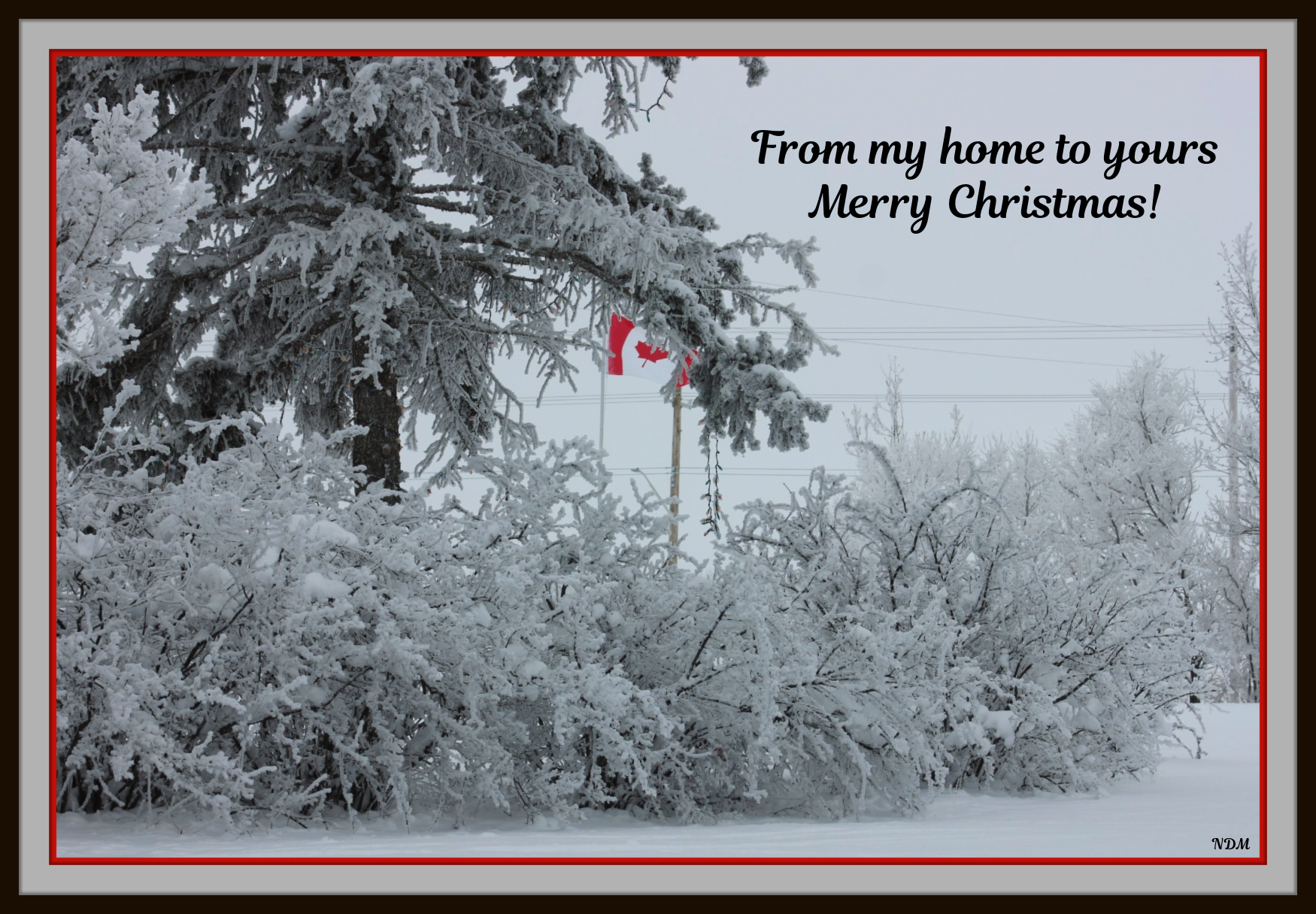
As I write this, I’m looking out my window at the prairie just beyond my home. Snow rests quietly on the ground. The sky is heavy with winter light. This image you see is what I see right now, in this moment, as Christmas Eve settles in. Tomorrow, my world will be smaller. It will be about my family, food on the table, familiar rituals, and deep gratitude for another year together. That’s as it should be.

I want to close with words from Arlene Dickinson, which feel especially right tonight: “… I hope that the book we are writing today, and that will be read thousands of years from now, is a story of acceptance, compassion, and love for one another.”

And I’ll add this. That is what we can all hope for. What we can wish for. What some of us will pray for. Not just at Christmas, but in the year ahead.

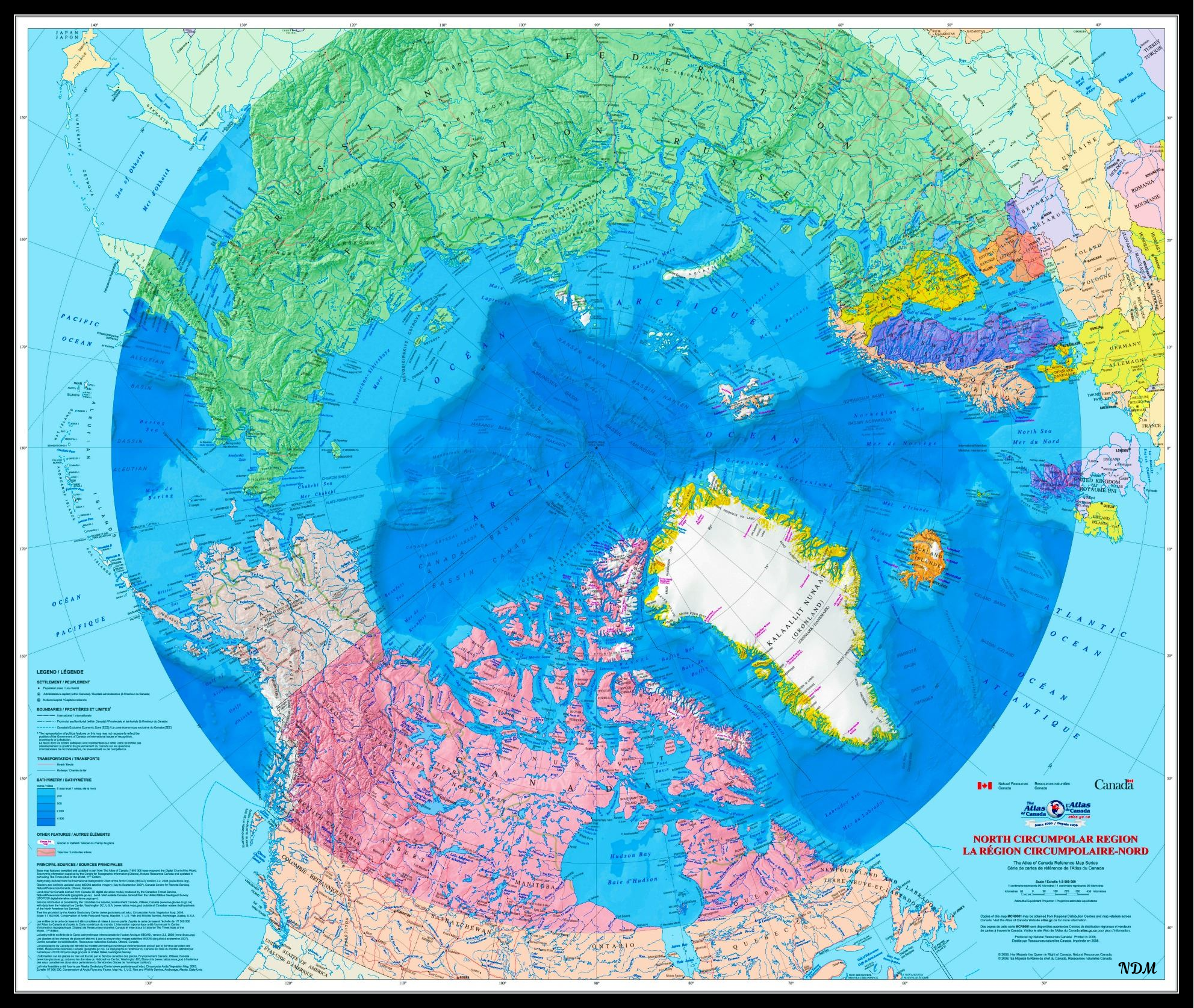
There’s something I say a lot when I’m trying to get people to understand the North and particularly how vast this country actually is. I usually turn it into a question. “If you were to leave Toronto and travel in a straight line north to Alert, Nunavut, how far do you think you’d be going?” People will throw out numbers. They’ll guess. And then I ask the second part. “If you went that exact same distance south, where do you think you’d end up?”

Almost no one ever gets this right. Most people say somewhere in the United States. Maybe the middle of it. Sometimes Mexico.

The actual answer is Bogotá, Colombia. In fact, just a few kilometres south of Bogotá. Every single time I say that, people stop.

Because once you hold that in your head, you can’t pretend the North is abstract anymore. It is a massive part of our country. That distance tells you something about scale, and scale tells you something about vulnerability.

That’s why, when I hear people talk casually about Greenland, I pay attention. With the renewed conversation this week about the United States assigning a new envoy to Greenland, I once again felt very concerned. This isn’t a response to an invitation. It isn’t a request for partnership. It’s the familiar posture of I’m doing this because I want to.

Greenland is not an idea. It is not a strategic blank space. And it is not a prize waiting for a powerful country to notice it. Greenland is primarily Indigenous, specifically Inuit. It is already someone’s home. And for my fellow Canadians it is not very far away. At Canada’s northernmost point, the distance from our coast to Greenland is 26 kilometres, (16 miles) miles. That’s not an ocean separating us. That’s proximity you can almost see across.

Only about 2% of Canadians have ever been north of the 60th parallel, even though nearly half of our landmass lies above it. And even then, most trips north are to places like Whitehorse or Yellowknife, northern cities, yes, but still sub Arctic, still below the tree line.

The Arctic is different. Being above Hudson Bay, above the ice, above the assumptions we carry from the south, that changes how you understand distance, exposure, and survival. It also changes how seriously you take casual talk about “acquiring” places that are already inhabited, already governed, already culturally whole. Those of us who have spent time in the North understand this instinctively.

Remote Indigenous communities are not empty space. They are resilient, deeply rooted, and far too often spoken about as if they exist only in relation to what outsiders want from them. Greenland is no different.

Which brings me to Denmark. I have always had a particular affinity for Denmark, my sister married into a Danish family, and growing up, Denmark was simply part of our world. My brother in laws mother was our Nana Cail. Familiar. Human. Not abstract. So when people talk about Greenland as if it is a loose possession, barely tethered to anything meaningful, it tells me they do not understand the depth of relationships or the weight of history that comes with it. Greenland’s relationship with Denmark is complicated. All colonial histories are. But complexity does not equal vacancy. And it certainly does not create an invitation for others to test boundaries simply because they can. Especially when Denmark is a NATO ally.

At some point, this conversation cannot just come from Denmark or Greenland. It has to come from NATO itself, reminding the United States that when it talks about Greenland, it is talking about a NATO-affiliated territory. This is not a sandbox. These alliances exist precisely to prevent powerful countries from testing limits simply because they feel entitled to do so.

Every time I name Donald Trump in my writings I want to be precise. I am not talking about one man acting alone. I am talking about an administration, a set of enablers, billionaires and a political culture that rewards impulse, spectacle, and domination especially when geography looks exploitable.

As the ice melts and Arctic routes become viable, conversations that once sounded absurd suddenly become operational. The Northwest Passage is no longer something unknown and vague. The United States has never fully accepted Canadian sovereignty over it.

So this is where people misunderstand the danger. Greenland is not asking for partners nor protection. And it is certainly not asking to be spoken about as if it is available.

And Indigenous homelands do not become negotiable because someone powerful has grown bored. If we keep treating places like Greenland as ideas instead of homes, as strategy instead of community, we shouldn’t be surprised when others decide consent is optional.

And history is very clear about what happens when powerful countries confuse proximity with entitlement. If Greenland can be spoken about as available, Canadians would be foolish to think we’re too far away to be next.

I’ve been wrestling for days with how to write about Venezuela.

I went down the research rabbit hole. Oil, sanctions, nationalization, corporations, authoritarianism, currency, and eventually hit an uncomfortable but honest wall: this is not a story that fits neatly into the 750–850 words I usually work within. This story can’t be flattened and things are escalating fast.

Then last night, I was given a gift. Another writer, Gordon F.D.Wilson, shared a piece that did what I was struggling to do. Through an aviation story (you know that got my attention), he captured the danger of what happens when the wrong people are in the cockpit and everyone else is strapped in as passengers. I’m not going to rewrite his work. I strongly encourage you to read it yourself. What is clear to me through my own research and his brilliant words, is that Venezuela matters far beyond Venezuela.

Let’s start with what is not up for debate. Venezuela is ruled by an autocrat. Nicolás Maduro is a corrupt, authoritarian leader who dismantled democratic institutions and presided over immense human suffering. But the story being told about Venezuela right now keeps shifting, and we need to pay attention. At first, we were told recent U.S. actions were about drugs. Fentanyl was even framed as a kind of weapon of mass destruction. Then the focus quietly moved from drug boats to oil tankers. By that point, fentanyl had vanished from the narrative altogether. We were no longer talking about drugs. We were talking about oil, shipping lanes, trade, currency, and power.

That’s the moment the explanation stopped making sense, and the behavior starts to matter more than the justification. The United States government did not lose Venezuelan oil. A U.S. corporation did. That is a distinct difference.

Venezuela’s oil sits on Venezuelan land. That doesn’t excuse corruption, mismanagement, or authoritarian rule, but it does implicate the claim that oil was “stolen” from the United States. Foreign investment does not equal permanent ownership of a country’s natural resources. If it did, sovereignty would be little more than a polite illusion.

This is where the history becomes too complex for slogans. Venezuela’s story involves decades of corporate dominance, oil nationalization, OPEC, sanctions, internal decay, and a slow, chilling slide from democracy into autocracy. If you want to see how an elected leader consolidates power over time, start with Hugo Chávez and work forward. But complexity is precisely what power prefers to erase.

Which brings us to the new U.S. National Security Strategy. This document quietly reframes America’s role in the world. Less global steward and more hemispheric enforcer. The Western Hemisphere is framed as America’s neighborhood its responsibility, its sphere.

That language should make every resource rich country in the Americas pause. The security doctrine shift, enforcement follows. And enforcement rarely arrives with clean explanations. One day it’s fentanyl. The next day it’s sanctions. Then it’s China. Then it’s oil. The story keeps changing. The actions do not.

And I can’t stop thinking about what this logic implies for Canada. I know what you’re saying “Canada is not Venezuela.” But Canada is resource rich. Our energy sector is deeply integrated with the United States. Our oil is traded in U.S. dollars. Our economy has been intertwined by design. If foreign investment quietly becomes conflated with ownership, if access starts to look like entitlement then sovereignty becomes thinner than we like to admit. The moment corporate loss is reframed as national injury, the line between partnership and pressure starts to blur. Let’s just say the phrase follow the money has never been more applicable. Your response President Trump?

This is where Wilson’s aviation metaphor lingers with me. We’re all passengers, distracted by turbulence in the cabin, while decisions are being made in the cockpit. The danger isn’t only the autocrat we can see. It’s the systems, incentives, and cronyism that decide who gets to fly the plane and whose laws apply when they become inconvenient.

I don’t have all the answers but I am seeking to understand. This situation is evolving, and the oil, currency, and enforcement implications are genuinely complex. But I do know this. Simple stories are being told about Venezuela right now, and simple stories are almost always dangerous. Especially as they relate to the United States right now. The Art of The Deal meets Follow The Money. So…if you want the deeper dive, the longer read that traces the full arc and asks the hardest questions, I strongly encourage you to read Gordon F.D. Wilson’s piece.

And this morning I need us to pay attention to what the U.S. leadership is counting on us not noticing, especially now, when people are tired, distracted, and trying to tune out the news over the holidays. But are we paying attention to who’s actually flying the plane, before the turbulence becomes something much worse.

A country this big doesn’t change direction suddenly. It travels there, one decision at a time.

I started my morning with population numbers for Canada in the New York Times. For the first time since 1946 our population is down. Changes that look small enough to dismiss. Is it just a fractional dip, or a a quarterly adjustment? It would be easy to scroll past. But these numbers are flagging something important.

I am fortunate to know many new Canadians. I personally know international students who came to Canada with a plan. It was not through a loophole, nor a fantasy, but with an actual plan. To study, to work and to stay and build their life here. I know people on work visas who did exactly what we told them to do, only to realize the door they were walking toward is now quietly narrowing. They come from all over the world. This isn’t about one country or one culture. It’s about what happens when policy pivots faster than lives can.

I’m not speculating here. Professionally, I know how much anxiety is sitting inside certain industries right now. Real anxiety. Not because executives are worried about optics, but because the labour math no longer works the way it used to. We can scoff at low wage jobs, but the truth is blunt. There are jobs in this country that are not being filled. Not because Canadians are lazy, but because those jobs may be unstable, seasonal, or incompatible with raising a family. Pretending otherwise doesn’t make us principled. It makes us unserious. Often those from other countries are willing to take these jobs with a goal to ultimately better theirs and their families lives.

At the same time, because reality refuses to behave, I also know domestic students who couldn’t find work. So yes, the system was strained. Yes, some promises were oversold. Two things can be true, even if our politics can’t handle that sentence.

What’s still barely being discussed is post-secondary education itself. Most Canadians don’t realize how much our colleges and universities have been financially buffered by international student tuition. Not necessarily out of greed but rather out of survival. Those large international student fees helped keep programs running, facilities open, and tuition for domestic students from climbing even faster. When that revenue drops, and it is dropping, something gives. Programs shrink, staff disappear and costs shift. That’s basic mathematics. And then there’s the demographic fantasy we seem keenly aware of. Canada is not repopulating itself through birthrates. Nothing more complicated than that. We are a vast country with an aging population, and no amount of lecturing about “family values” is going to change that. And let’s stop pretending otherwise. When some people say “we should just have more babies,” they’re usually picturing a very specific kind of Canadian family. I had two children. That replaces exactly two people. I do not expect my sons’ partners to reproduce on command to soothe someone else’s demographic anxiety.

Now I want to talk specifically about National defence. We have said, repeatedly, that Canada needs to grow its military. Global threats are increasing, not receding, and much of the current instability has been accelerated by the man south of the border. For the first time in generations, both our southern and northern borders are strategically fragile. You don’t protect a country with slogans. You protect it with skilled, trained people and in numbers that work.

As you know an industry important to me is aviation. We already face a pilot shortage both civil and military. Airlines are competing with the air force for talent, and the pipeline is thin. And aviation has always understood something politics and people sometimes forgets. An airplane has never cared about the colour or ethnicity of the pilot flying it. It only cares whether the person in the seat is trained, competent, and ready. Physics is brutally fair that way.

If we continue drawing potential military pilots into civil aviation or fail to build the pipeline at all, that’s not a cultural debate but rather a capability gap. And you don’t fill cockpits, secure borders, or respond to crises with wishful thinking.

This is why it’s so frustrating when immigration gets reduced to irritation. The Facebook drama when someone didn’t quite catch your order at a Tim Hortons drive-thru. Yes, communication matters. Yes, standards matter. But confusing momentary annoyance with national strategy is like judging an airline’s safety record based on whether you liked the coffee on your flight.

And this is where I suspect our Prime Minister’s thinking actually is. Not in slogans nor in extremes. But in the uncomfortable middle, where immigration, defence, education, labour, and global instability all collide. The real work isn’t choosing “more” or “less.” It’s designing a system that actually supplies the people we know we need, in the places we know we’re vulnerable.

This isn’t an argument for open borders. It’s an argument for adult policy.

Because Canada does need more people. But like any long journey, growth without direction is just motion. You need a route. You need capacity. And you need to know why you’re heading where you’re headed, before you find yourself miles down the road wondering how you got there.

I’ve spent a lot of time lately writing about things that are heavy, personal, and deeply consequential, and while that’s not going to change, every now and then I need a different kind of mental exercise. Something a little lighter and a little more entertaining. Something that reminds me why I enjoy paying attention in the first place. This Vanity Fair photo series does exactly that, because underneath the outrage and the hot takes, there’s something genuinely interesting going on here about strategy, image, and what happens when political presentation is stripped down to its bones.

None of this was accidental. The photographer, Christopher Anderson, wasn’t sprung on the White House without warning. His work was pre-approved. His bio was known. His style was known. He has made a career out of shooting very close images. Close enough to remove the usual polish, and Vanity Fair’s editor described the work as an attempt to cut through what Anderson himself has called the “theater of politics.” So the shock some people are expressing now feels, at best, selective.

Listening to pundits dissect the images, what struck me wasn’t the outrage so much as the misreading. These weren’t meant to flatter, and they weren’t meant to humiliate either. They function more like scans. Almost like x-rays. Not images designed to reassure, but images designed to show what’s there once distance, lighting, and control are no longer doing the work for you.

I’ll admit something here. On a purely emotional level, this delights me. There’s something deeply satisfying about watching people who spend their lives managing image and narrative suddenly confronted with a lens that refuses to play along. Not cruelly nor theatrically but rather precisely. Anderson’s brilliance isn’t just technical; it’s strategic. He shows them not as caricatures, but as they are when the scaffolding is removed. And for someone who pays close attention to power, messaging, and performance, that kind of clarity is genuinely enjoyable to witness.

Take J.D. Vance, photographed against a wall that quietly provides visual reference points. It’s subtle, but it matters. A way of grounding scale and proportion for someone who has spent a great deal of time rhetorically inflating his own presence. The photograph doesn’t argue, doesn’t editorialize, and doesn’t correct him. It simply measures and lets the viewer connect the dots. With these references it is easy to measure his true height.

And then there’s Karoline Leavitt, which is where the conversation predictably veered off course. Yes, you can see evidence of cosmetic work. So what. That’s neither shocking nor particularly interesting. What is interesting is what Anderson didn’t do. He didn’t soften. He didn’t blur. He didn’t smooth away the human texture that appears on every face when a camera gets this close. Anyone who has ever been photographed at that distance knows that skin behaves like skin.

It’s worth noting here that the image you’re looking at has had an HDR filter applied, and you can feel the difference right away. That small change alone alters clarity and mood, which is worth keeping in mind when we talk about what a photograph is, and isn’t telling us. Even light intervention shifts how an image reads, which only underscores how deliberate Anderson’s original choices were.

The result, even so, is striking. She’s 28, but she reads older, not in years but in bearing. Almost matronly, in the sense of discipline rather than age. This isn’t a face inviting dialogue; it’s a face trained for delivery and repetition.

Which brings Donald Trump into the picture, even when he’s not in the frame. Because he has publicly praised Leavitt not just for her performance, but for her appearance, focusing obsessively on her lips and how they “move like a machine gun.” Placed next to this image, stripped of gloss and distance, that comment lands differently. Less like admiration and more like a functional assessment. Less about judgment or insight, more about output.

This isn’t a beauty image. It isn’t about youth or glamour. It’s about role. Should I bother to mention the slight orange tinge to her nose?

Politics usually depends on illusion. In photos using flattering angles, soft light and careful distance. These photographs decline to participate in that bargain. They don’t demean anyone, and they don’t exaggerate. They simply remove the padding and let the structure show. An x-ray doesn’t flatter you, and it doesn’t insult you either. It just tells you what’s going on under the surface.

And before anyone worries that I’ve gone soft or lost my edge, don’t. I’ll be back, as always, with plenty to say about politics provincially, nationally, and globally. This is simply a reminder that sometimes the most revealing political commentary doesn’t come from a speech or a press conference. Sometimes it comes from a camera, a small adjustment, and the uncomfortable realization that once you really look, you can’t unsee how the machine actually works.

I started thinking about all of this while doing my Christmas cards. So I don’t send the same card to everyone. Some are funny and a little irreverent, because that’s who the recipient is. Some are quiet and beautiful, Thomas Kinkade like winter scenes, because they suit someone who loves stillness and tradition. And yes, some speak directly to faith, because the person I’m sending them to is deeply religious, and I want the message to meet them where they are. That’s never felt complicated to me. It’s felt respectful.

I say Merry Christmas. I always have. That’s the season I celebrate, and I mean it warmly. But I also know not everyone I’m speaking to celebrates Christmas at all. Some say Happy Hanukkah. Some prefer Season’s Greetings. Some don’t mark the season in any religious way. So I choose my words, and my cards, accordingly.

That has always felt very Canadian to me. It’s not about erasing faith. It’s about understanding that belief is personal, and that courtesy isn’t a threat.

Somewhere between addresses and stamps this year, that thought stuck with me. Because once belief starts shifting from something we honour in each other to something assumed, or enforced, by authority, the tone changes. That’s where this post began.

There’s a reason movements that want long-term power eventually turn their attention to young people. Adults are harder to move. They’ve lived a bit. They’ve made up their minds, or think they have. Young people are still figuring out who they are. They’re looking for belonging, certainty, direction. That’s not a criticism of youth, but rather the reality.

History shows this pattern again and again. Even before he fully consolidated power, Hitler understood that if you wanted to reshape a country, you didn’t start with adults. You reorganized youth life, school-adjacent clubs, uniforms, rituals, discipline, purpose. Not education but rather forced identity.

The following isn’t a one to one comparison. But patterns don’t have to repeat perfectly to be recognizable. And it would be irresponsible to pretend we don’t see familiar shapes forming today.

In the United States, Christian nationalism has moved out of the margins and into the mainstream. Not Christianity as faith, but Christianity as political structure, as a hierarchy, an identity, and ultimately as power. One of the clearest signs o f that shift in the US has been the focus on youth spaces including schools, universities, clubs, and mentorship networks and framed all framed as moral, values based, and patriotic. Organizations like Turning Point USA aren’t really about debate. They’re about direction. About telling young people who belongs, who leads, who should submit, and what a “real” citizen is supposed to look like. That should give anyone who cares about education pause.

Now bring this north. Canada isn’t immune to American political currents. We never have been. And if there’s a place where this kind of organizing has found fertile ground, it’s Alberta. I don’t say that casually. Alberta’s political ecosystem, particularly under the UCP, has become increasingly influenced by activist groups whose goals go well beyond taxes or pipelines. Groups like Take Back Alberta are open about what they want: reshape institutions, influence candidates, embed ideology, and redefine what it means to be Canadian and that’s often through a narrow religious lens.

This is not conspiratorial, it’s not abstract. It’s quite visible. When religious language starts showing up inside government messaging, not as personal belief but as shared moral authority, I pay attention. When education leaders speak as though faith is a given rather than a choice, I pay attention. When young people are talked about as something to be guided, corrected, or rescued, rather than taught how to think, I pay attention.

Because this is how movements grow, slowly and quietly with what looks like normalization.

Faith itself is not the issue. Some of the best people I know are deeply Christian. Their faith is generous, thoughtful, and lived, not imposed. That’s not what concerns me.

What concerns me is belief turned into obedience. Faith turned into hierarchy. Morality turned into political leverage. And when that mix starts organizing around young people, through schools, clubs, and identity-building, we are no longer talking about private religion. We’re talking about public power.

This is why it matters to me. I raised my kids here in Alberta and there were threads of this already growing 15 years ago. I’ve watched young people I love try to find their footing in a world that is louder, sharper, and far more manipulative than the one I grew up in. Because I know how comforting certainty can sound especially when it’s wrapped in the language of “values.”

I don’t come at this as an academic. I come at it as a parent, as a citizen, as someone who believes education should open doors, not close ranks. I say Merry Christmas. I always will. But I also want the kid who doesn’t celebrate Christmas to feel just as fully Canadian as my own children did. That matters to me. This isn’t fear mongering. It’s responsibility. Once you see how these things grow, it’s hard to unsee them.

So I’m paying attention. Not because I have special insight but because I care.

Beyond The Pale

Posted: December 16, 2025 in Uncategorized
Tags: , , , ,

There are so many things happening right now that make it hard to know what truly matters, or what deserves attention. I try to keep my writing rooted in Canadian context. In our values, our humanity, and our political reality, and yet we all know that so much of our public conversation gets tugged off course by the behaviour of the President of the United States. It creates this constant state of “pending,” waiting for the next outburst, the next shockwave, the next moment that should never be normal but somehow becomes part of the daily noise.

But this time, the noise has become something else entirely. Last weekend in Los Angeles, a man and his wife were killed by their adult son, who had long struggled with addiction and mental illness. Their celebrity is not the relevant point here. This is, at its core, a human tragedy before it is anything else and it is one that cuts deeply because it speaks to something I know too well.

Very few people know this about my family, but with my husband’s permission, I will share this. In June 2020, my husband’s only sister, in fact only sibling was murdered in her own home by her adult son, who had battled mental illness and addiction for years. Cold Lake, Alberta, where this happened, is an Air Force base community. Although retired at the time, both my sister in law and her ex-husband had served their country in the Canadian Armed Forces and had remained in Cold Lake because of their deep connection to that community.

Everything that followed, the hearings, the grief, the confusion, the guilt, the hollowed out days, was its own kind of hell. Unless you’ve lived inside that nightmare, you cannot understand the full weight that lands on a family’s shoulders, or how impossible it is to reconcile love with tragedy.

So when I look at the Reiner family, I don’t see celebrity. I don’t see politics. I see human beings, stunned, grieving, horrified, ashamed, questioning themselves, replaying every moment where they wonder if something, anything, could have gone differently. That is what this kind of tragedy feels like. It is not something any family imagines they will ever have to say aloud. We certainly didn’t.

Most people, even many who support Donald Trump, seem genuinely appalled by the comments he made about Rob Reiner in the immediate aftermath of this unimaginable loss. And for good reason. When Charlie Kirk was murdered, there was strong criticism directed at anyone who even hinted that such violence was justified. And rightly so. That is the morality line a healthy society should hold.

So how can a President of the United States justify criticizing Rob Reiner’s family in their darkest hour? If cruelty was wrong then, how is it suddenly acceptable now?

“Beyond the pale” is the phrase I’ve heard repeatedly these last few days, and for once it feels accurate. It was cruelty for sport. And then he doubled down on it. Clearly there is no political ideology that excuses mocking a grieving family. Not conservative, not liberal, not anything.

Rob Reiner was known to most of us as “Meathead” on All in the Family, or as the director of films like Stand By Me, A Few Good Men, The Princess Bride, When Harry Met Sally, and Spinal Tap. Yes, his political views were strong. Many people disagreed with them. None of that matters today. A man and his wife were murdered, and their surviving family is shattered.

And yet the loudest, most powerful political voice in the United States chose, at this moment, to dehumanize them.

When people ask, “Why didn’t the family fix it?” I can only say this: you have no idea how hard families try. For years. For decades. With professionals, without professionals, with hope, without hope. Addiction and severe mental illness are not solved by parental willpower. They are battles that break families long before the worst day arrives.

Rob Reiner’s family is no different than ours was in 2020. They lived in pain, trying everything they could. And now they face a grief that will never fully heal.

This goes beyond politics. It goes beyond partisanship. It goes beyond anything a reasonable society should tolerate. Donald Trump crossed a moral line, maybe worse than any he has crossed before . And I say that as someone who has lived the reality of this kind of tragedy, who knows the shame, the confusion, the judgment, and the quiet, desperate question: What more could we have done?

There is no forgiveness for attacking a family in that moment. And I believe, truly, that this will be a defining point for many people, even among his supporters. Some moments reveal a person’s character in ways that cannot be dismissed, spun, or excused. This is one of them.

So let me finish with this:
If anyone tries to tell me that this is still about “the good things Trump is doing,” or that there is some political justification for this behaviour, then you’ve just met your match. This is the moment where I’m done entertaining those arguments. There is a line between disagreement and cruelty, and he stepped so far past it that there’s no coming back.

And if this moment doesn’t make people rethink their loyalty, then nothing will, because if cruelty toward the grieving isn’t a deal-breaker, what on earth is?

Last week in the House of Commons, Canada’s Secretary of State for Sport, Adam van Koeverden, delivered a speech that was sharp, funny, and painfully accurate. And for everyone still defending Pierre Poilievre and the style of politics he has perfected, it was a reminder of exactly what that legacy is in the words of MP van Koeverden.

“Mr. Speaker, remember when the Grinch tried to steal Christmas? He drove all the way up to the top of Mount Crumpit because he had everything that he needed, and he was going to throw the gifts that the Whos deserved because he thought they didn’t deserve to have nice things. It’s kind of like the leader of the Conservative Party, Mr. Speaker. For 25 years, he’s had dental care because he’s had a job here in the House of Commons, so he votes against dental care for 9 million Canadians. He’s got secure housing. He lives comfortably at Stornoway in government-owned housing, so he votes against affordable housing for millions and millions of Canadians. My Christmas wish is that the leader of the Conservative Party comes back in January with a heart that’s grown three sizes and tries to help a Canadian for once in his 21 years.”

That is Poilievre’s political biography in a paragraph. He is a man who has enjoyed every structure of public stability while dedicating his career to denying those same supports to everyone else. And rather than come back after he “won” or, let’s be honest, acquired his Alberta by-election in a riding that any Conservative could win in a coma, did he return with a better attitude? A vision? A grown heart? Anything?

No. He returned with the exact same tone, and the same fixation on Justin Trudeau that his followers can’t seem to let go of, despite the fact that Trudeau isn’t even in politics anymore. It has become some kind of reflexive obsession, a default setting they can’t reset, and it would almost be funny if it weren’t so detached from the reality the rest of us are living in.

For the continued supporters of Pierre Poilievre note that in 21 years he has not produced a single original idea. Nothing substantive, nor visionary. Nothing that withstands even casual inspection. Ask his supporters to name a policy, and they can’t. They can only tell you who they dislike. The only people insisting he’s “leadership material” are perched so far on the right flank of conservatism that competent global diplomacy looks like a threat to them.

Meanwhile, the same voices who accuse the Liberal government of being “socialist” conveniently forget that Canada’s core social programs that they likely embrace, such as unemployment insurance, public healthcare, old age security, and the Canada Pension Plan are exactly the kinds of systems they claim to oppose. And let’s not forget the single biggest fiscal challenge of the past five years, COVID. I would pay good money to see the statistic showing how many small government Conservatives cashed their CERB cheques without hesitation. Canadians across every political stripe were grateful for that “socialist” support when they needed it. Funny how ideology melts when the deposit hits the account.

Because here’s the uncomfortable global truth. There is no Conservative leader right now who would receive the level of international respect Mark Carney does. Could one emerge? Possibly. But the only route to international visibility available to the current Conservative movement is alignment with Donald Trump’s authoritarian worldview and Vladimir Putin’s destabilizing ambitions. That’s the company they’ve chosen.

And that should worry all of us. Leadership in 2025 is not just about the economy. It’s about safety. Economic strength collapses without geopolitical stability. Trade dies without trusted alliances. Investment evaporates when partners can’t count on you. Safety is the foundation of everything, and right now, Conservative politics offers no path to a safer Canada.

Meanwhile, we have a Prime Minister who is respected internationally, who is navigating one of the worst tariff crises in decades, and who does understand the complexity of global economics. Mark Carney is not perfect, no leader is, but he has the credibility Canada requires at a moment when credibility is currency.

And yet, the Conservative Party marches forward behind a man whose political compass points only toward resentment and reduction. A man who has had every benefit of public life yet opposes extending those same benefits to the people who fund them. A man who believes anger is a national strategy.

But unlike the Grinch, this story doesn’t end with a heart growing three sizes. In fact, if anything, every year he sounds more like the guy standing on the hill screaming about the downfall of Whoville while offering exactly zero ideas for how to fix it. A man who wants power with all the enthusiasm of someone who’s never bothered to figure out what he’d do with it once he had it.

Perhaps, perhaps, the spell is weakening. There is growing speculation that January could bring not just a new parliamentary session but a new Conservative leadership race. And if the Conservative leadership team has any instinct for political survival, they see the writing on the wall.

But then comes the real question. If not Poilievre… then who?

Andrew Scheer? You could replace him with a lump of coal and get more heat. A rising star? From where? This caucus has hollowed itself out. Jason Kenney? No love lost there, but compared to today’s far-right chaos, he now looks moderate, (don’t worry I’m not fooled). This says everything about the state of the party.

Adam van Koeverden’s Grinch analogy landed because Canadians recognize themselves as the Whos down in Whoville. Just trying to build something together while a man on the mountaintop insists we don’t deserve it. But unlike the Grinch, this story doesn’t end with a heart that grows.

And if that’s the best the Conservative Party can offer in a moment this dangerous, then it’s not a government in waiting. It’s a loud distraction for people who’ve stopped looking for real solutions.

Late last night, I was watching news coverage of yet another horrific shooting in the United States. But what struck me wasn’t the familiar “BREAKING NEWS” banner. It wasn’t even the grim resignation that now accompanies every American mass shooting.

It was the face of a young woman speaking from her dorm room at Brown University, 19-year-old Zoe Wisemann, currently in lockdown. This is the second time she has lived through a school shooting. At twelve years old, she survived Parkland. And at nineteen, she is now surviving this.

As she spoke, I felt my own stomach twist, because what she said out loud is exactly what millions feel and what I have felt for years: she’s sad, yes, but right now, she’s angry. Furious that in the seven years since Parkland, nothing of meaning has changed. Furious that Congress has done nothing to reduce the violence or the risk. Furious that a generation of students is now collecting trauma the way they collect course credits.

And I echoed her, word for word. I’m angry too. Because here is the horrible, staggering truth. The statistical likelihood of anyone experiencing one school shooting should be zero. Zero. That should be the floor, the ceiling, and everything in between. Instead, we are now watching teenagers and young adults survive multiples, before they’re even old enough to legally order a drink in the United States.

Zoe is clearly bright and resilient, attending one of the most prestigious universities in the world. And none of that has protected her. No campus, no zip code, no GPA shields a student from a political system that has decided that guns matter more than human beings.

Before anyone trots out the tired talking points, mental health, pandemic isolation, social media, video games, cultural decay, let’s be realistic. Every single one of those conditions exists in Canada, in the UK, in Australia, in Germany, in Sweden, and across the entire Western world.

And of course, we all know what comes next, the ritual chorus of thoughts and prayers. Well, have at ’er with the thoughts and prayers. I will always assume those are a given. But thoughts and prayers are supposed to be the starting point, not the entire response. What matters is what comes after. And in the United States, “after” has become a blank space. A void and a shrug. A refusal to take even one step that would actually make a difference. That is what Zoe is angry about, and that is what I am angry about too.

The common denominator is guns. Are there mental health issues elsewhere? Of course. Do young people struggle everywhere? Yes. Does society feel strained everywhere? Absolutely. But only one country has decided that the “right” to a weapon outweighs the right of a child to survive a school day.

And here is the piece I hate to admit. In those first few seconds after the alert broke, I caught myself thinking, “Please don’t let this become fodder for the current government.” Because we all know how this works. Before anyone even absorbs the human cost, the political machine starts spinning. The question becomes not why is this happening but which side benefits from the narrative. And whether the extremism comes from the right or the left, the human tragedy gets buried under the political tug of war. The horror becomes background noise while everyone fights over who gets the last word. And that, too, is part of the sickness.

And yes, last night was supposed to be a night where I wasn’t writing about the United States at all. I already had a Canadian-focused political post ready but that can be for tomorrow morning. Some realities are too big, too raw, too completely unacceptable to pretend they didn’t happen.

Because the truth is this. No one is safe when the places that should be safe aren’t safe at all. Schools., universities, grocery stores, concerts, parades, malls nor places of worship.

And once again, like after every shooting, every mass event, every moment of national grief, the real question isn’t what happened. We know what happened.

The real question is where the hell is Congress? Where is the leadership? Where is the courage? Where is the willingness to do anything other than protect the gun lobby and their own titles?

Because whether the national conversation is about the Epstein files, or tariffs, or fentanyl, or Caribbean interdictions, or school shootings, or anything else that touches actual lives, the theme is always the same. Power first. Country second. People last. Every day, every hour and every crisis.

And last night, listening to a young woman who has now lived through two school shootings before the age of twenty, the weight of that reality hit me harder than usual. I’m sad. Yes. But like Zoe Wisemann, I’m mostly angry. And if America’s so called leaders refuse to take meaningful action, then maybe the young people who keep surviving these nightmares will be the ones who finally force the change the “adults in charge” never had the courage to make. Because nothing changes until someone decides enough is enough. And last night, a 19-year-old student reminded the world she reached that point a long, long time ago.

Politics across the globe feel dangerous in a way that is hard to articulate without sounding alarmist, but alarmed is exactly what we should be. The world is sitting on a fault line. Every major decision made by the global superpowers reverberates across continents, supply chains, borders, households, and families. No one is insulated. And while Canadians have a uniquely deep economic and geographical relationship with the United States, this moment isn’t just about us. It’s about the entire world and its future.

Today we learned that the head of NATO expects the alliance to be formally at war with Russia within the next five years. I’m not unpacking that intelligence or the what-ifs around it. But I am acknowledging the obvious: three of those years will unfold under Donald Trump’s second presidency. And that reality, paired with what we’re seeing in front of our eyes, has pushed me to talk about something I’ve deliberately avoided.

I have a close family member living with a memory-loss disease. I’ve never said that publicly because it hurts, because naming it out loud makes it real, and because I’ve never wanted to use their struggle as a metaphor. But over these past months, as politics have escalated into something darker, I’ve found myself unable to ignore parallels in patterns of behaviour I’ve personally witnessed and the behaviour we see, daily, globally, from the President of the United States.

To be clear, I am not making a diagnosis. I’m not a doctor. I’m not suggesting equivalency. One is a loved one who lived a good, quiet life and deserves compassion and safety and never acts from a place of cruelty or evil. The other is the most powerful person on Earth. But I am talking about recognizable human patterns, changes in speech, changes in focus, erratic storytelling, unshakeable belief in invented narratives, emotional volatility, unusual physical mannerisms, and moments that simply do not match past behaviour.

Back in Trump 1.0, we all witnessed the erratic late night tweets, the mood swings, the wild pivots, the sudden tangents, behaviour that became part of the spectacle, part of the chaos-for-show that defined his first term. It was volatile and unnerving, but it was still framed as “Trump being Trump,” an exaggerated performance wrapped in grievance and bravado.

But it wasn’t until recent months that people began using the word “sundowning” in a more serious way, pointing to his increasingly disorganized late-night Truth Social posts, sharper emotional swings, moments of confusion that couldn’t be brushed off as theatrics, and most of all, the growing certainty with which he clings to things that simply aren’t real. For those of us who have lived with someone who truly does experience certain changes in behaviour and ‘imaginings’ the parallels are impossible to ignore. The volatility, the slipping coherence, the absolute conviction in invented narratives, once you’ve seen these patterns up close, it is deeply unsettling to watch echoes of them play out on a global stage.

In my family’s case we made the heartbreaking decision to place our loved one somewhere safe, supported, respected, and protected. They hold no power, no weapons, no military chain of command and yet we knew we had to make that decision. They require care, patience, and stability. And they deserve that.

Now imagine a similar pattern of behaviour, but the individual holds the largest nuclear arsenal on the planet, commands 1.3 million active-duty service members, and is treated by his closest advisors as flawless and unquestionable. Imagine that person at the centre of a geopolitical world already teetering, and imagine that no one around them is willing, or able, to intervene.

That terrifies me. And it should terrify every Canadian, every ally, every democracy. Not because we dislike his politics. Not because we preferred Biden. But because unchecked power combined with unchecked behaviour is historically catastrophic.

And yes, there were legitimate questions about Biden’s age and capacity. Some of that should have been more transparent. But Biden, for all his flaws, did not glory in cruelty. He did not fantasize about retribution. He did not weaponize the military against political enemies. The comparison is not equivalent.

As Canadians, including those of us in Alberta, we must choose leaders who will not normalize this, who will not run to Mar-a-Lago for approval, who will not bend the knee for trade favours or photo-ops. Mark Carney was never going to “manage” Donald Trump, because Trump is unmanageable. Only those closest to him can intervene. That is the point and the danger. No one is doing that.

I also know I’m not alone in this world. We are living in a time where more and more families are navigating memory-loss diseases. Millions of people understand these behavioural patterns because they live with them every single day. And yes, I know many people are waiting for the full release of the Epstein files and the Caribbean boat incident, and those disclosures absolutely matter. But just as urgent is something far closer to the present: there needs to be a full, unambiguous disclosure of this man’s cognitive and neurological assessment, not another distraction about how “perfect” his heart supposedly looked or another deflection about cankles. Transparency about his actual capacity is not a luxury; it is a global safety issue.

Something is happening, and the people around Donald Trump are doing nothing. That is what keeps me up at night. That is why I am breaking my silence about my family’s situation. Because I know what these patterns look like up close. And when I see echoes of those patterns in the Oval Office, backed by absolute power, global instability, and a circle of enablers?

Yes, it terrifies the hell out of me.