Where Humanity Takes Flight

Posted: December 11, 2025 in Uncategorized
Tags: , , , ,

So my conversation today isn’t supposed to be about politics. Well, yes it is, and no it isn’t. What it’s really about is humanity, compassion, decency, and the expectations we set for the people who lead us and for the people we choose to be.

Some of you know me through the stories I tell. I’m not a historian or a journalist, I speak from lived experience, from the people and places that shaped me. And today, even though I said I wasn’t going to talk about politics, how can I talk about how we treat other human beings without landing there?

With yesterday’s talk of requiring five years of social media history just to enter the United States, it became clear that many of us, myself included, won’t be visiting anytime soon. Honestly, I’m not sure I’ll miss it. I’ve been to Disney more times than I can count; I’ve walked New York; I can survive without Vegas.

What I can’t survive without is my sense of humanity, and today I was reminded of where it comes from.

I grew up in Moncton, a small city in New Brunswick. In the 60s and early 70s it looked overwealmingly white, like so many communities across Canada. The exception was the steady stream of students from around the world who came to learn to fly at my father’s flight school. That was my normal. As a teenager I was pumping avgas, dispatching flights, and working around those students. I grew up in a hangar full of languages, accents, hopes, and dreams. I didn’t understand then what a gift that was.

A few months after my father passed away in 2008, a letter arrived from one of those former students, Israel Ameh of Nigeria. I hadn’t known him at the time he trained in Moncton, I had already left Moncton, but his words captured exactly who my father was and what humanity can look like when lived fully and without prejudice.

Here is his letter, unchanged: “I came to Canada from Nigeria in 1982 to learn how to fly. Even before I got here I felt like I knew Mr. McClure as he tried to make my voyage to Canada as trouble-free as possible. When I arrived at the Moncton Train Station on August 2nd 1982, Don sent his Cool Station Wagon to pick me up. He made the MFC become like… a revolving family setting and as I needed to take different courses, I did not think twice about where to return for those courses. When I returned in 1988/89 and got my Flight Instructor rating, Don helped me get my First and second jobs. His recommendation also made securing a Work Visa easy. I ended up marrying from Buctouche making the Moncton area part home. In 2008, I found Don’s email address on the Internet and sent him a thank you letter which was unfortunately returned due to a bad email address. When I learnt of his passing, it was a sense of tremendous loss that I did not get to thank him for all he did in my life. Mr. McClure, I know you can still read this and I want to say THANK YOU for being such a wonderful person. You practised equality and globalisation with sterling vision before it became fashionable. To many of us, you were like a father. I still remember a talk you gave to me in 1985 about AIDS and why us young men had to be aware and cautious. Other students laughed at the time but it made me into a better man. From the provinces of Canada, Libya, Nigeria, UK, the Carribeans, Nepal, India, Pakistan and all other places that sent men and women to you to turn into Pilots, I think I speak for all of them when I say the world lost a Great Man. Rest in Peace Don, but I know that if they have airplanes in Heaven, you will be helping run an efficient operation and checking up on the airplanes and asking why they are not up flying just as you did to keep us on our toes; but most of all, thank you for changing the life of an 18 year old from an African village.”

That letter, especially that last line, tells you everything about my core. And it’s why, when I hear Donald Trump speak of Haiti or Africa or Afghanistan as though the people from those places are somehow lesser, it hits like a gut punch. It dishonours the young men and women I grew up around. It dishonours my father. And it dishonours that young man whose life changed because someone treated him with dignity.

Trump, born with every advantage, has no understanding of what it means to build your life by strength, opportunity, and gratitude. No understanding of being a guest in another country. No understanding of leadership grounded in humanity. This isn’t left or right. It’s about whether we widen the circle or shrink it until only people who look like us get to belong.

Most of you reading this already get that. But maybe someone, somewhere, will feel something crack open. Because there are cracks everywhere right now, cracks in the asphalt, cracks in the façade of cruelty-as-strength. But dear God, don’t let this be the world our children and grandchildren inherit. Not a world sliding backward into suspicion and hate toward anyone who doesn’t look like us.

If an 18-year-old from an African village could take flight because someone believed in him, then surely we can choose humanity.

Surely we can chart a better course, one where compassion, not fear, keeps us airborne.

There’s an expression I’ve used for decades. I don’t know who first said it, but it has stayed with me longer than most political slogans or news cycles ever will. ‘If you blame others, you give up the power to change.’

When I first started using it, it had nothing to do with politics. It was about people I knew, family, friends, community members, who faced difficult circumstances. We’ve all known those situations where two children grow up in the same home with the same opportunities and the same challenges, and one rises despite adversity while the other drowns despite prosperity. Circumstance isn’t destiny. Choice is always part of the picture, small, incremental choices about how we react, how we cope, and how we move forward.

But somewhere along the way, this human truth got swallowed by something much larger. Blame has stopped being an individual habit and has instead become a societal norm. It’s now a default setting, a reflex, a cultural posture. It doesn’t just show up in personal relationships or family dynamics. It shows up everywhere now. In politics, in public discourse, in online communities, in the way we talk to strangers and the way we talk to ourselves. It has become the new standard, and an unhealthy one.

And nowhere is that more obvious than in the way politics is now practiced. Over the past decade, politics has increasingly become a performance of victimhood. Not genuine suffering, but strategic grievance. In the United States, Donald Trump has practically built an empire out of it. You hear his refrain daily. Joe Biden this, Crooked Joe that, on and on and on. It’s a relentless drumbeat of pointing fingers outward to avoid ever turning the mirror inward.

And here in Canada? We’re not immune. Pierre Poilievre has turned Justin Trudeau into his entire personality. Ten plus years of the same line: Trudeau broke it, Trudeau ruined it, Trudeau is the cause of every pothole, every grocery bill, every global shockwave, every structural issue that existed long before he was even an MP. There is never a solution, only a scapegoat. And if he ever stopped blaming, he’d have to start explaining, which is far more difficult.

But this isn’t just about them. The real danger is what this style of politics does to us. When leaders model blame, they normalize it. They give society permission to adopt the same posture. And suddenly we are a nation, and a generation, encouraged to externalize everything. Everything becomes someone else’s fault. Someone else’s failure. Someone else’s responsibility to fix.

It creates a kind of moral paralysis.

If everything is always someone else’s doing, then nothing is ever within our power to change. The story becomes fixed. Our agency disappears. And once agency disappears, cynicism fills the space it leaves behind.

This is not the country I grew up in. It’s not the country many of us tried to build. And it’s certainly not a healthy model for young people, because when the only thing they hear from politicians is blame, how on earth are they supposed to learn accountability? How are they supposed to believe they have influence over their own lives, let alone their communities?

If society keeps modelling the opposite, if our political culture keeps rewarding the loudest finger pointer instead of the most honest problem-solver, then we shouldn’t be surprised when the entire public starts behaving the same way.

Leadership is not about who can yell “not my fault” the loudest or who can dig up the oldest grievance. Real leadership is quieter than that. It’s steadier than that. It’s the person who wakes up and without pageantry puts one foot in front of the other and deals with the issues actually in front of them. No excuses. No endless rehashing of who messed up what ten years ago. Just the work.

That’s the kind of leadership I prefer: the kind that solves instead of performs. The kind that owns responsibility instead of outsourcing it. The kind that doesn’t need an enemy to justify its existence.

Because the alternative is exactly what we’re living through, a political landscape where deflection has replaced direction, grievance has replaced governance, and blame has become the cheapest currency in public life.

And honestly who is driving that trend? Donald Trump has built an entire political identity around never taking responsibility for anything, ever, even when the consequences are catastrophic. Pierre Poilievre has spent more than a decade scripting every sentence around Justin Trudeau as if reciting a grievance is the same thing as offering a plan. And Danielle Smith has turned deflection into an art form, blaming everyone from judges to civil servants to the federal government rather than simply governing the province she was elected to lead.

This is not strength. This is not vision. This is not leadership.

We deserve leaders who face the hard truths, not run from them. Leaders who build instead of burn. Leaders who don’t need a scapegoat to feel powerful — and who understand that their job is not performance art but public service.

And we deserve leaders who model that for our children. Because whatever behaviour we normalize at the top quickly becomes the behaviour young people believe is acceptable. They watch how we speak, how we react, how we handle conflict, how we take, or avoid, responsibility. If all they ever hear is blame, then blame becomes the cultural default.

We deserve a society that refuses that path. A society that understands that blame might feel satisfying in the moment, but it is a dead end. It does not move us forward. It does not solve a single problem. It keeps us exactly where we are, frozen in place, circling the same resentments, repeating the same grievances.

And it brings us back to the line I’ve carried through decades of my life, a line more relevant now than ever. “When we blame others, we give up the power to change!”

Other than being a beautiful, almost-winter day here in my corner of rural Alberta, December 7th carries a weight that never leaves me. For Canadians, Americans and the rest of the world this date is part of our shared history, a reminder that the world doesn’t fracture in isolation and that we have always stood shoulder to shoulder with our allies when democracy is threatened. Today is the anniversary of the bombing of Pearl Harbour, December 7th, 1941, the moment the United States was pulled into the Second World War, and the moment the trajectory of the 20th century changed. I debated writing about it at all because I try, so often, to anchor things “at home.” But everything I write comes from my own lived place, memory, emotion, experience, and this date sits at the centre of all of that.

My father, as many who read me now know, shaped so much of how I see the world. Back in 1981, during the 40th anniversary of the bombing of Pearl Harbour, my parents wanted one final trip to Hawaii, my mother already many years into the paralysis of her stroke. I met them there because my father couldn’t manage the physical care on his own, and because time with them mattered. Two things were important to him on that trip: travelling to the remote resting place of Charles Lindbergh, and standing where the Second World War began for America.

Standing above the sunken USS Arizona with them is something I will never forget. Tourists moved around us, reading plaques or pointing at the quiet water. But for my father, it was not a tourist stop. It was a place of reverence. A place of loss. A place that demanded silence. He stood there as a Canadian who had done his part in those dark years, because it was right to stand with an ally, with democracy, with the world. And I felt that through him. I wasn’t alive in 1941, but I knew the significance of that place because he carried it in his bones.

That’s why it sits so heavily with me that, according to reporting years later, when Donald Trump toured the USS Arizona Memorial in 2020, he asked what it was and why it mattered. The president of the United States standing on the graves of 1,177 Americans and not understanding the meaning of where he was. People say, “Well, that’s just Trump.” But that is the point. When you cannot feel history, when you do not carry its weight, you cannot grasp consequences. You cannot lead through the echoes of the past when you don’t even hear the original sound.

And today, after the United States released its new National Security Strategy, framed against a backdrop of global instability, authoritarian drift, and democratic stress this anniversary lands with a different heaviness. Because Pearl Harbour wasn’t only an American call to arms. It was a turning point for Canada too. My father, like so many Canadians of his generation, believed that when democracy was threatened, you didn’t shrug and say, “That’s someone else’s problem.” You showed up. You stood with your allies. You defended something bigger than borders.

And now, as Americans face a crossroads inside their own country, the echoes of 1941 feel unbearably loud. Not because history is repeating itself, but because, as a historian recently said, it is not repeating. It is echoing, resonating and warning.

I think about my father’s reverence on that platform above the Arizona. The way he held the past with both gratitude and responsibility. And I contrast that with a man who once stood in the same place and asked, essentially, “What is this?”

So maybe it’s an emotional weekend. Maybe it’s Christmas coming. Maybe it’s age. Maybe it’s the weight of watching the world tilt again in ways too familiar for comfort. But as a Canadian who once stood above the USS Arizona carrying the reverence my father carried, I will say this plainly:
We understand, perhaps more than we say aloud, that America’s turning points have always shaped our own, economically, politically, militarily, and morally. Canada has never been a bystander in the currents of history.

The anniversary of Pearl Harbour matters, not just to Americans, but to all of us. Especially now, as we watch a man who has never understood the weight of history wield presidential power without any sense of consequence. The echoes are loud. Please hear them.

People keep telling me I’m “not writing from a Canadian perspective”. So let me be uncomfortably blunt: everything I write, whether it’s about Washington, Moscow, Venezuela, or the moon, is through a Canadian lens. Because in 2025, there is no such thing as an American crisis that stays on the American side of the border. What happens there reaches us in real time. Economically, militarily, socially, digitally and emotionally.

Anything I write about the U.S. is about Canada. And this week, the danger became impossible to soften.

Two months ago, Pete Hegseth stood before senior U.S. military leaders and said the quiet part out loud, not hinted at, not theorized, not coded. No, he declared, “We don’t fight with stupid rules of engagement. We untie the hands of our war fighters to intimidate, demoralize, hunt, and kill… Just common sense, maximum lethality, and authority for war fighting.”

Maximum lethality. Untie the hands, intimidate, demoralize, hunt, andkill. That is not doctrine nor strategy. That is permission.

So when the world watched the evolving, contradictory explanations around the second strike on a drug boat, one that looks chillingly like a war crime, none of us should be surprised. The guardrails are gone. They told us they were removing them. They said it right into the cameras.

And as Canadians we’re supposed to shrug and say, “U.S. politics are weird right now”? This isn’t “weird.” This is destabilization and destabilization doesn’t need a passport to cross borders. My nephew, who served his entire career in the Royal Canadian Air Force and now continues with them in a civilian role wrote something earlier this year that I keep returning to. I’m paraphrasing, but he described standing on a tarmac in Afghanistan watching Star Spangled Banner draped coffins being loaded onto a plane. He talked about serving beside Americans who lived, laughed, fought, bled, and grieved as brothers, never caring what flag was on your shoulder as long as you showed up. He believed, deeply, that those same American generals would never obey an order to turn their military against Canada. He believed it was unthinkable. And in March, I believed that too. But this is not March. And the United States is not the same country it was even eight months ago.

Last night’s National Security Strategy should have stopped the world in its tracks. Instead, it barely caused a ripple because we’ve all become numb to shock. But we cannot afford numbness. Not here in Canada. Not when the document refers to Canada, explicitly, as a vassal state. If you look up that term, it means the following. ‘A state that has a mutual obligation to a superior state or empire, similar to a subordinate in a medieval feudal system.’

This is how Trump’s America now views Canada. Not as an ally. Not as a partner. Not as a neighbour with whom it shares the longest peaceful border in the world. But as a subordinate with obligations to an empire.

Read that again. And if you still think Trump is a “good guy,” and that the far-right radical politics sweeping across North America are some kind of righteous populist uprising, then you’re reading the wrong post and the wrong blogger or exactly the one you needed.

People often tell me that my writing calms them. But today, I don’t think I can do that. Today is not about calm. Today is about clarity. About looking at the shift happening south of us, militarily, politically, psychologically, and understanding that Canada is not insulated.

And yes, of course we need to pay attention to what’s happening right here at home, not to hide from the global picture, but because what’s unfolding in Alberta is part of that global picture. The erosion of institutional trust, the attacks on journalism, the flirtation with authoritarian rhetoric, the manufactured chaos, it all mirrors, almost perfectly, what we saw in the U.S. before their political centre collapsed. And the truth is, action always begins closest to home. We can’t fix the entire world, but we can damn well protect the ground we’re standing on. If we don’t get our house in order here, if we don’t recognize the direction these currents are pulling us, then political chaos becomes a gift to anyone who sees Canada not as a nation to respect, but as a chess piece to be moved.

And as much as this fear sits in my chest like a stone, I remain grateful, profoundly grateful, that Mark Carney is the one steering the ship in this moment. Steady when the world is lurching. Calm when our neighbour is convulsing. Focused when others are consumed by rage, impulse, and decline. But leadership can only work when a country understands the stakes.

I wish I could tell you everything will be fine. I wish I could offer comfort instead of warning. But the truth is that Canada is vulnerable. Not because we are weak, but because the reality around us has changed faster than we have been willing to admit.

And the most dangerous thing we can do right now,  as Canadians, as Albertans, as people who love this country, is pretend that the ground beneath us isn’t shaking. I am still optimistic. I wouldn’t write any of this if I weren’t. I believe in us. I believe in what we can be. I believe in our capacity to meet the moment. But optimism is not the same as denial. And today, the truth is simple and unavoidable: When an unstable superpower drops its guardrails, every nation in its shadow had better wake up. Because history does not wait for those who refuse to see it coming.

Last night I sat down with the intention of putting up my Christmas tree. But before I even touched the lights, I looked out my front window and saw what I always see this time of year: the quiet that villains underestimate, a winter prairie, a lone flag, and a province ready to string its own lights and write its own ending.

That was supposed to be my escape, a quiet moment to step away from politics, breathe, and let myself remember what this season means to me. But as I stood there untangling lights, my mind was racing in a dozen other directions: Putin announcing he will never give back the Ukrainian land he stole, the laws of armed conflict circling my thoughts, and now, because Alberta and specifically the UCP never miss an opportunity to raise the temperature… a new disaster is unveiled by our own government which a can only be described as a very dark fairy tale.

So let me tell it the way it came to me, standing in my living room with a half-lit Christmas tree and a full-body rant building.

Once upon a time, in a province known for grit and generosity, there lived a woman who fancied herself a queen.
I think her name was Queen Danielle. She wore a crown forged out of grievance and applause, and behind her stood several shadowy figures, not through the will of the people, but through decrees disguised as “choice” and “freedom.” And alas they unveiled their latest spell: Bill 14.

Every fairy tale has a moment when the villain finally stops pretending. This was that moment. Bill 14 removes oversight from Elections Alberta. It clears a path for a separatist referendum petition even if it is unconstitutional. Even if it violates treaties. Even if it fails every requirement of the Federal Clarity Act. In the old storybooks, this is where the queen waves her wand and announces, “The rules no longer apply to me.”

And as I stared at my tangled Christmas lights, I thought, Oh my God. We are living inside the chapter where the queen rewrites the kingdom.

And here is where the fairy tale becomes prophecy: This is exactly how it started south of the border. Not with a bang, but with “technical changes,” “procedural tweaks,” and “temporary exceptions” that slowly gutted democratic safeguards. A slippery slope never feels like a slide until you’re already halfway down. Albertans need to understand, clearly, that what we are watching here is the same playbook being run in slow motion.

I’ve perhaps tried to deny the “Trump-lite” comparisons, but today it was impossible not to see it. South of the border, people are begging for a Congress that will stand up to a would-be ruler. Here in Alberta? Not one MLA in the governing party seems willing to stand up to Queen Danielle or the shadows behind her. They just nod, bow, and pretend this is fine.

But let me break from fairy tale language for one crucial, real-world point: The government are saying the separatists need to do the same petition Forever Canadian did. Except they don’t.
Because they changed the rules. They only need half the signatures Forever Canadian gathered. And they get an extra month.

Forever Canadian began with a petition. As Thomas A. Lukaszuk has said many times: we have moved from petition into momentum. And now, we move from momentum into MOVEMENT because what is coming requires every single Albertan who cares about our future to show up. If you signed the Forever Canadian petition before or you volunteered or canvassed we still need you to sign into the system again. Not to re-sign the petition, but so we have accurate, up-to-date information for the work ahead. And if you’ve never heard of this until today please sign up now. forever-canadian.ca

But now this is the part of the fairy tale where the villagers decide whether they show up or surrender the ending to someone else.

And I’ll tell you exactly where I stand. If there are calls to be made, I’ll make them. If there are doors to knock, I’ll knock them.
If there is organizing to be done, I’ll do it. If we need to rally again, I’ll be there, boots on, voice ready.

Because Alberta already said, loudly, that we want to remain part of Canada. And I refuse to let an cabal of ideologues twist the story into something none of us asked for.

I wanted last night to be about Christmas lights. But villains don’t schedule their power grabs around my holiday decorating.
And this fairy tale can only end one of two ways; when the people give up or when the people rise I know exactly which ending I’m fighting for.

If you’re reading this from the United States, please know this: we see what’s happening to you, and we are determined to stop that slide from taking hold here. We’re fighting it now, while we still can.

If you’re reading this from elsewhere in Canada, understand how critical this moment is. Alberta is part of our country, and protecting that bond protects us all. And if you’re reading this here in Alberta… well, you already know what needs to be done. Our province is worth fighting for, and we’re not letting anyone rewrite its future.

The fairy tale isn’t over but I’ll be damned if we let the villains write the ending.

Oil! Oil! Oil!

Posted: December 3, 2025 in Uncategorized

Oil. Say it again. Oil. That three-letter word that runs everything from the price of my groceries to the geopolitical temperature of the Western Hemisphere. In Alberta, it isn’t a resource, it’s a personality type. In federal politics, it’s a loyalty test. And internationally? We dress it up with talk of democracy, alliances, religion, security… but strip away the slogans and what’s underneath? Oil!

I’ve watched my entire lifetime of Middle East “operations,” “peacekeeping,” and “stabilization missions.” Peel off the moralizing, and you find that same three-letter word holding the marionette strings. And here at home, Alberta has built whole identities, economies, and political movements around it. Including mine. My husband leaves next week for another new project, because as much as I write about diversification and long-term planning, oil still pays the bills in this household.

That’s not hypocrisy. That’s Alberta. And darn oil has been good to us. But it’s also the problem. Because Alberta acts like it’s insulated from global chaos when in reality we’re sitting right in the middle of an energy world that’s shifting fast. And if you want proof of how dangerous this can get, look at Venezuela.

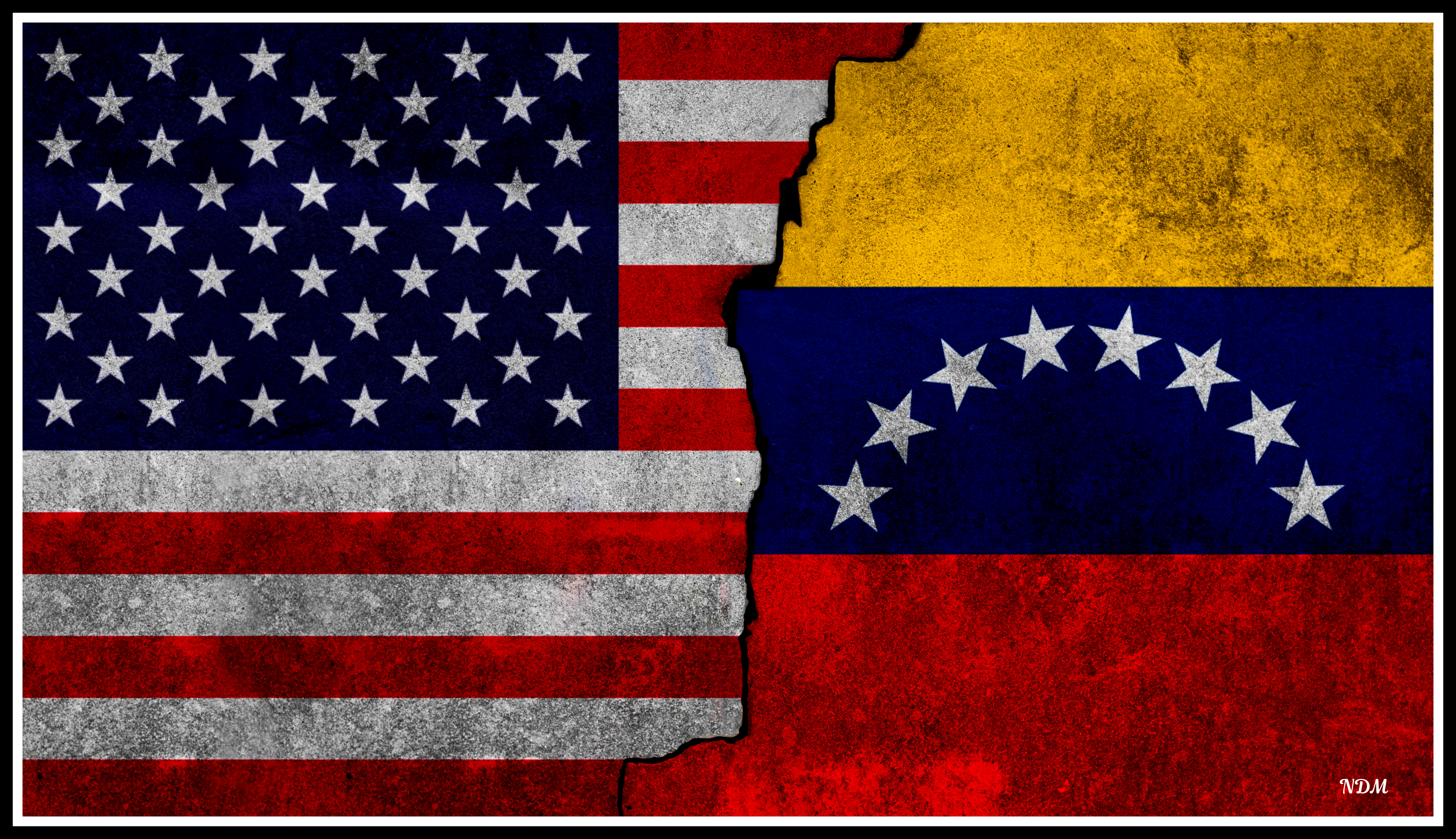
Never mind the complicated tapestry. It’s oil. Just oil. Venezuela has it. The U.S. wants it. And with Trump in the White House, the U.S. is dragging the Monroe Doctrine out of the 1820s like a museum relic and pretending the entire Western Hemisphere is its personal property. Don’t like a government? Overthrow it. Want a canal? Take it. Want resources? Just grab them. International law is treated as optional.

Sound familiar? Because that swagger. The belief that resources equal entitlement is the same attitude we see entrenched in some parts of Alberta politics. Cheered on by the extreme right, it fuels everything from separatist fantasies to “take back” rhetoric to the idea that oil gives us moral permission to do whatever we want.

Now the U.S. is treating Venezuela the way imperial powers used to treat Africa or Latin America: as a cupboard of resources you pry open when you feel like it. And here’s the terrifying part:
Launching an attack on Venezuela without congressional authorization or legal justification would violate international law. It would place the U.S. beside Russia on the list of nations that commit aggressive war. It would prove that the world’s self-proclaimed defender of freedom is fully willing to abandon the rules it demands everyone else follow.

All because,say it with me, OIL!

Now, Alberta loves to think we’re separate from all this mess. But we aren’t. We’re tied directly to the global market, the global politics, and the global moral compromises that come with fossil dependency. And if Alberta chases the American model, which many want to, if we follow the “oil above all” mindset,we might not like where that road ends.

This is where it gets personal. When my husband spent five years fighting for his life,cancer, cardiac arrest, a coma,I had a front-row seat to a truth most Albertans never face until their world collapses: oil money means nothing when you’re wondering if the person you love will ever wake up. Nothing!

Not the wages, not the big projects, not the boom years, not the politics built around it. You don’t sit beside a hospital bed praying for another oil boom. You sit there hoping for one more conversation.

But in Alberta, too many people view oil as a birthright and high wages as entitlement. As if this industry is supposed to guarantee them a certain lifestyle forever. As if the rest of the country should bow to our exceptionalism. As if questioning oil’s supremacy is an act of betrayal.

Let me be clear. I know what oil has provided my family. I know what it provides to Alberta. I know what it has contributed to Canada. But I also know that when life hangs in the balance, the entire mythology around oil collapses. What remains is what actually matters: people, families, health, community, stability, democracy. Not oil.

Which is why watching Alberta flirt with the same aggressive, resource-obsessed worldview we see in parts of the United States should concern every one of us. If Alberta believes its wealth gives it moral permission, if we take the American route of dominance, supremacy, and extraction above all, we are heading toward the same democratic rot.

Oil is a tiny word, just three letters. But Alberta has given it far more power than it deserves. The love of money may be the root of all evil. But the worship of oil, its money, its mythology, its political leverage, is the root of a whole lot more.

And if we don’t learn that now, we’re going to learn it the hard way.

Before I even begin, I want to say this clearly: I would never change a Franklin book, its message, or its imagery to suit political commentary. These stories were foundational for my kids and for me and the lessons Paulette Bourgeois wrote and Brenda Clark illustrated deserve to be kept intact exactly as they are.

Which is why it feels so bizarre, and frankly insulting, to watch someone else drag Franklin into a political stunt while utterly disregarding the values these books were built on.

Because yes, the U.S. Secretary of Defense (who still calls himself the Secretary of War, as though renaming the job is part of the fantasy) posted an AI-generated picture of Franklin the Turtle hanging out of a helicopter holding a gun. And let me tell you, as someone who read Franklin books for decades and actually respects their moral compass: there is not a single Franklin story where he leans out of a helicopter with a weapon.

So while President Trump’s team continues rewriting norms, reality, and now children’s literature, I’d like to remind them what Franklin books actually taught. And if they’re going to keep dragging Franklin into this, the least we can do is put the real titles back on the table, the ones with actual lessons, not whatever that unhinged helicopter scene was supposed to convey.

Let’s look at some actual Franklin titles I read to my children as maybe they may be relevant in name only to those who frequent the oval office. And yes for the sake of this I will allow the titles to be related to the current US Administration. But just the titles and maybe the lessons that COULD be learned.

Franklin Is Bossy; inspirational reading for anyone who believes leadership involves yelling.

Franklin Plays the Game; although in Washington these days it’s mostly about changing the rules mid-game.

Franklin Is Messy; a political allegory if I’ve ever seen one.

Franklin’s Bad Day; every day ending in “y” when President Trump opens his mouth.

Franklin’s New Friend; once Putin, now the Saudi Prince… the club rotates.

Franklin Is Lost; spiritually, ethically, emotionally, geographically. Pick one.

Franklin Fibs; I don’t even have to explain this one.

Hurry Up, Franklin; or: Hurry up, Trump, could you please just step out of the building? Any building.

Franklin’s Secret Club; perfect for a president who loves a secretive inner circle, complete with loyalty oaths, whispered instructions, and a clubhouse password no one else is allowed to know. I’m guessing the entrance involves tapping three times on a gold-plated door and saying, “Do you love me? Tell me you love me.”

These books were designed to teach children kindness, honesty, problem-solving, and the value of friendship. It is… something else entirely to see those teachings twisted into a militarized meme featuring Franklin leaning out of a helicopter like he’s auditioning for a role in Rambo: The Turtle Years. My apologies for the sarcasm as I relate the titles to current American politics but would they understand the lessons if they moved past the titles

I don’t want to misuse Franklin here. I don’t want to transform a gentle Canadian icon into a prop. I don’t want to corrupt a childhood lesson into a political stunt. However I am using it to comment on the absurdity.

Because when we’re living in a moment where even after verifying screenshots, checking sources, and confirming clips, we still find ourselves asking, Is this parody then something has gone very wrong.

And CBC, if by chance you, Kids Can Press, or anyone who holds licensing rights to Franklin is listening, do you have any ability to tell the Secretary of Defense to stop? I know cease-and-desist letters can’t solve everything, but in this case, I would frame one on my wall out of sheer gratitude.

Franklin deserves better.

Alberta’s Road Ahead

Posted: November 30, 2025 in Uncategorized
Tags: , , , ,

Today, I’m reaching out to a group that might not think of me as “their” voice, but I believe you are. I write from a progressive point of view, yes, but I am not far left and never have been. I am a centrist, maybe philosophically a little left, and most people who follow me are the same: grounded, pragmatic, and driven by fairness over ideology.

But this post isn’t for the usual audience. It is specifically for those Albertans who once proudly called themselves progressive conservatives or small-c conservatives, people who understood conservatism as careful stewardship, not chaos; community, not division; country, not grievance. I need you to hear this before Alberta follows the path unfolding south of us. And to my regular readers, who know I work hard to be fair and fact-driven: I’m asking you to put party labels aside. Think instead about your philosophy, your values, the things you believe when you think about your family, your neighbours, and the country we share. Because I need to say this plainly: the word “conservative” tastes bitter in my mouth these days. Not because of its history, that I respect, but because of what extremists have turned it into.

And I know many of you feel the same. You are not extremists. You are not separatists. You are not Christian nationalists. You are not part of this radical takeover. You represent the Alberta I know and love, and you deserve to hear the truth about what is happening inside the party you once believed in.

What happened at the UCP AGM in Edmonton this weekend was a defining moment. In truth the moment it became undeniable that the UCP is not simply “right-leaning.” It is controlled by an extreme-right faction whose language and goals mirror the dangerous movements tearing the United States apart. And they are not hiding it anymore. Their conversations about divisiveness and separation aren’t fringe now, they are escalating. And we need to be honest about why as even Danielle Smith has lost her audience. She will not be leading this party forward. She is now a liability to the very forces she once empowered. And that leaves Alberta staring down something far worse than “better the devil you know,” because what’s waiting in the wings is far more radical, far more determined, and far more dangerous.

That reality hit me hard during the recent discussions around the pipeline memorandum of understanding between Alberta and Canada. Let me be blunt: that pipeline, framed that way, is never going to happen. And the separatists know it. They are shifting, regrouping, and preparing their next move.

But here is where you need to stop, breathe, and listen. Those separatists do not define this province. Not now. Not ever.

And this circles us back to Forever Canadian. When Thomas A. Lukaszuk and team launched the Forever Canadian campaign, I knew we were responding to something real. But this weekend hit me like a freight train with the realization of just how vital that work was, and how vital it still is. We proved something timeless, something that matters more than ever and is especially true to the quote from Margaret Mead. “Never doubt that a small group of thoughtful, committed citizens can change the world. Indeed, it’s the only thing that ever has.”

Forever Canadian wasn’t loud. We didn’t have deep pockets. What we had were real Albertans who wanted this place to remain part of Canada. Our strength wasn’t in noise. It was in purpose, unity, and integrity.

So yes, right now it may look like the separatists have the upper hand. But loudness is not strength. Money is not legitimacy. Coordination is not public support. A fringe is still a fringe, even when it shouts.

As we wait for the constitutional ruling that will determine whether this extremist faction can legally push a separation agenda, I need to speak personally. This is not the Alberta I expected to live in during the later chapters of my life. And I refuse to watch it fall into the hands of people whose vision would tear this province apart. This weekend left me asking, over and over; what can I do? I can write which I do. I can speak,often boldly. And I will not sit still and watch this happen. I still have something to give. Maybe more than one thing and I am ready to take on whatever tasks are needed to keep this province whole, sane, democratic, and Canadian.

And I believe with absolute certainty that most conservatives do not want what is happening inside their party. So I am asking, genuinely and urgently, please speak out. If what you saw this weekend unsettled you or frightened you, you are not alone. And you do not have to stay silent. We have a decision to make about the future of our province and it has to be made now.

Forever Canadian was never a one-time campaign. It was the first line of defense. Now we must choose whether it was a moment or whether it becomes a movement. I know where I stand. And after this weekend, I know exactly why we must stand together again. This moment feels like a long Alberta prairie road, the storm rolling in on one side, sunlight fighting on the other. We can still choose which way we go. But we have to choose now.

Between a rock and a hard place! Yesterday was quite a day. Alberta and Ottawa, two traditional sparring partners, suddenly stood shoulder-to-shoulder long enough to sign an energy memorandum of understanding, not a memorandum of agreement. One does not magically turn into the other. Canada has a long, proud tradition of signing MOUs with great pomp, flair, and photo ops… only for the “U” to quietly pack its bags and never become an “A.” Depending on who you talk to, this is either a long-overdue breakthrough, the beginning of the end for environmental policy, or proof that Mark Carney “finally caved.” I’ve heard it all, I live in Alberta, my husband works in oil and gas, everyone knows I believe strongly we have an obligation to the environmental protection of the planet, and trust me, no one here is quiet.

But the claim that Carney “threw the baby out with the bathwater”? Please. The baby’s fine (so far). The tub isn’t filled. The faucet isn’t even turned on yet. This MOU was political choreography. Alberta needed to feel seen, Danielle Smith needed a headline, and Carney needed to show he understands the economic stakes. But the moment the ink dried, the real work shifted westward. Because nothing, and I mean nothing, is moving without British Columbia and the Indigenous peoples of B.C. agreeing to it. And that is not something Alberta can yell its way through.

Now, here’s where I land, and I’ll be honest, it’s not a simple place. I understand the economic argument. Alberta has been told “transition” for decades while carrying a massive share of this country’s revenue. And yes, we need new markets; relying on the United States as our one and only customer was a naïve strategy. Alberta has failed to promote alternative energies and that needs to be part of any conversation. I have serious environmental concerns, and they’re not small ones. Carbon capture has promise, but promise isn’t proof. Pipeline safety on a rugged coastline isn’t a slogan; it’s math, engineering, and risk that must be measured, not wished away. If someone wants me to believe this can be done safely, they’d better bring more than talking points. I’m open to listening, but not to blind faith.

And that’s why today’s announcement feels less like a yes or a no and more like a “well, let’s see.” A private sector proponent still has to appear. A major projects process has to be navigated. A reworked carbon pricing agreement has to materialize. And Indigenous nations, including coastal nations, have to consent. They can’t be pressured, nor bypassed and must have consent.

Meanwhile, in B.C., the reaction has already ranged from skeptical to incredulous. Some communities want growth; others see this as Alberta’s reward and B.C.’s risk. And let’s be honest: that’s not a dynamic that sells well at the best of times.

Add to that the internal fallout, including a cabinet resignation rooted in environmental alarm, and it’s clear this isn’t just a provincial fight. It’s a national conversation wrapped in competing long-term visions, with no easy consensus and no shortcuts.

And here’s where I am this morning, and I’m not going to pretend it’s comfortable. Economically, I understand why Alberta wants this. We need new markets. We need to stop pretending the United States is a stable or reliable customer. An additional pipeline to tidewater could give us leverage we haven’t had in decades. I’m not blind to that. I live in a province built on this industry and married to someone who works in it. But the environmental risks are real. Not theoretical, not hysterical, real. A coastline spill would be catastrophic. And no politician waving a pen in Ottawa or Edmonton changes the fact that Indigenous nations have both constitutional standing and international protections under UNDRIP. Without their consent, this project doesn’t just slow down it stops. Add to that a little practical reality check: There is no proponent. Oil prices aren’t high enough to attract one. And until someone with billions of dollars raises their hand, this entire conversation is a hypothetical one presented as momentum.

Meanwhile, just last week the Premier of B.C. said they would consider increasing capacity on the existing Trans Mountain pipeline, a project already built, already operating, and already moving barrels west. Somehow that wasn’t treated as the headline opportunity. And maybe it should have been.

Carney and the country are in a hard place. A place between economic urgency and environmental responsibility. Between national ambition and on-the-ground reality. Between wanting to move forward and recognizing all the reasons we should not. I still believe Carney knows what he’s doing. I just hope this doesn’t cost him more inside his own caucus on the way through, because the stakes for this country, economically, environmentally, politically, are too high to lose steady hands now.

And so for the moment, I’m doing what most Canadians are doing: watching and thinking and waiting. Trying to find that landing spot between hope and worry. It’s not easy, it’s not neat, and it’s not resolved. I feel on the edge of something, uncertain of its shape, and unwilling to look away.

Ukaine and the 28 Point Plan

Posted: November 23, 2025 in Uncategorized
Tags: , , , ,

I’m sorry, but we have to go back to a dark conversation. It’s hard, from where we sit in our relatively safe corner of the world, to fully grasp the geopolitical weight of what is unfolding. Most of us have never lived under bombardment, never fled our homes with minutes to spare, never had to choose between surrendering dignity or surviving another winter under attack. But for those who still carry the memories of our last great global conflicts, for those whose families understand occupation, invasion, and loss, this moment is not theoretical. They know exactly what this means.

And we need to be honest with ourselves too. Canada is not insulated from this. We may feel far from Europe’s danger, but we share a border, not by fence line but by Arctic geography, with Russia. That reality doesn’t go away because we find it uncomfortable. It’s not fear-mongering to acknowledge it; it’s realism. Geography will not change. And when Russia pushes the boundaries of the international order, those ripples reach us whether we want them to or not.

And today, President Volodymyr Zelensky made it clear: Ukraine is standing at the edge of an impossible choice. He warned that the country may soon face “either the loss of dignity or the risk of losing a key partner.” Dignity is not a stray word. It’s a deliberate reference to Ukraine’s 2014 Revolution of Dignity, when Ukrainians overthrew a corrupt, Moscow-aligned president and claimed a democratic, European future. They fought for sovereignty once. Now they’re being cornered into signing it away.

Because the 28-point “peace plan” Donald Trump is pressuring Ukraine to sign before Thanksgiving is not a peace plan. It is a Russian-authored blueprint, awkwardly translated into English, and presented as diplomacy. Ukraine didn’t help write it. Europe wasn’t consulted. Congress was blindsided. But Putin’s allies were deeply involved.

The plan begins by restating Ukraine’s sovereignty, something Russia already promised in 1994 and promptly violated in 2014. From there, it accelerates: Crimea and vast sections of Ukraine’s eastern industrial heartland would be ceded to Russia. Ukraine would be forced to shrink its military. And Russia would face zero accountability, not for the torture chambers, not for the mass graves, not for the sexual violence, not for the deliberate targeting of civilians.

Instead, the plan offers full amnesty: no claims, no charges, no justice. Then comes the financial contortion. The world is being told Russia will “rebuild Ukraine,” except the reconstruction is mostly for the territories Russia would keep. Frozen Russian assets would be used to clean up Russia’s own destruction, and the improved regions would then belong to Russia. Europe, again not consulted, would unfreeze more Russian assets and contribute an additional $100 billion. And then the U.S. and Russia would split the profits.

Europe pays. Russia gains land. Trump gets to call it a deal.

Ukraine would also be required to amend its constitution to permanently reject NATO membership which has been Putin’s obsession for decades. And the plan attempts to reframe the United States not as a NATO ally but as some kind of “mediator” between NATO and Russia. It’s an unmistakable attempt to weaken the alliance system that has kept Europe stable since World War II.

NOTHING in this plan hides its purpose. It dismantles the post-war rules-based order and drags the world back to a time when powerful nations carved up smaller ones and called it “peace.”

This is the pressure Zelensky faces. This is the trap being set for a country already exhausted by loss, displacement, and years of Russian brutality. And somehow, through all of this, we’re meant to pretend Donald Trump has changed. That he’s independent. That Putin no longer has influence over him.

But this document reads like it was drafted in Moscow and couriered straight to Trump’s desk. It mirrors Putin’s priorities word for word. And it confirms something we already suspected: Trump is still firmly aligned, ideologically, politically, and predictably, with Vladimir Putin.

The geopolitical risk to Europe is enormous. A fractured Ukraine doesn’t bring peace; it creates a corridor of instability stretching from the Baltics to the Balkans. It emboldens Russia. It fractures NATO. And it signals to every authoritarian regime that borders can be erased if you find the right Western politician to help rebrand your land grab.

We may be far from Ukraine’s front lines, but Canada is not outside this story. Our security relies on an international system that punishes aggression, not one that rewards it. Our geography ties us directly to Russia in the Arctic. And our history, our real, lived history, reminds us why appeasement has always been the most dangerous path of all.

The world cannot afford to look away. And I know I’m not able to look away. And you shouldn’t look away.