Archive for July, 2026

April 10, 2026

Posted: July 12, 2026 in Uncategorized

There are days when my head is completely consumed by politics. but today is not one of them. Today belongs to four people.

We talk about Artemis II like it’s a mission, a milestone, a technical achievement. And it is all of those things. But before any of that, it is four human beings who said yes to something that most of us can barely comprehend.

Reid Wiseman, the commander. A father of two daughters, who lost his wife to cancer just a few years ago. Before he left, he had to sit down with those girls and have a conversation no parent ever wants to have. Not about the glory of spaceflight, but about the reality of risk. About what it would mean if he didn’t come home.

Victor Glover, the pilot. A husband, a father of four daughters. A man who carries not just the weight of the mission, but the quiet understanding of what it means to leave behind everything that matters most and trust that the work is worth it.

Christina Koch, mission specialist. Brilliant, steady, experienced. A partner, a teammate, someone who has already pushed the boundaries of what we thought was possible in space, and chose to go back and push them further.

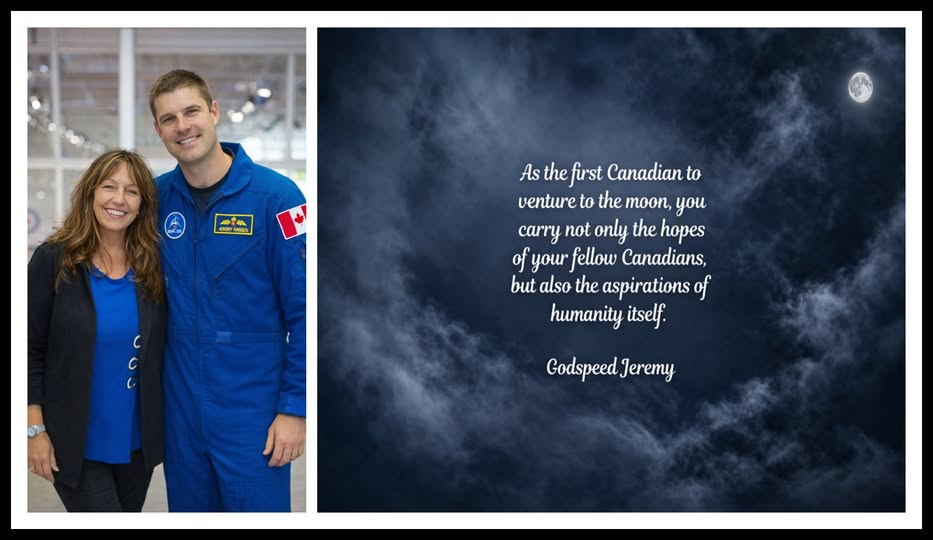
And Jeremy Hansen. Our Jeremy. A husband, a father of three, deeply rooted in this country in a way that feels personal if you’ve ever had the chance to meet him, or even just listen to him speak. His wife, is a physician and his children are growing into their own paths.

These are extraordinary people. And yet what strikes me most is how entirely ordinary they are in their face to the world. There is no ego in the way they carry themselves, nor distance. No sense that they are somehow separate from the rest of us. If anything, it’s the opposite. They feel like the kind of people you would sit across from at a kitchen table, coffee in hand, talking about family and work and the rhythm of everyday life. I can say that personally about Jeremy. I’ve seen it. I know it to be true.

And then they strap themselves to the top of a rocket and leave the planet.

I will be watching today. I will be watching the numbers, the timelines, the calm voices calling out each phase as they begin that final burn into re-entry. It will be the fastest, hottest return any human beings have ever experienced. Physics doesn’t care about emotion. It doesn’t soften because I am invested. It simply does what it does.

And so I sit here, on a spring Friday, with a knot in my stomach.

Because this is the part that asks the most of them.

I can talk about exploration, about science, about pushing humanity forward. And all of that is true. Every generation has had its version of this, from ships crossing unknown oceans to aircraft pushing past the limits of what we thought wings could do. This is simply our version of the frontier. But frontiers have always come with risk. Not abstract risk. Human risk.

And if I feel this way, sitting here on the ground, watching from a distance, I can only imagine what it feels like for the people who love them.

The daughters, the son, the partners, the parents and the families who smiled, supported, and let them go anyway. We see the composure. We see the pride. What we don’t see is the anxiety and fear that must exist.

Today is not about politics. There will be time for that again soon enough. But I would be lying if I said this team doesn’t make me think about something more. What I see when I look at them is a reminder of something that once felt steady. That sense of Canada and the United States being neighbours and being connected not just by geography, but by trust, shared purpose, and the understanding that when something mattered, we showed up together.

There is a line by John F. Kennedy, that geography made us neighbours, history made us friends, economics made us partners, and necessity has made us allies. For a while now, that hasn’t always felt true. But when I look at this crew, I see it again.

Not in speeches or headlines, but in the quiet, unspoken way they operate as one team. No hierarchy of nationality nor distance. Just four people, from two countries, carrying the same responsibility, the same risk, the same purpose. And in that, I find something I didn’t expect today; hope.

Today is about four people who represent something we don’t get nearly enough of right now. Curiosity, courage, discipline and belief that moving forward still matters.

So as they make their way home, through heat and speed and everything that stands between where they’ve been and where I am, I know this much. My anxiety doesn’t ease. Not until it’s over.

I will be transfixed to that screen, watching every second, waiting for the only moment that matters. All four of them, back on the ground.


April 7 2026

Posted: July 12, 2026 in Uncategorized

I didn’t sleep well last night, and while part of that was physical as I gave blood last night, that wasn’t really what kept me awake. I kept reaching for my phone, knowing I shouldn’t, watching the same pattern unfold over and over again. Escalation. Language that didn’t sit right. A sense that things were moving faster than anyone was willing to acknowledge. And then this morning, The U.S. Presidents statement that “a whole civilization will die tonight.” It’s not a phrase we should hear and move past. It’s not a word we should use lightly, yet it was delivered as if it were just another statement in a long list.

Most of us learned what civilization meant early on. The cradle of civilization. Mesopotamia, part of which includes modern day Iran. It was the beginning of organized society, of agriculture, of law, of writing, of systems that still shape how we live today. That place is not abstract. It is real, and it is part of what we are now watching being discussed as if it can simply be erased or sacrificed in pursuit of something that is never fully explained. What unsettles me most is how easily we discuss other societies as less than. We talk about the Iranian civilization, sometimes without even realizing that underneath it sits an assumption that they are somehow less civilized and we are more so. That we are the rational ones, the stable ones, the ones who define what “civil” even means. I can’t get out of my head and heart that destroying the ‘cradle of civilization’ may ultimately bring about the fall of all civilization.

But there is nothing in what I heard today that is remotely civil. Talking casually about striking bridges, power plants, and infrastructure that sustains daily life, brushing off questions about legality and morality, and framing destruction as strategy is not civility. Suggesting that people living under bombardment are asking for more of it is not just uncivil, it is a complete abandonment of reality. If we are going to use that word honestly, then we need to be just as honest about what we are watching. We also need to stop pretending that military and civilian infrastructure can be neatly separated, as though there is a clean line between what is strategic and what is human. There isn’t, and we know that from our own lives. In Alberta, roads that lead to Cold Lake are also the roads people use every day. Power that supports the base at Trenton also supports entire communities. Water systems sustain everyone. In parts of the world where water itself is manufactured through desalination, infrastructure is not a convenience; it is survival, and there is no separating those things when they are targeted.

All of this comes on the heels of something that should have held our attention for very different reasons. A dangerous and complex rescue mission brought people home. That required discipline, training, and courage, and it deserved to stand on its own. But it didn’t hold, because it was immediately overtaken by something louder and more inflated that needed to escalate beyond it. That is the pattern that is becoming impossible to ignore. If escalation is what is rewarded, then it does not stop with one country or one moment. It expands. It looks for the next stage, the next justification, the next target.

And that is where this stops being about somewhere else. Where does that leave Canada? Where does that leave our allies? Where does that leave a system that depends on some shared understanding of restraint and of limits? If those limits no longer matter, then we are not just watching a conflict unfold at a distance. We are watching the erosion of something much closer to home. I don’t know what happens tonight, but I do know that when the destruction of the systems that sustain human life is spoken about as strategy or inevitability, something has already shifted. Civilization is something we either uphold in our actions and our words, or we don’t.

April 8, 2026

Posted: July 12, 2026 in Uncategorized

I sat down to write something thoughtful about this “ceasefire,” and by the time I got to my second sentence, Israel was still striking, Iran was still posturing, the Strait of Hormuz was apparently open but also not really, Pete Hegseth was out there sounding ready to drop more bombs at a moment’s notice, and Donald Trump was floating the idea of sharing toll proceeds from the Strait with a regime he’s already declared essentially gone. I’m flashing back to watching The NeverEnding Story with my oldest years ago, thinking how wild it was that a story could just keep going without ever landing. Turns out, that wasn’t fantasy. It was a preview.

So I’m going to do something radical and not pretend I can keep up with a story that is rewriting itself every fifteen minutes. I’ll be back when the plot stops changing mid-paragraph. Until then, if this is what “resolution” looks like, it’s not an ending. It’s a pause where everyone keeps their finger on the trigger and calls it peace.

April 2, 2026

Posted: July 12, 2026 in Uncategorized

If you were part of the Forever Canadian effort, you already know what we built.

You know what it looked like to take something from nothing and somehow get it airborne. You know what it felt like to stand in the heat or the cold, hold a clipboard, have conversations that mattered, and watch something real take shape in real time. We built that aircraft together. Not perfectly, not easily, but honestly. And it flew. We reached the threshold. Then we went beyond it. Hundreds of thousands of Albertans put their names down in response to a simple question. “Do you agree that Alberta should remain part of Canada?”

And then we landed. In that strange, quiet way where something big ends and you expect the next step to come quickly.

It didn’t. And while that aircraft has been sitting on the runway, something else has been moving.

That ‘other’ petition is not about strengthening Canada, but leaving it. The petition question, however unpalatable, is clear. “Do you agree that the province of Alberta should cease to be part of Canada to become an independent state?”

That effort only needs a fraction of the signatures that Forever Canadian gathered. Half the passengers. A completely different destination.

And like any aircraft being assembled in a hurry, it is being presented as ready for takeoff before anyone has really examined the design. A narrative is being built around it. That separation is straightforward, financially viable, offers control, clarity, and a better future, and somehow, the risks are manageable.

And this is where I keep coming back to something as basic as what most of us learned in school. Think back to grade six and Bernoulli’s principle. Flight only happens when the forces actually work together.

You can say you have lift. You can claim you have thrust. But if you ignore drag, if you ignore the real resistance that comes from economics, trade, geography, law, and global reality, the aircraft does not fly.

We have known that for a very long time. Anyone who remembers Icarus understands that belief alone does not keep you in the air. We may be tempted to see Icarus as a warning for the separatist movement. But if we sit back and assume this will resolve itself, we may be the ones left with melted wings.

That is the risk we need to pay attention to. We cannot spend the next number of months debating every flaw in their design. Because the outcome of that conversation will not be decided in arguments. It will be decided in a referendum.

And if that question makes it onto a ballot, every single person in this province is on that flight, whether they paid attention to the boarding call or not. That is the moment where there is no more watching from the terminal. No more assuming someone else has it handled. You are on board.

And this is where we need to be very clear with ourselves. Those of us who supported that original question, who signed, who showed up, cannot act like the work is finished. It is not. We cannot sit back now and assume that what we built will carry forward on its own. It will not.

The people driving the separation effort are organized. They are motivated. They are putting in the time and pushing this forward.

We need to do the same.

If you supported Forever Canadian, go to the Forever Canadian website. Make sure you have actually completed the process. Then encourage someone else to do the same.

Volunteers are still needed. Resources are still needed. And yes, there is a financial reality to this. If you are in Canada and asking how to help, you can support this effort. That information is on the website.

We are living in a moment where the world is already unstable enough. Economically, politically, globally, there is no shortage of pressure on countries trying to hold their footing.

And here at home, we are debating whether to fracture ourselves on purpose. If we cannot hold this together here, how exactly do we expect to navigate anything beyond it?

I am proud to have been part of the Forever Canadian effort. Proud of what we built. Proud of the people who showed up in the heat and the cold and proved that this province is capable of more than division.

But pride does not keep a country together. Participation does.

If you were engaged, stay engaged. If you signed, make sure it counts. If you have been watching from the sidelines, this is the moment to step in.

Go to https://www.forever-canadian.ca/en your name. Bring someone with you. Because this is no longer about building the plane.

It is about making sure it actually flies.

March 28, 2026

Posted: July 12, 2026 in Uncategorized

We are measuring this war all wrong.

We are measuring it by how it impacts each of us individually here in the first world. In gas prices, grocery bills, and whether our own country might get pulled into it. We are measuring it through our own lens, and in my case, through a Canadian lens. What does this mean for us? What does this mean for our economy? What does this mean for our security?

And I understand that instinct. It’s human. It’s immediate. But it is also dangerously incomplete.

Because while we watch oil tick upward and debate strategy like it’s some kind of geopolitical chessboard, the actual cost of this war is being borne elsewhere entirely. It is being paid by people who have absolutely no say in any of this.

This is a humanitarian crisis. And we are already starting to talk around it instead of about it.

The war is out of control. Those words are coming from people whose entire job is to measure human suffering, and even they are running out of language for it.

Thousands dead and millions displaced. Aid systems are already strained and are now being pushed beyond capacity. And still, the conversation we hear most often is about leverage, retaliation, and who is winning.

Winning. As if that word has any meaning left in this context.

We talk about the Strait of Hormuz as if it is only about fuel, as if the worst outcome is what it costs to fill our tanks. We barely mention the Bab el-Mandeb Strait, another critical artery, where not just oil but food, aid, and basic goods move through every day. When those routes are threatened, it is not just markets that react. It is entire populations that lose access to the most basic necessities.

And yet somehow, we keep bringing it back to ourselves.

We ask what Iran deserves. We debate Israel’s strategy. We rage about American leadership, and yes, I have my own very clear views on that. But none of those perspectives change the most fundamental truth here. The victims are the civilians.

They are the families in southern Lebanon who will be displaced, whether or not they had anything to do with this. They are the people in Iran who have no control over the regime that governs them. And if you are going to blame the people of Iran for their leadership, then let’s be consistent and say it plainly, you would also have to blame the people of the United States for theirs.

Because this is not about governments, as we keep trying to frame it. It is about people who live under them.

These are also the communities in Gaza that we have already begun to push to the background because, if we are honest, we only seem to have the bandwidth for a crisis or two at a time. We can only cope with so much.

Ukraine has not ended. Gaza has not ended. Africa’s humanitarian crises have not ended. We have simply shifted our attention.

And while we do that, the system that is supposed to support human survival is being hollowed out. Funding cut. Access limited. Supply routes threatened. Needs rising faster than the world is willing, or able, to respond.

So I keep coming back to one question that nobody seems to want to answer. Where are all of these displaced people supposed to go? And what are they supposed to eat?

Because displacement and starvation are not theoretical. It is families, children, entire communities being pushed out of their homes with nowhere stable to land. And at the same time, many of the countries that once absorbed that pressure are closing doors, tightening borders, stepping back.

We are watching the number of displaced people grow while the places they can go continue to shrink.

And still, we measure the impact of this war by what it costs us.

I live in a country where we can still have that conversation. Where the question is cost, not survival. And that contrast should not be lost on any of us.

Donald Trump may claim he can stop this. He may declare some version of victory and move on. But you do not get to ignite something at this scale and then pretend that ending your involvement ends the consequences.

It doesn’t. The economic shock will ripple. The instability will spread. The humanitarian cost will compound for years. This is not a contained conflict. It is a cascading one. Literally out of control.

And if we continue to look at it only through our own lens, if we continue to measure it only by what it means for us, we are going to miss the reality of what is unfolding until it is far too large to ignore.

Because yes, I notice the price when I fill up my tank. Of course I do. But I cannot pretend that compares to a mother trying to find a bowl of rice for her child. I cannot pretend that inconvenience sits in the same universe as displacement, hunger, and survival.

Because the real cost of this war is not what we are paying.

It is what millions of displaced people are losing. And if we stop seeing that clearly, we lose something essential about who we are.

April 1, 2026

Posted: July 12, 2026 in Uncategorized

When I was ten years old, I had a scrapbook. Not a fancy one, just pages filled with whatever I could find. We didn’t have endless access to information the way we do now. What I had were local newspapers, and if there was anything about space, anything about astronauts, anything about the moon, I saved it. Every clipping. Every photo. Every word. Because I was going to be an astronaut.

I didn’t fully understand the science, or the politics, or the cost, or any of the debates that surrounded it. But I understood awe. I understood what it felt like to look up and believe that something extraordinary was possible.

No, I didn’t become an astronaut. But life has a way of bringing things back around. I’ve had the opportunity to spend time with Chris Hadfield over the years, and I was invited to the Canadian Space Agency for the splashdown event when he returned from the International Space Station, landing in Russia. That day, I met David Saint-Jacques and Jeremy Hansen, part of that next generation of astronauts. David has since had his time in space. And today, as it stands, Jeremy has his.

And I will be watching.

Not as someone weighing policy or arguing priorities. There will be time for all of that. But today, I’m choosing something else. I’m choosing to sit with that same feeling I had all those years ago. That ten-year-old girl with her scrapbook, cutting out pieces of a future she didn’t yet understand, but believed in anyway.

Not everyone will feel this the same way, and I understand that. But more than half a century later, that little girl is still here. She’ll be looking up at the sky, still watching, still believing, and still wanting to be an astronaut when she grows up.

Godspeed, Jeremy.

March 26, 2026

Posted: July 12, 2026 in Uncategorized

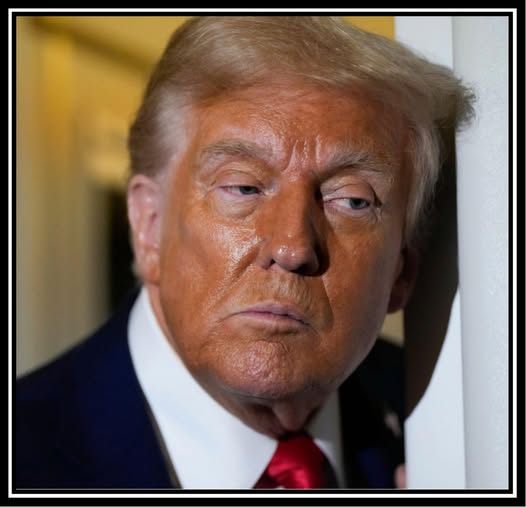
This is completely unfair, wildly speculative, and based on absolutely no confirmed information whatsoever. But this morning, I found myself wondering what it actually takes to get Donald Trump ready for the day. I know. Who cares? But honestly I think it reflects something more about his ‘team.’

Because we all have a routine. There was a time in my life when mine involved very little more than water, optimism, and a questionable level of self confidence. Now it involves lighting, negotiation, and occasionally just deciding it’s not worth the effort. But this feels like something else entirely. This feels like a production.

I’m assuming it starts with the tan. And I say that as someone who didn’t just try QT tanning lotion in high school, but fully committed to it as a look. Not for a week. For a stretch. Long enough that people from back then may still be recovering from the visual. Bright, unapologetic and slightly alarming under fluorescent lighting.

You would think that in the almost half century since, they would have refined the tanning formula. And yet here we are. So I have questions. Is it applied the night before. Is there a moment in the morning where someone steps back and says yes, that’s the exact shade of late summer citrus we’re going for today. Is there a stopping point, or is it more of a we’ve come this far, why not push the colour correction a little more.

From there, I imagine they move into concealment. Not politically. That comes later. I mean the practical side. The careful editing of what the public sees and what gets quietly blended into the background. Cover-up on the backs of hands, necks etc. The kind of work designed to hold up under lights, cameras, and a level of scrutiny most people will never experience.

Then we arrive at the hair. And I’m going to be honest, I do not want to ever see it in its natural state. Some things in life are better left unexplained. Because that is not a hairstyle. That is infrastructure. That is long term planning. Multiple lengths of hair entering into a strategic alliance, each with a specific role, all working together toward a common objective that no one fully understands. This morning in particular, it looked bigger. Softer. Like it had entered a kind of atmospheric phase, not sitting on the head so much as hovering above it.

And then, of course, the suit. Somewhere between Pete Hegseth’s slightly too small and Donald Trump’s significantly too large, there appears to be a shared belief that tailoring is more of a suggestion than a requirement. There is speculation around what might be covered by the poorly fitted suit, but I’ll leave that part alone.

And then, fully assembled, out he goes. To speak with absolute certainty, even when that certainty has a lifespan of about five minutes. Donald Trump can deliver a statement with complete conviction and then quietly replace it with a different version before the first one has even had time to settle. Positions shift, stories evolve and facts bend.

And that’s where this starts to land differently. Because I’ll be the first to admit I don’t look in the mirror as often as I used to. Age has a way of negotiating that relationship for you. But when I do, I recognize what’s there. Because a mirror has no filter and doesn’t pretend it’s something it isn’t.

And I think that’s the difference. Because surely Mar-a-Lago has mirrors. The White House certainly has mirrors. You would think somewhere in all of that space, there would be one honest moment. One real look.

But maybe that’s not how it works. Maybe the mirrors don’t matter. Maybe they’re covered. Or worse, maybe they’re surrounded by people who step in before any reflection has a chance to land and say no, no, it looks great. You look great.

Which would explain a lot. Because when the room is built on telling you everything is perfect, you stop questioning anything at all. The hair. The colour. The performance. Even when everything underneath it is shifting by the minute.

And at that point, it’s not really about aging. It’s not even about appearance.

It’s about what happens when nothing, and no one, is willing to reflect reality back to you.