


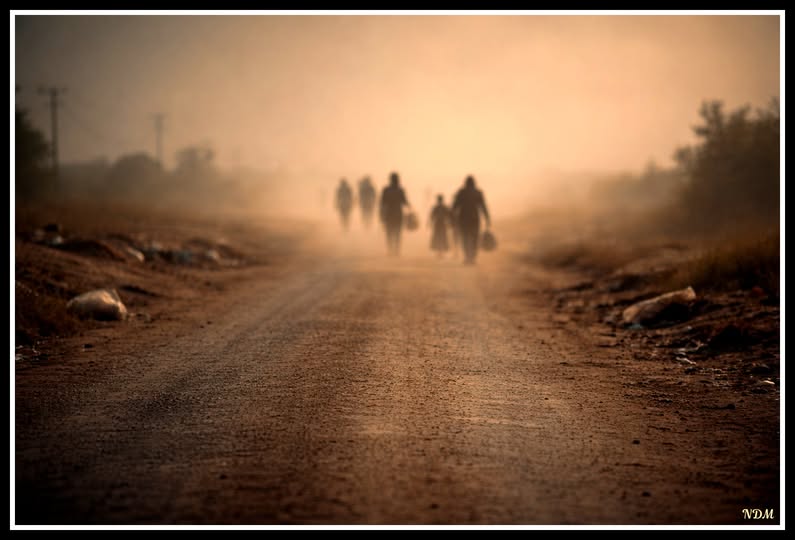
We are measuring this war all wrong.
We are measuring it by how it impacts each of us individually here in the first world. In gas prices, grocery bills, and whether our own country might get pulled into it. We are measuring it through our own lens, and in my case, through a Canadian lens. What does this mean for us? What does this mean for our economy? What does this mean for our security?
And I understand that instinct. It’s human. It’s immediate. But it is also dangerously incomplete.
Because while we watch oil tick upward and debate strategy like it’s some kind of geopolitical chessboard, the actual cost of this war is being borne elsewhere entirely. It is being paid by people who have absolutely no say in any of this.
This is a humanitarian crisis. And we are already starting to talk around it instead of about it.
The war is out of control. Those words are coming from people whose entire job is to measure human suffering, and even they are running out of language for it.
Thousands dead and millions displaced. Aid systems are already strained and are now being pushed beyond capacity. And still, the conversation we hear most often is about leverage, retaliation, and who is winning.
Winning. As if that word has any meaning left in this context.
We talk about the Strait of Hormuz as if it is only about fuel, as if the worst outcome is what it costs to fill our tanks. We barely mention the Bab el-Mandeb Strait, another critical artery, where not just oil but food, aid, and basic goods move through every day. When those routes are threatened, it is not just markets that react. It is entire populations that lose access to the most basic necessities.
And yet somehow, we keep bringing it back to ourselves.
We ask what Iran deserves. We debate Israel’s strategy. We rage about American leadership, and yes, I have my own very clear views on that. But none of those perspectives change the most fundamental truth here. The victims are the civilians.
They are the families in southern Lebanon who will be displaced, whether or not they had anything to do with this. They are the people in Iran who have no control over the regime that governs them. And if you are going to blame the people of Iran for their leadership, then let’s be consistent and say it plainly, you would also have to blame the people of the United States for theirs.
Because this is not about governments, as we keep trying to frame it. It is about people who live under them.
These are also the communities in Gaza that we have already begun to push to the background because, if we are honest, we only seem to have the bandwidth for a crisis or two at a time. We can only cope with so much.
Ukraine has not ended. Gaza has not ended. Africa’s humanitarian crises have not ended. We have simply shifted our attention.
And while we do that, the system that is supposed to support human survival is being hollowed out. Funding cut. Access limited. Supply routes threatened. Needs rising faster than the world is willing, or able, to respond.
So I keep coming back to one question that nobody seems to want to answer. Where are all of these displaced people supposed to go? And what are they supposed to eat?
Because displacement and starvation are not theoretical. It is families, children, entire communities being pushed out of their homes with nowhere stable to land. And at the same time, many of the countries that once absorbed that pressure are closing doors, tightening borders, stepping back.
We are watching the number of displaced people grow while the places they can go continue to shrink.
And still, we measure the impact of this war by what it costs us.
I live in a country where we can still have that conversation. Where the question is cost, not survival. And that contrast should not be lost on any of us.
Donald Trump may claim he can stop this. He may declare some version of victory and move on. But you do not get to ignite something at this scale and then pretend that ending your involvement ends the consequences.
It doesn’t. The economic shock will ripple. The instability will spread. The humanitarian cost will compound for years. This is not a contained conflict. It is a cascading one. Literally out of control.
And if we continue to look at it only through our own lens, if we continue to measure it only by what it means for us, we are going to miss the reality of what is unfolding until it is far too large to ignore.
Because yes, I notice the price when I fill up my tank. Of course I do. But I cannot pretend that compares to a mother trying to find a bowl of rice for her child. I cannot pretend that inconvenience sits in the same universe as displacement, hunger, and survival.
Because the real cost of this war is not what we are paying.
It is what millions of displaced people are losing. And if we stop seeing that clearly, we lose something essential about who we are.

